AAWSAP DIRD, Biomaterials, January 2010
DOW-UAP-D119 · page 28 of 32
Text
This text came with the file. It may have mistakes. When the text and the image disagree, the image is right.
UNCLASSIFIED// FOR OFFICl,CL l:ISI!!! 8HL'f
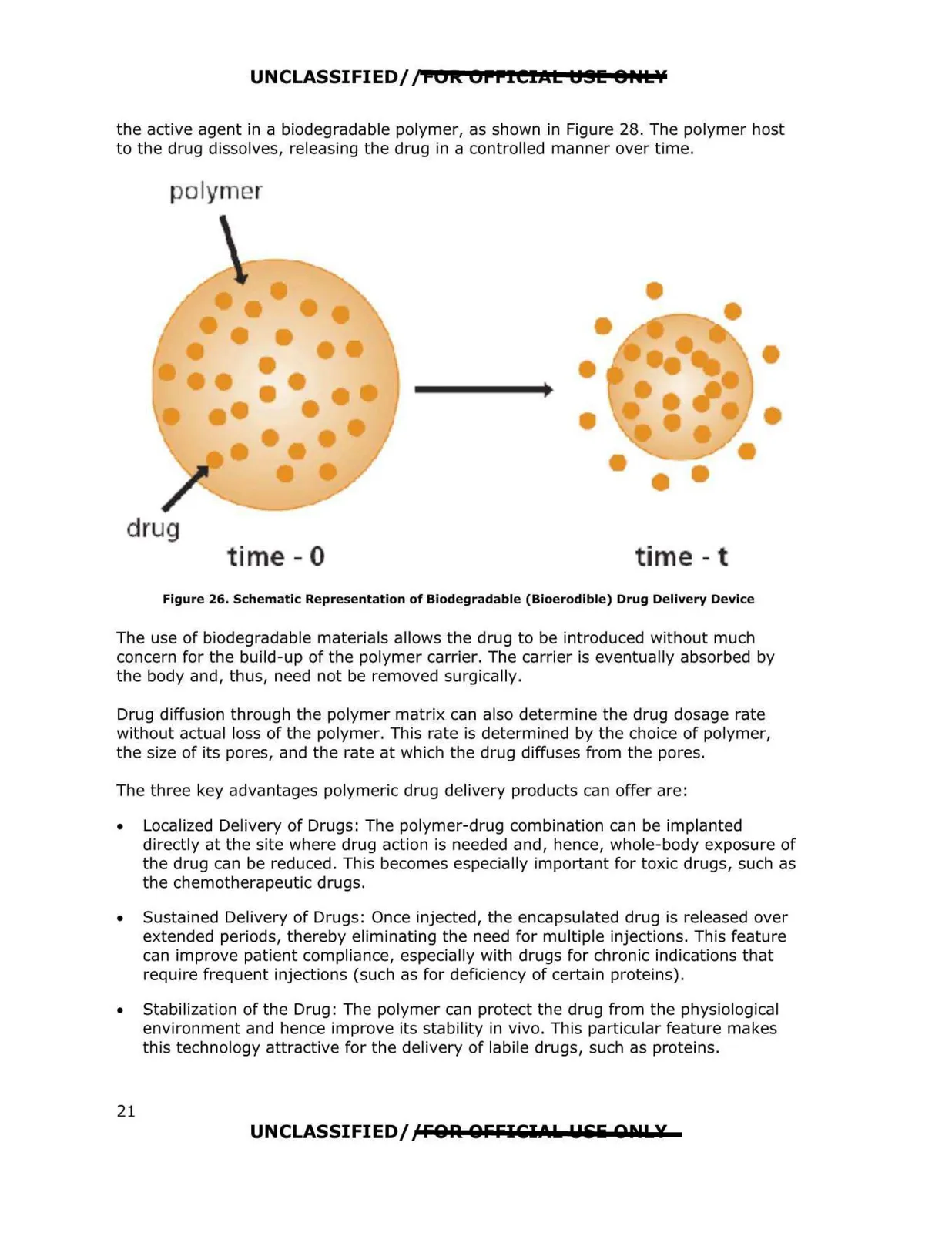
the active agent in a biodegradable polymer, as shown in Figure 28. The polymer host
to the drug dissolves, releasing the drug in a controlled manner over time.
polym r
•
•• ••
•
• •
•
•
•
••••
• •
drug
time - 0
time - t
Figure 26. Schematic Representation of Biodegradable (Bioerodible} Drug Delivery Device
The use of biodegradable materials allows the drug to be introduced without much
concern for the build-up of the polymer carrier. The carrier is eventually absorbed by
the body and, thus, need not be removed surgically.
Drug diffusion through the polymer matrix can also determine the drug dosage rate
without actual loss of the polymer. This rate is determined by the choice of polymer,
the size of its pores, and the rate at which the drug diffuses from the pores.
The three key advantages polymeric drug delivery products can offer are:
•
Localized Delivery of Drugs: The polymer-drug combination can be implanted
directly at the site where drug action is needed and, hence, whole-body exposure of
the drug can be reduced. This becomes especially important for toxic drugs, such as
the chemotherapeutic drugs.
•
Sustained Delivery of Drugs: Once injected, the encapsulated drug is released over
extended periods, thereby eliminating the need for multiple injections. This feature
can improve patient compliance, especially with drugs for chronic indications that
require frequent injections (such as for deficiency of certain proteins).
•
Stabilization of the Drug: The polymer can protect the drug from the physiological
environment and hence improve its stability in vivo. This particular feature makes
this technology attractive for the delivery of labile drugs, such as proteins.
UNCLASSIFIED/fFOA QFFICiI> .. U&'li ODIL¥
21