AAWSAP DIRD, Materials for Advanced Aerospace Platforms, January 2010
DOW-UAP-D120 · page 20 of 27
Text
This text came with the file. It may have mistakes. When the text and the image disagree, the image is right.
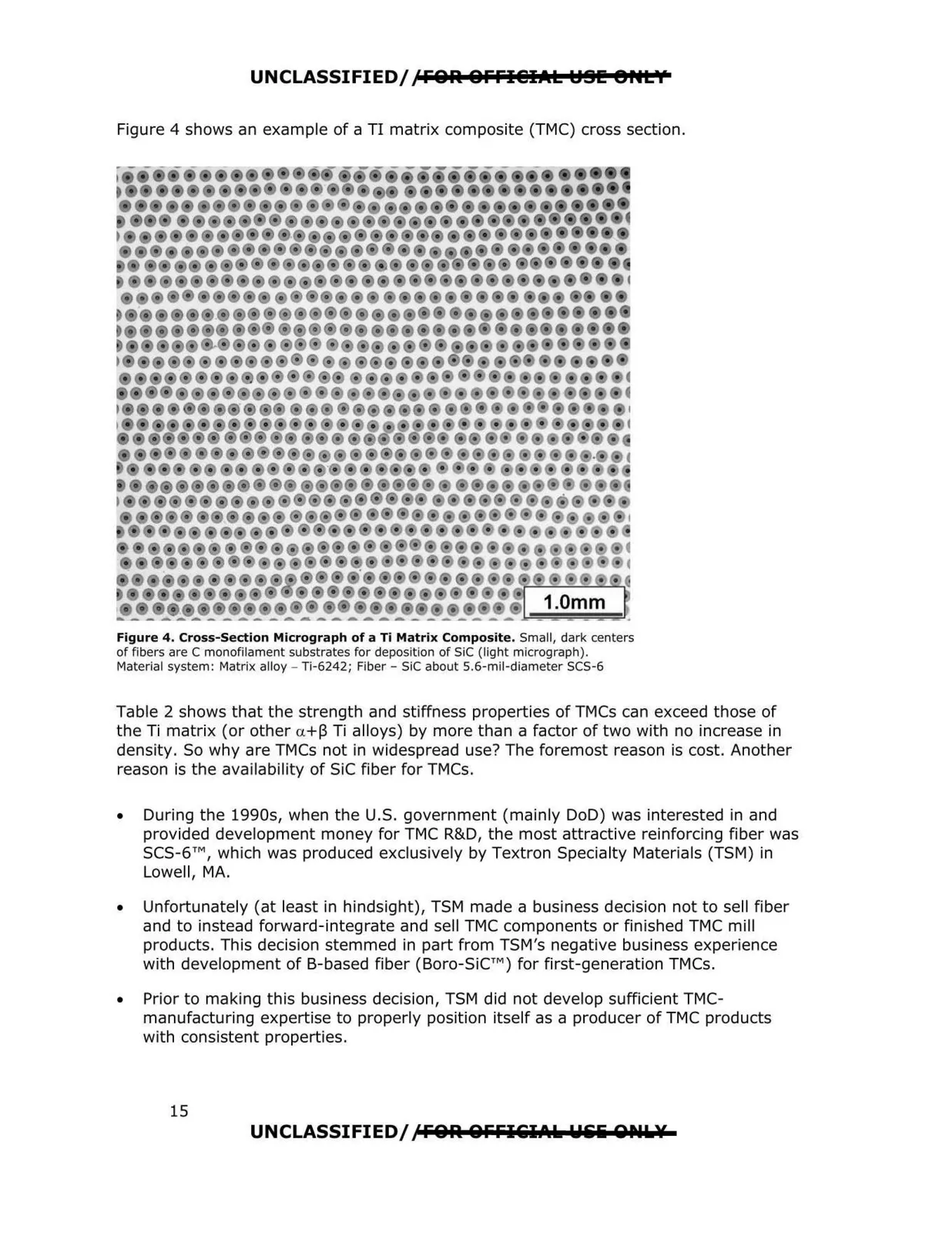
UNCLASSIFIED/ fFOR 8FFI@IAL YSI!! f>HLY Figure 4 shows an example of a TI matrix composite (TMC) cross section. Figure 4. Cross-Section Micrograph of a Ti Matrix Composite. Small, dark centers of fibers are C monofilament substrates for deposition of SiC (light micrograph). Material system: Matrix alloy - Ti-6242; Fiber - SiC about 5.6-mil-diameter SCS-6 Table 2 shows that the strength and stiffness properties of TMCs can exceed those of the Ti matrix (or other a.+13 Ti alloys) by more than a factor of two with no increase in density. So why are TMCs not in widespread use? The foremost reason is cost. Another reason is the availability of SiC fiber for TMCs. • During the 1990s, when the U.S. government (mainly DoD) was interested in and provided development money for TMC R&D, the most attractive reinforcing fiber was SCS-6™, which was produced exclusively by Textron Specialty Materials (TSM) in Lowell, MA. • Unfortunately (at least in hindsight), TSM made a business decision not to sell fiber and to instead forward-integrate and sell TMC components or finished TMC mill products. This decision stemmed in part from TSM's negative business experience with development of B-based fiber (Boro-SiC™) for first-generation TMCs. • Prior to making this business decision, TSM did not develop sufficient TMC manufacturing expertise to properly position itself as a producer of TMC products with consistent properties. 15 UNCLASSIFIED/ f FOR OFFIQl.\k Uili Qfslk¥