AAWSAP DIRD, Materials for Advanced Aerospace Platforms, January 2010
DOW-UAP-D120 · page 19 of 27
Text
This text came with the file. It may have mistakes. When the text and the image disagree, the image is right.
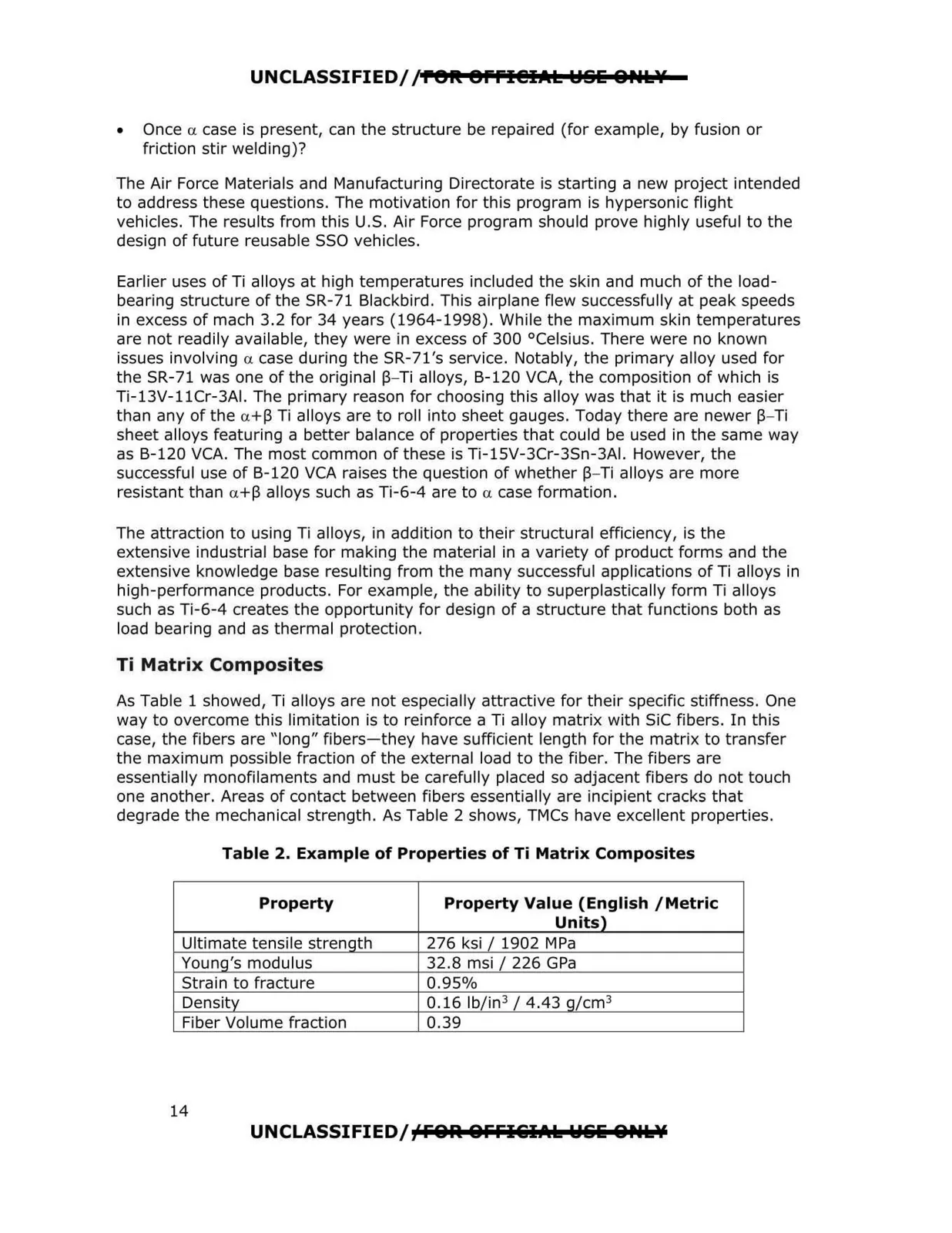
UNCLASSIFIED//FOil OFFl@IAL YSli 8Ptllf • Once a case is present, can the structure be repaired (for example, by fusion or friction stir welding)? The Air Force Materials and Manufacturing Directorate is starting a new project intended to address these questions. The motivation for this program is hypersonic flight vehicles. The results from this U.S. Air Force program should prove highly useful to the design of future reusable SSO vehicles. Earlier uses of Ti alloys at high temperatures included the skin and much of the load bearing structure of the SR-71 Blackbird. This airplane flew successfully at peak speeds in excess of mach 3.2 for 34 years (1964-1998). While the maximum skin temperatures are not readily available, they were in excess of 300 °Celsius. There were no known issues involving a case during the SR-71's service. Notably, the primary alloy used for the SR-71 was one of the original ~-Ti alloys, B-120 VCA, the composition of which is Ti-13V-11Cr-3AI. The primary reason for choosing this alloy was that it is much easier than any of the a +~ Ti alloys are to roll into sheet gauges. Today there are newer ~-Ti sheet alloys featuring a better balance of properties that could be used in the same way as B-120 VCA. The most common of these is Ti-15V-3Cr-3Sn-3AI. However, the successful use of B-120 VCA raises the question of whether ~- Ti alloys are more resistant than a+ ~ alloys such as Ti-6-4 are to a case formation. The attraction to using Ti alloys, in addition to their structural efficiency, is the extensive industrial base for making the material in a variety of product forms and the extensive knowledge base resulting from the many successful applications of Ti alloys in high-performance products. For example, the ability to superplastically form Ti alloys such as Ti-6-4 creates the opportunity for design of a structure that functions both as load bearing and as thermal protection. Ti Matrix Composites As Table 1 showed, Ti alloys are not especially attractive for their specific stiffness. One way to overcome this limitation is to reinforce a Ti alloy matrix with SiC fibers. In this case, the fibers are "long" fibers-they have sufficient length for the matrix to transfer the maximum possible fraction of the external load to the fiber. The fibers are essentially monofilaments and must be carefully placed so adjacent fibers do not touch one another. Areas of contact between fibers essentially are incipient cracks that degrade the mechanical strength. As Table 2 shows, TMCs have excellent properties. Table 2. Example of Properties of Ti Matrix Composites Property Property Value (English /Metric Units) Ultimate tensile strenqth 276 ksi / 1902 MPa Young's modulus 32.8 msi / 226 GPa Strain to fracture 0.95% Density 0.16 lb/in 3 / 4.43 q/cm3 Fiber Volume fraction 0.39 14 UNCLASSIFIED/;SFOR. OFFl&IAL Y&li 8Ptllf