AAWSAP DIRD, Pulsed High-Power Microwave Source Technology, January 2010
DOW-UAP-D121 · page 19 of 37
Text
This text came with the file. It may have mistakes. When the text and the image disagree, the image is right.
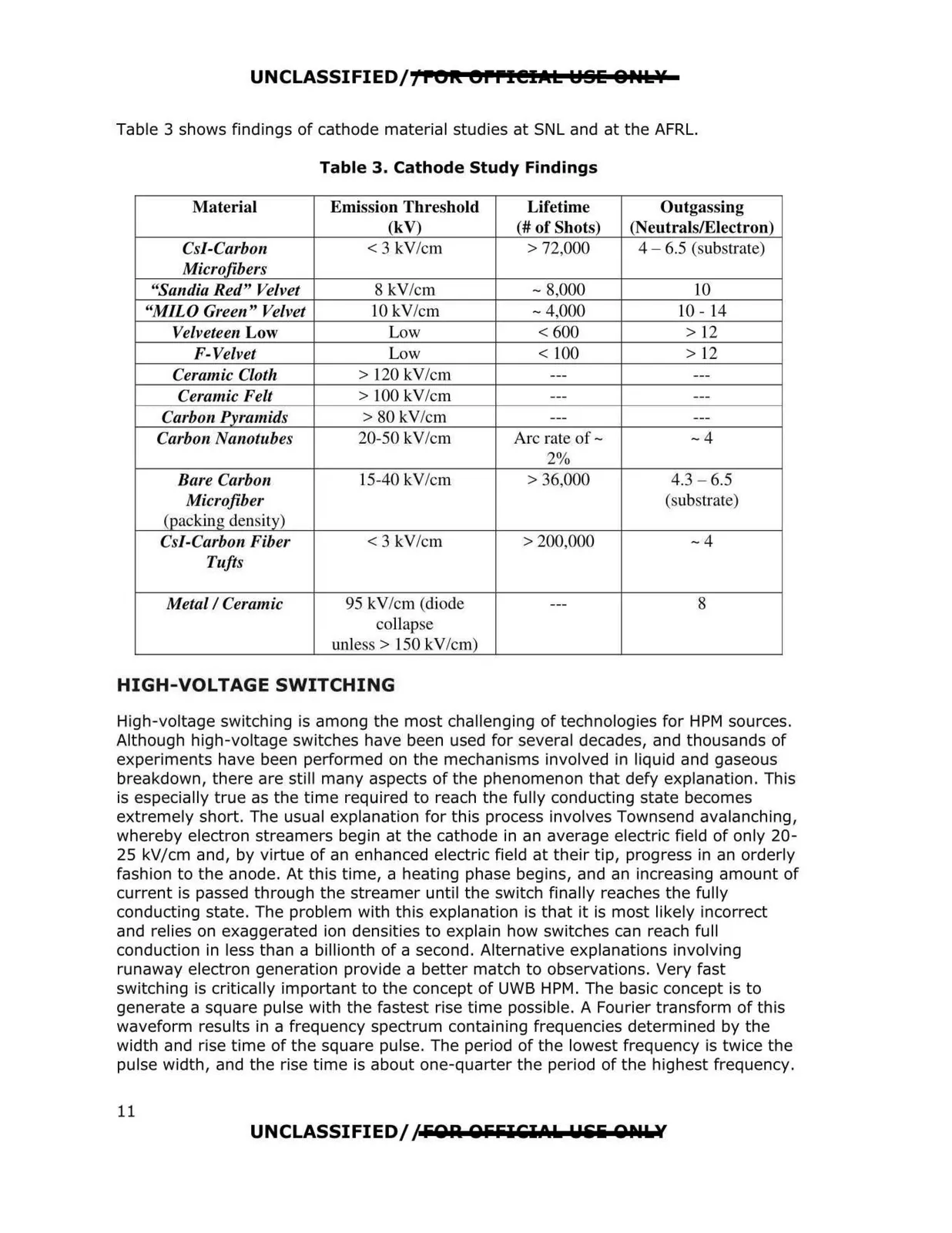
UNCLASSIFIED/} P'Olt OP'P'l@IAL l:ISE &P•LY Table 3 shows findings of cathode material studies at SNL and at the AFRL. Table 3. Cathode Study Findings Material Emission Threshold (kV) Lifetime (# of Shots) Outgassing (Neutrals/Electron) Csl-Carbon Micro.fibers < 3 kV/cm > 72,000 4 6.5 (substrate) "Sandia Red" Velvet 8 kV/cm - 8,000 10 "MILO Green" Velvet 10 kV/cm - 4,000 10-14 Velveteen Low Low <600 > 12 F-Velvet Low < 100 > 12 Ceramic Cloth > 120 kV/cm -- -- Ceramic Felt > 100 kV/cm -- -- Carbon Pyramids > 80 kV/cm -- -- Carbon Nanotubes 20-50 kV/cm Arc rate of 2% -4 Bare Carbon Microfiber (packing density) 15-40 kV/cm > 36,000 4.3 6.5 (substrate) Csl-Carbon Fiber Tufts < 3 kV/cm > 200,000 -4 Metal I Ceramic 95 kV/cm (diode collapse unless> 150 kV/cm) -- 8 HIGH-VOLTAGE SWITCHING High-voltage switching is among the most challenging of technologies for HPM sources. Although high-voltage switches have been used for several decades, and thousands of experiments have been performed on the mechanisms involved in liquid and gaseous breakdown, there are still many aspects of the phenomenon that defy explanation. This is especially true as the time required to reach the fully conducting state becomes extremely short. The usual explanation for this process involves Townsend avalanching, whereby electron streamers begin at the cathode in an average electric field of only 20 25 kV/cm and, by virtue of an enhanced electric field at their tip, progress in an orderly fashion to the anode. At this time, a heating phase begins, and an increasing amount of current is passed through the streamer until the switch finally reaches the fully conducting state. The problem with this explanation is that it is most likely incorrect and relies on exaggerated ion densities to explain how switches can reach full conduction in less than a billionth of a second. Alternative explanations involving runaway electron generation provide a better match to observations. Very fast switching is critically important to the concept of UWB HPM. The basic concept is to generate a square pulse with the fastest rise time possible. A Fourier transform of this waveform results in a frequency spectrum containing frequencies determined by the width and rise time of the square pulse. The period of the lowest frequency is twice the pulse width, and the rise time is about one-quarter the period of the highest frequency. UNCLASSIFIED/ ,<FQA OFFICIO I. Uili OPII.V 11