AAWSAP DIRD, Pulsed High-Power Microwave Source Technology, January 2010
DOW-UAP-D121 · page 30 of 37
Text
This text came with the file. It may have mistakes. When the text and the image disagree, the image is right.
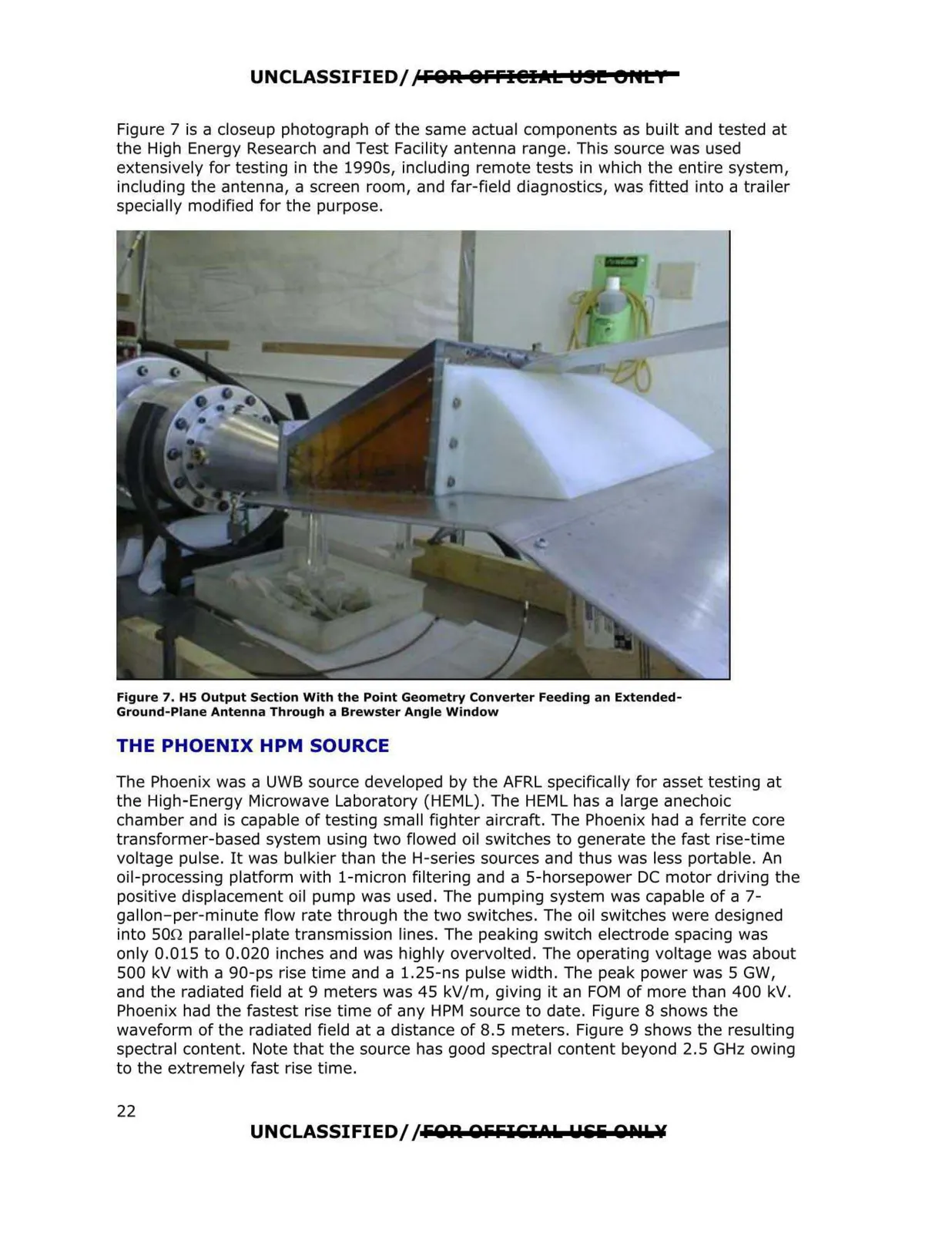
UNCLASSIFIED/fFOR 8FFI@IAL tl91!! f>flt I Figure 7 is a closeup photograph of the same actual components as built and tested at the High Energy Research and Test Facility antenna range. This source was used extensively for testing in the 1990s, including remote tests in which the entire system, including the antenna, a screen room, and far-field diagnostics, was fitted into a trailer specially modified for the purpose. Figure 7. HS Output Section With the Point Geometry Converter Feeding an Extended Ground-Plane Antenna Through a Brewster Angle Window THE PHOENIX HPM SOURCE The Phoenix was a UWB source developed by the AFRL specifically for asset testing at the High-Energy Microwave Laboratory (HEML). The HEML has a large anechoic chamber and is capable of testing small fighter aircraft. The Phoenix had a ferrite core transformer-based system using two flowed oil switches to generate the fast rise-time voltage pulse. It was bulkier than the H-series sources and thus was less portable. An oil-processing platform with 1-micron filtering and a 5-horsepower DC motor driving the positive displacement oil pump was used. The pumping system was capable of a 7 gallon-per-minute flow rate through the two switches. The oil switches were designed into 50.Q parallel-plate transmission lines. The peaking switch electrode spacing was only 0.015 to 0.020 inches and was highly overvolted. The operating voltage was about 500 kV with a 90-ps rise time and a 1.25-ns pulse width. The peak power was 5 GW, and the radiated field at 9 meters was 45 kV/m, giving it an FOM of more than 400 kV. Phoenix had the fastest rise time of any HPM source to date. Figure 8 shows the waveform of the radiated field at a distance of 8.5 meters. Figure 9 shows the resulting spectral content. Note that the source has good spectral content beyond 2.5 GHz owing to the extremely fast rise time. UNCLASSIFIED/ /5iOA O5i5ilCI0I. Uili OPII.¥ 22