AAWSAP DIRD, Invisibility Cloaking Theory and Experiments, March 2010
DOW-UAP-D122 · page 16 of 29
Text
This text came with the file. It may have mistakes. When the text and the image disagree, the image is right.
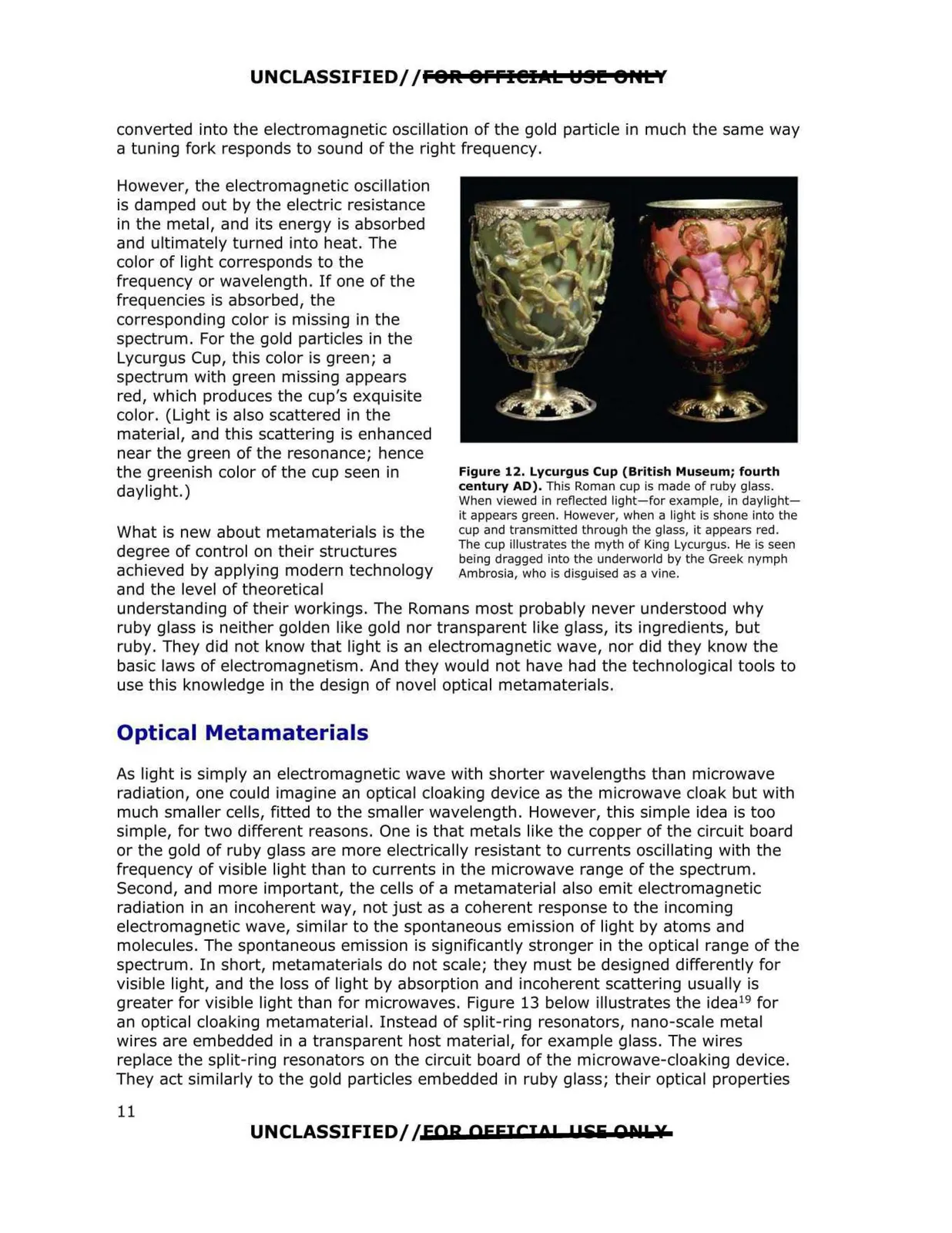
UNCLASSIFIED/ /FOR: OFFl@IAL l!ISI!!! 9HL'f converted into the electromagnetic oscillation of the gold particle in much the same way a tuning fork responds to sound of the right frequency. However, the electromagnetic oscillation is damped out by the electric resistance in the metal, and its energy is absorbed and ultimately turned into heat. The color of light corresponds to the frequency or wavelength . If one of the frequencies is absorbed, the corresponding color is missing in the spectrum. For the gold particles in the Lycurgus Cup, this color is green; a spectrum with green missing appears red, which produces the cup's exquisite color. (Light is also scattered in the material, and this scattering is enhanced near the green of the resonance; hence the greenish color of the cup seen in daylight.) What is new about metamaterials is the degree of control on their structures achieved by applying modern technology and the level of theoretical Figure 12. Lycurgus Cup (British Museum; fourth century AD). This Roman cup is made of ruby glass. When viewed in reflected light- for example, in daylight it appears green. However, when a light is shone into the cup and transmitted through the glass, it appears red. The cup illustrates the myth of King Lycurgus. He is seen being dragged into the underworld by the Greek nymph Ambrosia, who is disguised as a vine. understanding of their workings. The Romans most probably never understood why ruby glass is neither golden like gold nor transparent like glass, its ingredients, but ruby. They did not know that light is an electromagnetic wave, nor did they know the basic laws of electromagnetism . And they would not have had the technological tools to use this knowledge in the design of novel optical metamaterials. Optical Metamaterials As light is simply an electromagnetic wave with shorter wavelengths than microwave radiation, one could imagine an optical cloaking device as the microwave cloak but with much smaller cells, fitted to the smaller wavelength. However, this simple idea is too simple, for two different reasons. One is that metals like the copper of the circuit board or the gold of ruby glass are more electrically resistant to currents oscillating with the frequency of visible light than to currents in the microwave range of the spectrum. Second, and more important, the cells of a metamaterial also emit electromagnetic radiation in an incoherent way, not just as a coherent response to the incoming electromagnetic wave, similar to the spontaneous emission of light by atoms and molecules. The spontaneous emission is significantly stronger in the optical range of the spectrum. In short, metamaterials do not scale; they must be designed differently for visible light, and the loss of light by absorption and incoherent scattering usually is greater for visible light than for microwaves. Figure 13 below illustrates the idea 19 for an optical cloaking metamaterial. Instead of split-ring resonators, nano-scale metal wires are embedded in a transparent host material, for example glass. The wires replace the split-ring resonators on the circuit board of the microwave-cloaking device. They act similarly to the gold particles embedded in ruby glass; their optical properties UNCLASSIFIED//EAR OFFICIO! I 155 ODIL¥ 11