AAWSAP DIRD, Invisibility Cloaking Theory and Experiments, March 2010
DOW-UAP-D122 · page 6 of 29
Text
This text came with the file. It may have mistakes. When the text and the image disagree, the image is right.
UNCLASSIFIED//FOA OFFI&Il.tl l::181: 8HL'f
Camouflage
Invisibility may be achieved through three principal methods: camouflage,
transparency, and cloaking. Many animals and some plants use camouflage to disguise
themselves from predators-for example, by assuming the shapes and colors of objects
in their surroundings. The military has long used forms of camouflage; a recent military
application of camouflage is stealth technology.
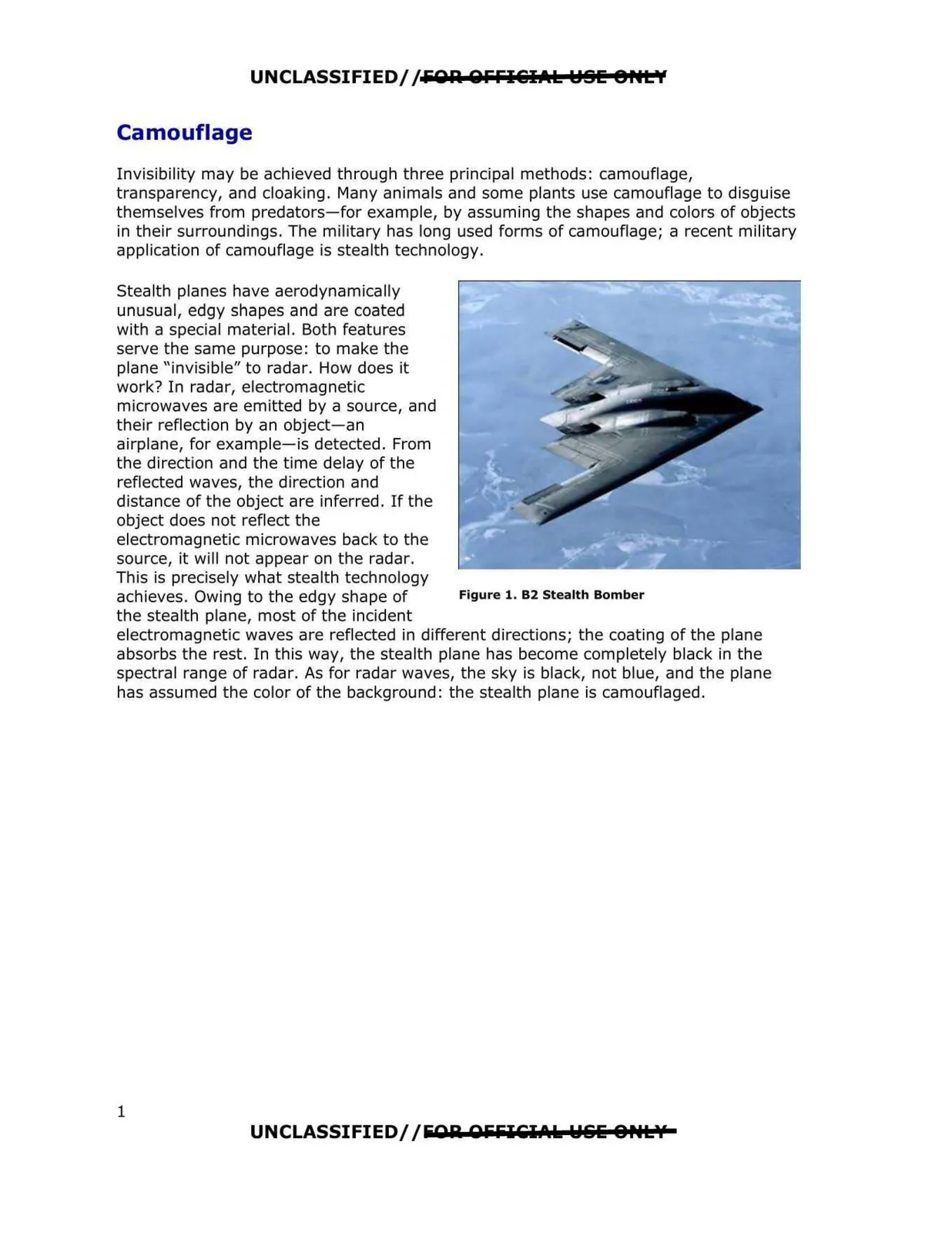
Stealth planes have aerodynamically
unusual, edgy shapes and are coated
with a special material. Both features
serve the same purpose: to make the
plane "invisible" to radar. How does it
work? In radar, electromagnetic
microwaves are emitted by a source, and
their reflection by an object-an
airplane, for example-is detected. From
the direction and the time delay of the
reflected waves, the direction and
distance of the object are inferred. If the
object does not reflect the
electromagnetic microwaves back to the
source, it will not appear on the radar.
This is precisely what stealth technology
achieves. Owing to the edgy shape of
Figure 1. B2 Stealth Bomber
the stealth plane, most of the incident
electromagnetic waves are reflected in different directions; the coating of the plane
absorbs the rest. In this way, the stealth plane has become completely black in the
spectral range of radar. As for radar waves, the sky is black, not blue, and the plane
has assumed the color of the background: the stealth plane is camouflaged.
UNCLASSIFIED/ /&iOA: OFFICl.t.k W&li 8,.lY
1