AAWSAP DIRD, Invisibility Cloaking Theory and Experiments, March 2010
DOW-UAP-D122 · page 7 of 29
Text
This text came with the file. It may have mistakes. When the text and the image disagree, the image is right.
UNCLASSIFIED/ /FOA OFFI&I.t.k Wfili 8,.LY
Another recent example of camouflage is
optical camouflage, developed by the
University of Tokyo's Tachi Laboratory.
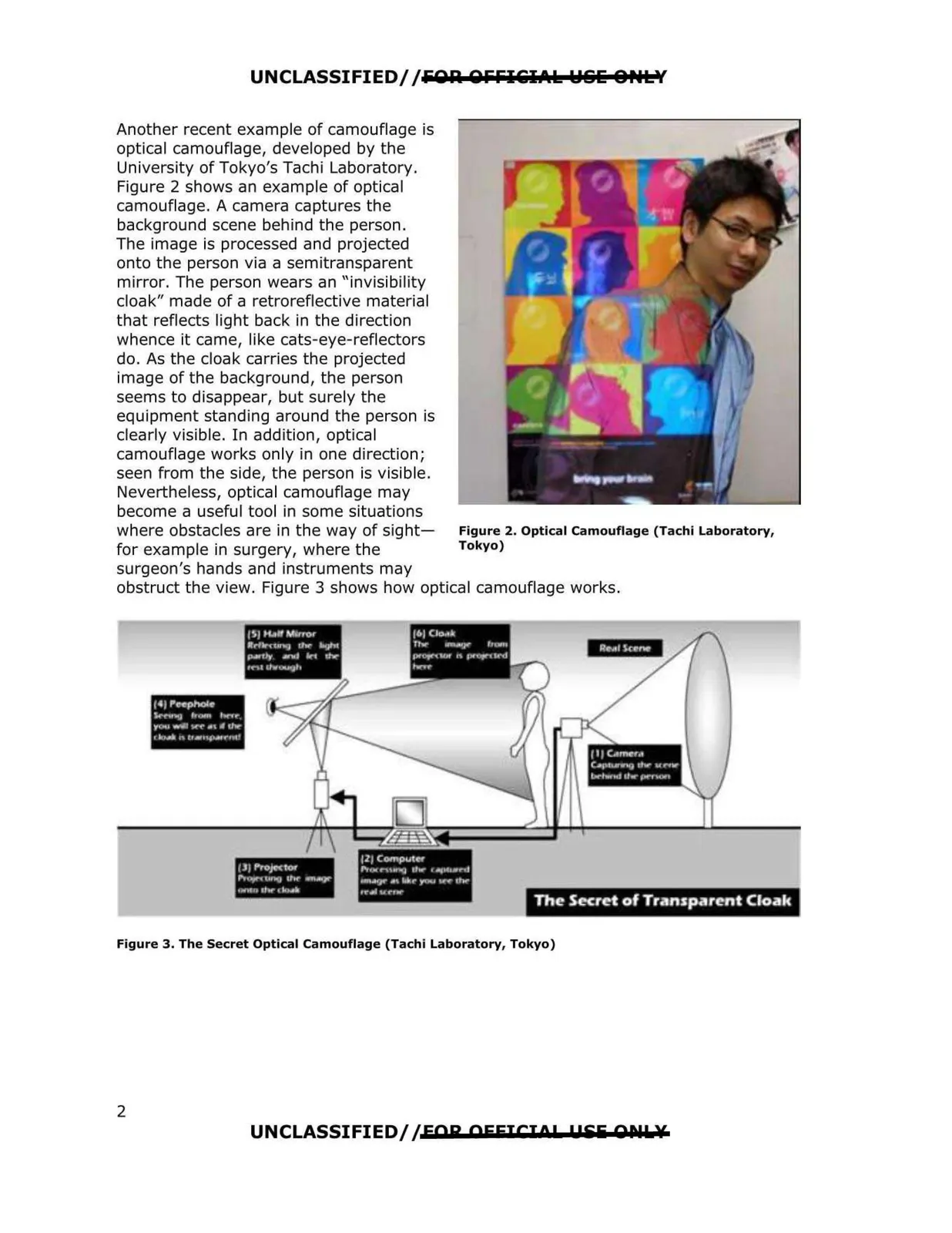
Figure 2 shows an example of optical
camouflage. A camera captures the
background scene behind the person.
The image is processed and projected
onto the person via a semitransparent
mirror. The person wears an "invisibility
cloak" made of a retroreflective material
that reflects light back in the direction
whence it came, like cats-eye-reflectors
do. As the cloak carries the projected
image of the background, the person
seems to disappear, but surely the
equipment standing around the person is
clearly visible. In addition, optical
camouflage works only in one direction;
seen from the side, the person is visible.
Nevertheless, optica l camouflage may
become a useful tool in some situations
where obstacles are in the way of sight-
Figure 2. Optical Camouflage (Tachi Laboratory,
for example in surgery, where the
Tokyo}
surgeon's hands and instruments may
obstruct the view. Figure 3 shows how optical camouflage works.
I JJ f"n>Jl'<to<
rt,.,,.. Ol"'J irlf' .-n•,r
,_.1111 thr,t.i.,.,.
The S~cret of Trollnsparent croalc 1
Figure 3. The Secret Optical Camouflage (Tachi Laboratory, Tokyo)
UNCLASSIFIED/ /FOP OFFICIO P I !iii ODIL¥
2