AAWSAP DIRD, Invisibility Cloaking Theory and Experiments, March 2010
DOW-UAP-D122 · page 8 of 29
Text
This text came with the file. It may have mistakes. When the text and the image disagree, the image is right.
UNCLASSIFIED/; POI\ OPPICIAL U.!I!! er•tY
Transparency
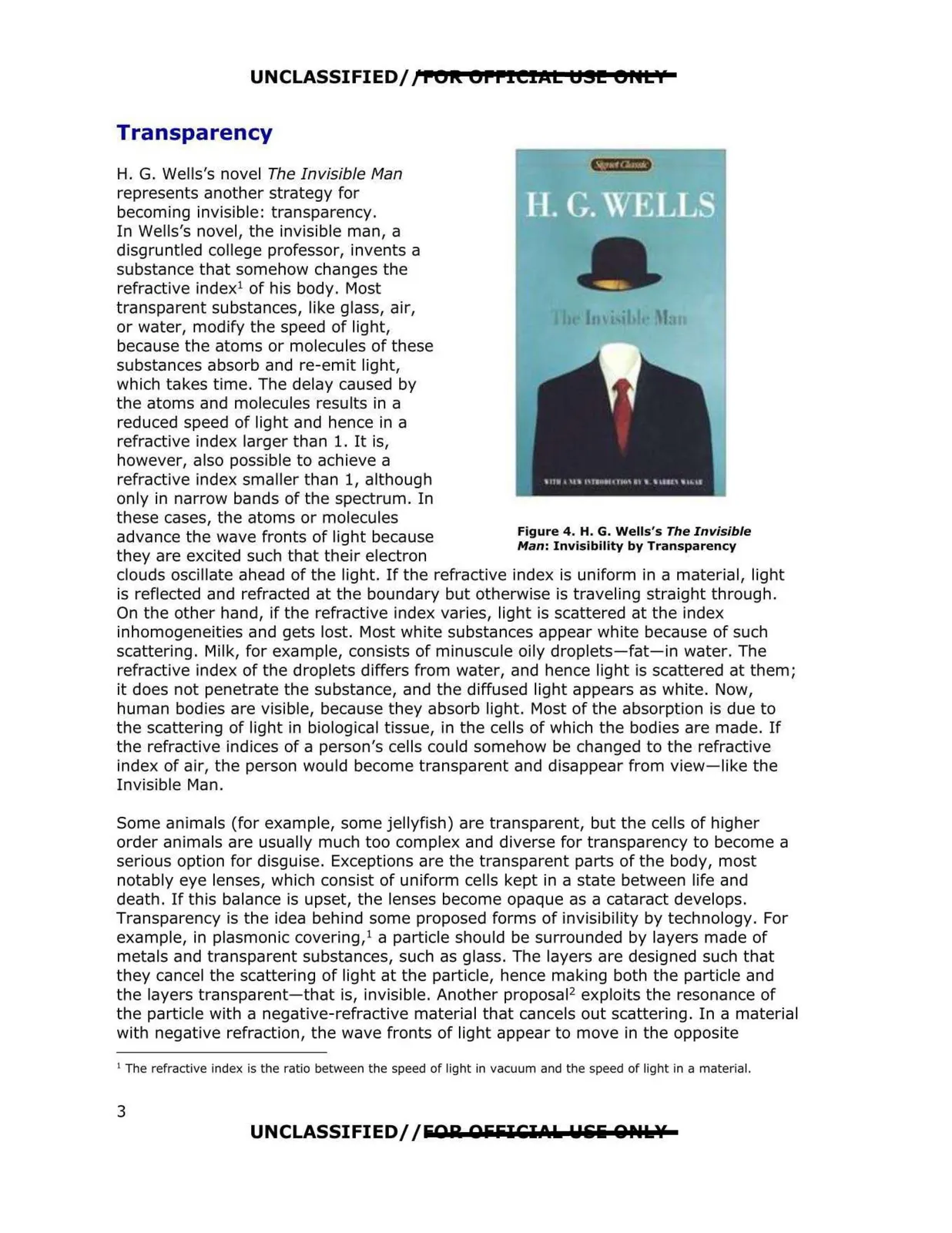
H. G. Wells's novel The Invisible Man
represents another strategy for
becoming invisible: transparency.
In Wells's novel, the invisible man, a
disgruntled college professor, invents a
substance that somehow changes the
refractive index1 of his body. Most
transparent substances, like glass, air,
or water, modify the speed of light,
because the atoms or molecules of these
substances absorb and re-emit light,
which takes time. The delay caused by
the atoms and molecules results in a
reduced speed of light and hence in a
refractive index larger than 1. It is,
however, also possible to achieve a
refractive index smaller than 1, although
only in narrow bands of the spectrum. In
these cases, the atoms or molecules
advance the wave fronts of light because
they are excited such that their electron
clouds oscillate ahead of the light. If the refractive index is uniform in a material, light
is reflected and refracted at the boundary but otherwise is traveling straight through.
On the other hand, if the refractive index varies, light is scattered at the index
inhomogeneities and gets lost. Most white substances appear white because of such
scattering . Milk, for example, consists of minuscule oily droplets-fat-in water. The
refractive index of the droplets differs from water, and hence light is scattered at them;
it does not penetrate the substance, and the diffused light appears as white. Now,
human bodies are visible, because they absorb light. Most of the absorption is due to
the scattering of light in biological tissue, in the cells of which the bodies are made. If
the refractive indices of a person's cells could somehow be changed to the refractive
index of air, the person would become transparent and disappear from view-like the
Invisible Man.
Some animals (for example, some jellyfish) are transparent, but the cells of higher
order animals are usually much too complex and diverse for transparency to become a
serious option for disguise. Exceptions are the transparent parts of the body, most
notably eye lenses, which consist of uniform cells kept in a state between life and
death. If this balance is upset, the lenses become opaque as a cataract develops.
Transparency is the idea behind some proposed forms of invisibility by technology. For
example, in plasmonic covering, 1 a particle should be surrounded by layers made of
metals and transparent substances, such as glass. The layers are designed such that
they cancel the scattering of light at the particle, hence making both the particle and
the layers transparent-that is, invisible. Another proposal2 exploits the resonance of
the particle with a negative-refractive material that cancels out scattering. In a material
with negative refraction, the wave fronts of light appear to move in the opposite
1 The refractive index is the ratio between the speed of light in vacuum and the speed of light in a material.
UNCLASSIFIED//5O9 OEEICI0 .. Uili QPlkY
Figure 4. H. G. Wells's The Invisible
Man: Invisibility by Transparency
3