AAWSAP DIRD, Positron Aerospace Propulsion, March 2010
DOW-UAP-D123 · page 16 of 35
Text
This text came with the file. It may have mistakes. When the text and the image disagree, the image is right.
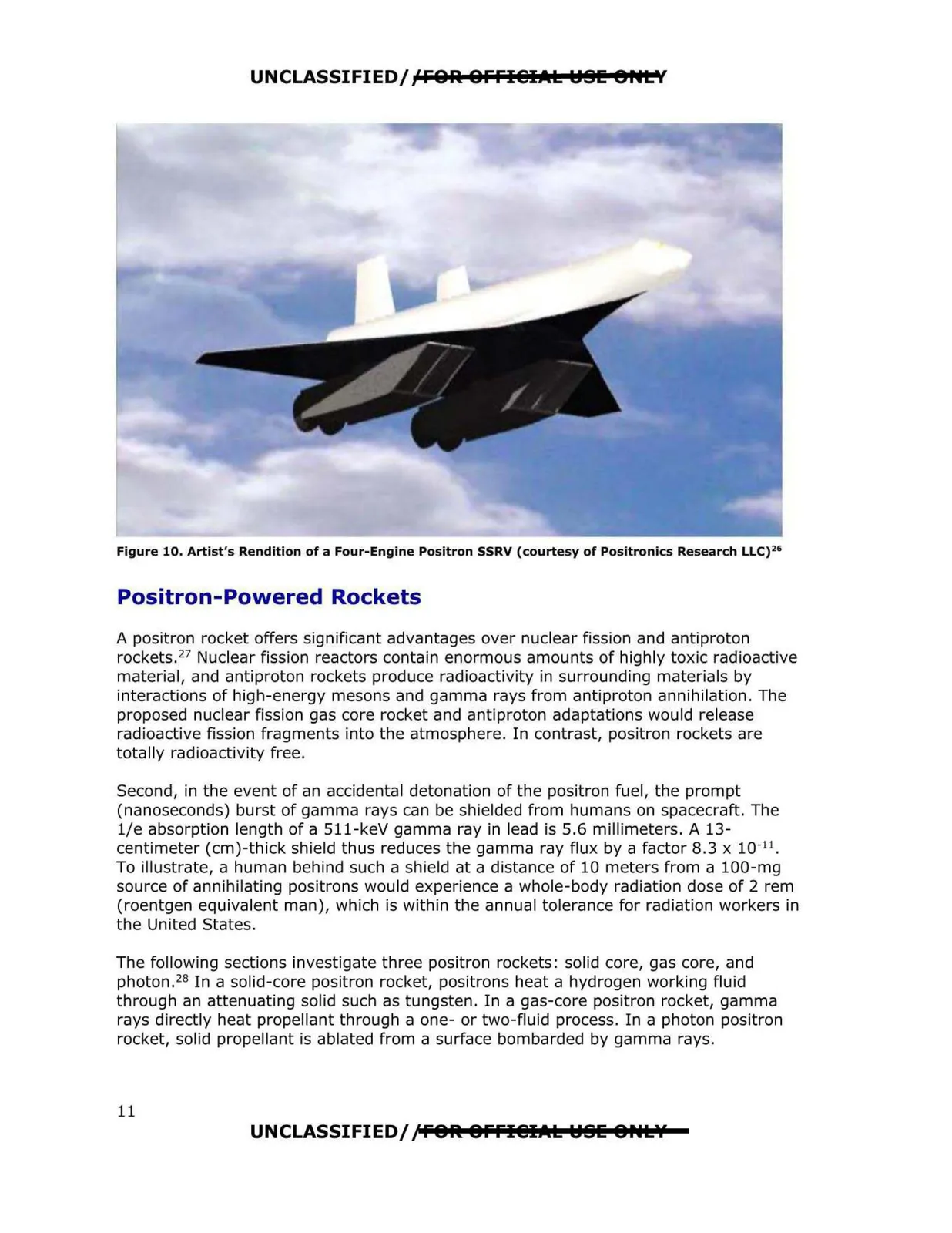
UNCLASSIFIED/,,roR 8FFI@IAL l:l!H! 9HLY Figure 10. Artist's Rendition of a Four-Engine Positron SSRV (courtesy of Positronics Research LLC) 26 Positron-Powered Rockets A positron rocket offers significant advantages over nuclear fission and antiproton rockets. 27 Nuclear fission reactors contain enormous amounts of highly toxic radioactive material, and antiproton rockets produce radioactivity in surrounding materials by interactions of high-energy mesons and gamma rays from antiproton annihilation. The proposed nuclear fission gas core rocket and antiproton adaptations would release radioactive fission fragments into the atmosphere. In contrast, positron rockets are totally radioactivity free. Second, in the event of an accidental detonation of the positron fuel, the prompt (nanoseconds) burst of gamma rays can be shielded from humans on spacecraft. The 1/e absorption length of a 511-keV gamma ray in lead is 5.6 millimeters. A 13 centimeter (cm)-thick shield thus reduces the gamma ray flux by a factor 8.3 x 10⁻¹¹ . To illustrate, a human behind such a shield at a distance of 10 meters from a 100-mg source of annihilating positrons would experience a whole-body radiation dose of 2 rem (roentgen equivalent man), which is within the annual tolerance for radiation workers in the United States. The following sections investigate three positron rockets: solid core, gas core, and photon. 28 In a solid-core positron rocket, positrons heat a hydrogen working fluid through an attenuating solid such as tungsten. In a gas-core positron rocket, gamma rays directly heat propellant through a one- or two-fluid process. In a photon positron rocket, solid propellant is ablated from a surface bombarded by gamma rays. UNCLASSIFIED/,'FOR. OFFI@IAL l:ISIE OHL\« 11