AAWSAP DIRD, Positron Aerospace Propulsion, March 2010
DOW-UAP-D123 · page 17 of 35
Text
This text came with the file. It may have mistakes. When the text and the image disagree, the image is right.
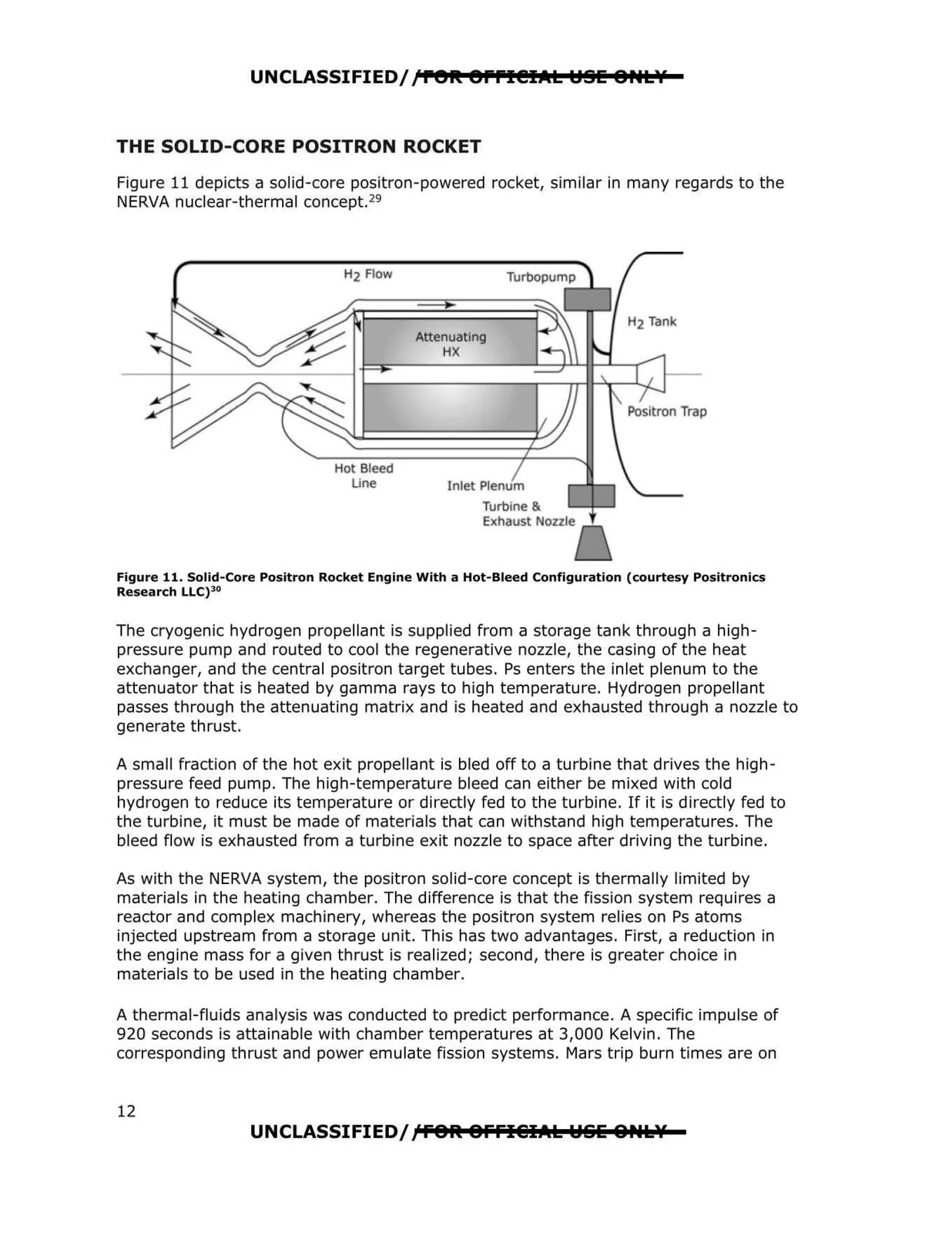
UNCLASSIFIED/ /FOR. errl@IAL YSI: e ..tv THE SOLID-CORE POSITRON ROCKET Figure 11 depicts a solid-core positron-powered rocket, similar in many regards to the NERVA nuclear-thermal concept. 29 Attenuating HX Inlet Plenum Turbine & Exhaust Nozzle Hot Bleed Line Figure 11. Solid-Core Positron Rocket Engine With a Hot-Bleed Configuration (courtesy Positronics Research LLC)30 The cryogenic hydrogen propellant is supplied from a storage tank through a high pressure pump and routed to cool the regenerative nozzle, the casing of the heat exchanger, and the central positron target tubes. Ps enters the in let plenum to the attenuator that is heated by gamma rays to high temperature. Hydrogen propellant passes through the attenuating matrix and is heated and exhausted through a nozzle to generate thrust. A small fraction of the hot exit propellant is bled off to a turbine that drives the high pressure feed pump. The high-temperature bleed can either be mixed with cold hydrogen to reduce its temperature or directly fed to the turbine. If it is directly fed to the turbine, it must be made of materials that can withstand high temperatures. The bleed flow is exhausted from a turbine exit nozzle to space a~er driving the turbine. As with the NERVA system, the positron solid-core concept is thermally limited by materials in the heating chamber. The difference is that the fission system requires a reactor and complex machinery, whereas the positron system relies on Ps atoms injected upstream from a storage unit. This has two advantages. First, a reduction in the engine mass for a given thrust is realized; second, there is greater choice in materials to be used in the heating chamber. A thermal-fluids analysis was conducted to predict performance. A specific impulse of 920 seconds is attainable with chamber temperatures at 3,000 Kelvin. The corresponding thrust and power emulate fission systems. Mars trip burn times are on UNCLASSIFIED/ /FOR. 8ffl@IAI:: W&lii 8P.l::lf 12