AAWSAP DIRD, Positron Aerospace Propulsion, March 2010
DOW-UAP-D123 · page 18 of 35
Text
This text came with the file. It may have mistakes. When the text and the image disagree, the image is right.
UNCLASSIFIEDj} P'OR. OP'P'l@IAL l:ISE 8PUs:lf
the order of 30 minutes, indicating that a spacecraft employing three 72-kN solid-core
engines would require 6-9 mg of positrons per mission.
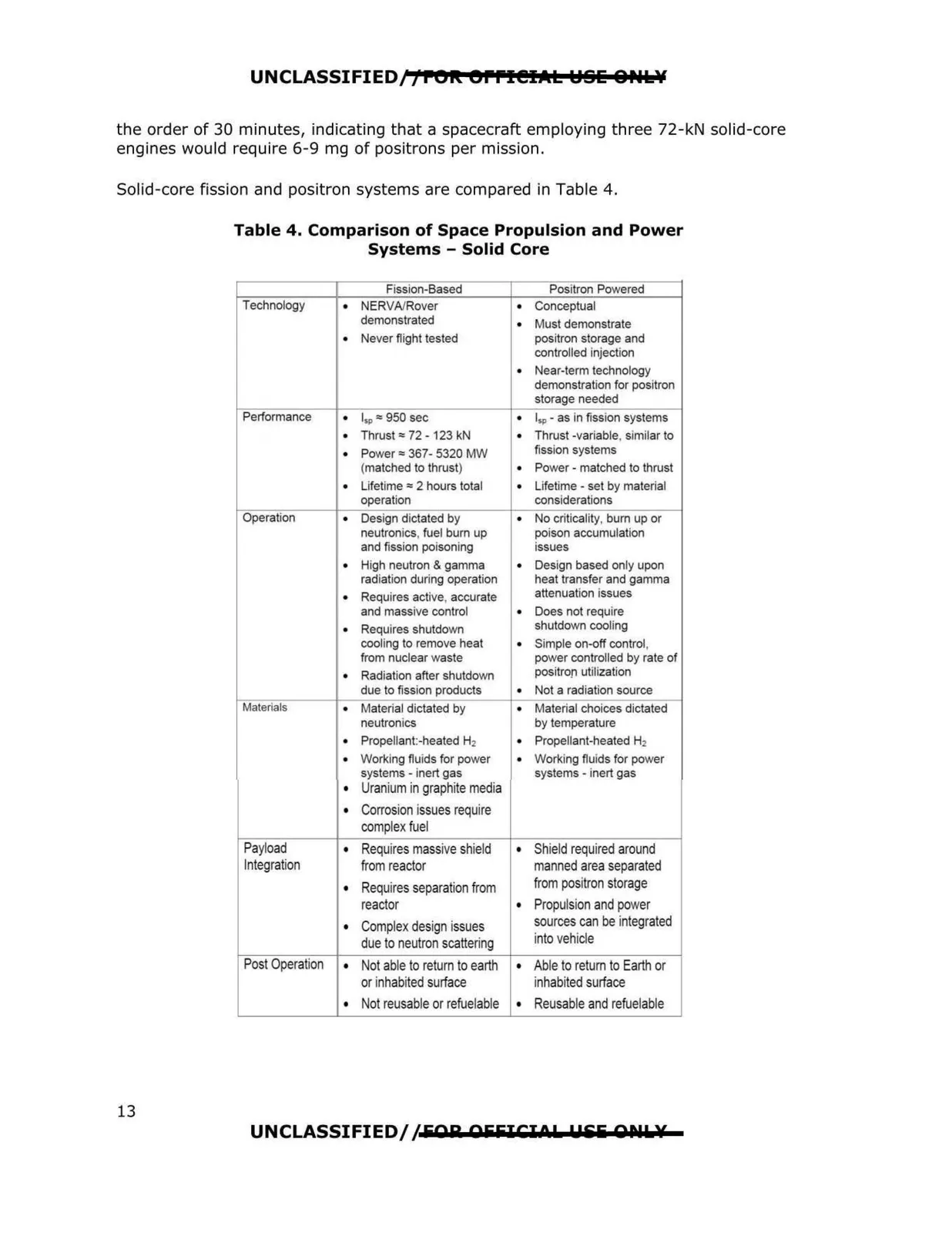
Solid-core fission and positron systems are compared in Table 4.
Table 4. Comparison of Space Propulsion and Power
Systems - Solid Core
Fission-Based
Positron Powered
Technology
• NERVA/Rover
demonstrated
• Never fl ight tested
• Conceptual
• Must demonstrate
positron storage and
controlled injection
• Near-term technology
demonstration for positron
storage needed
Performance . I,p "' 950 sec
. Thrust "' 72 - 123 kN
. Power "' 367 - 5320 MW
(matched to thrust)
• Lifetime "' 2 hours total
operation
. lsp - as in fission systems
. Thrust -variable, similar to
fission systems
. Power - matched to thrust
• Lifetime - set by material
considerations
Operation
. Design dictated by
neutronics, fuel burn up
and fission poisoning
. High neutron & gamma
radiation during operation
. Requires active, accurate
and massive control
. Requires shutdown
cooling to remove heat
from nuclear waste
• Radiation after shutdown
due to fission products
. No criticality, burn up or
poison accumulation
issues
. Design based only upon
heat transfer and gamma
attenuation issues
• Does not require
shutdown cooling
. Simple on-off control,
power controlled by rate of
positrop utilization
• Not a radiation source
Materials
. Material dictated by
neutron Jes
• Propellant-heated H2
. Working fluids for power
systems - inert gas
• Uranium in graphite media
• Corrosion issues require
complex fuel
. Material choices dictated
by temperature
• Propellant-heated H2
. Working fluids for power
systems - inert gas
Payload
• Requires massive shield
• Shield required around
Integration
from reactor
• Requires separation from
reactor
• Complex design issues
due to neutron scattering
manned area separated
from positron storage
• Propulsion and power
sources can be integrated
into vehicle
Post Operation
• Not able to return to earth
or inhabited surface
• Not reusable or refuelable
• Able to return to Earth or
inhabitedsurface
• Reusable and refuelable
UNCLASSIFIED//EAR OFFICIO I. Pili QPII.¥
13