AAWSAP DIRD, Positron Aerospace Propulsion, March 2010
DOW-UAP-D123 · page 21 of 35
Text
This text came with the file. It may have mistakes. When the text and the image disagree, the image is right.
UNCLASSIFIED//FOil 8FFl&I.t.k U&li Qt,IP X
THE SANGER PHOTON POSITRON ROCKET
In 1953, German engineer Eugen Sanger proposed the photon rocket. One means of
providing thrust was to shower a parabolic mirror with positron annihilation gamma
rays .37 Unfortunately, there are no materials that reflect gamma rays at large angles.
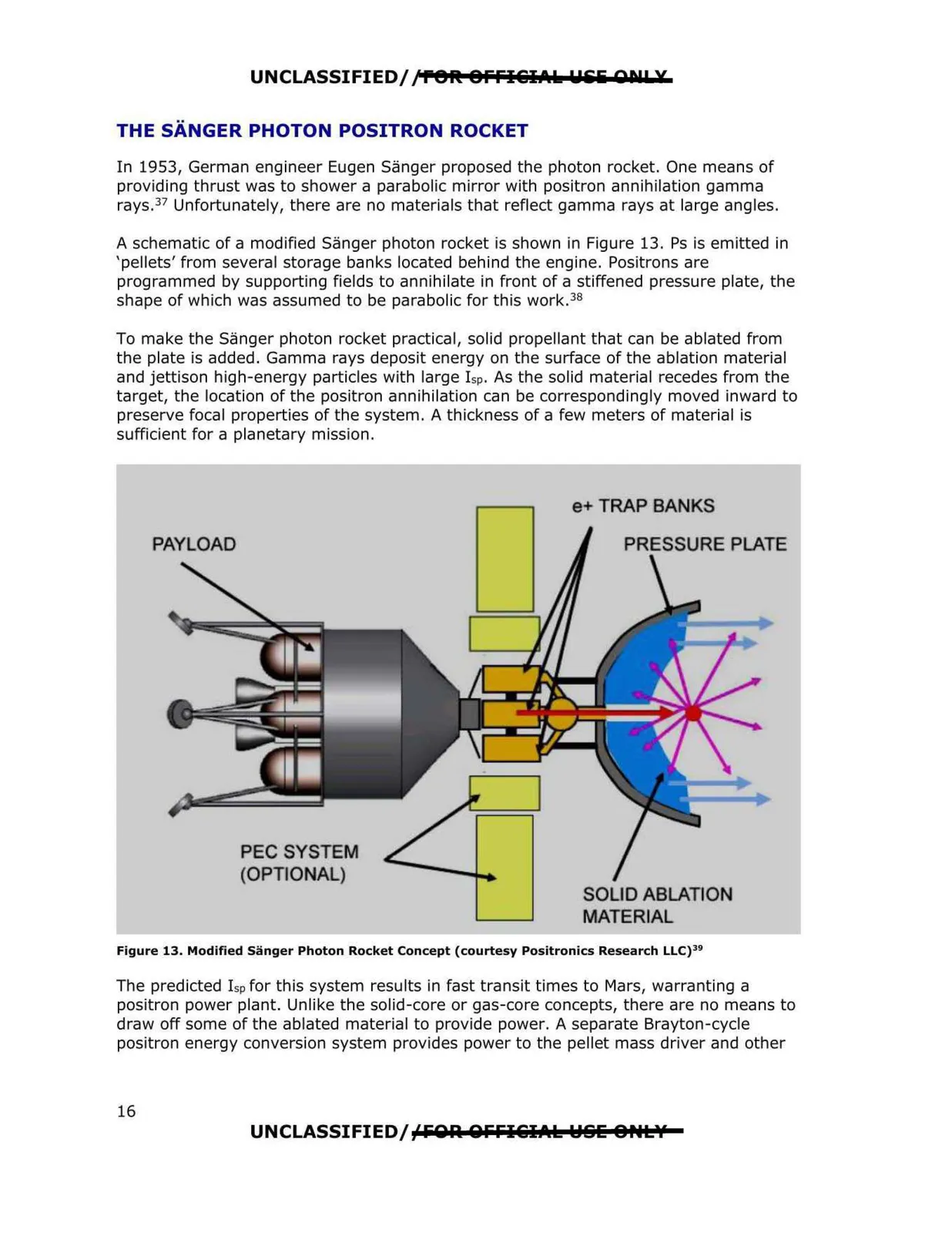
A schematic of a modified Sanger photon rocket is shown in Figure 13. Ps is emitted in
'pellets' from several storage banks located behind the engine. Positrons are
programmed by supporting fields to annihilate in front of a stiffened pressure plate, the
shape of which was assumed to be parabolic for this work. 38
To make the Sanger photon rocket practical, solid propellant that can be ablated from
the plate is added. Gamma rays deposit energy on the surface of the ablation material
and jettison high-energy particles with large lsp . As the solid material recedes from the
target, the location of the positron annihilation can be correspondingly moved inward to
preserve focal properties of the system. A thickness of a few meters of material is
sufficient for a planetary mission.
PEC SYSTEM
(OPTIONAL)
e+ TRAP BANKS
SOLID ABLATION
MATERIAL
Figure 13. Modified Sanger Photon Rocket Concept (courtesy Positronics Research LLC) 39
The predicted l sp for this system results in fast transit times to Mars, warranting a
positron power plant. Unlike the solid-core or gas-core concepts, there are no means to
draw off some of the ablated material to provide power. A separate Brayton-cycle
positron energy conversion system provides power to the pellet mass driver and other
UNCLASSIFIED/fFOA QFFI&I.t.k WSE 8rtt'I
16