AAWSAP DIRD, Positron Aerospace Propulsion, March 2010
DOW-UAP-D123 · page 22 of 35
Text
This text came with the file. It may have mistakes. When the text and the image disagree, the image is right.
UNCLASSIFIED//FOR OFFl@IAL l!ISl!!! 9Ht5i"
components. Alternatively, solar collectors or closed-loop nuclear reactors could be
employed .
To improve ablation efficiency, annihilation gamma rays must be wavelength shifted
(WLS) by passing them through a high-Z WLS material. The material of choice, lead,
also serves as the shell of the Ps pellet. The pellet vaporizes into high-energy plasma,
and the WLS photons propagate to the pressure plate. Silicon carbide ablation material
has been adopted from the antiproton catalyzed microfission/fusion concept4°, 41
developed at Penn State University by the author and coworkers. Photon energy
distributions are shifted through 2 cm of lead to 1-10 keV from 511 keV with 85 percent
efficiency.
Performance depends primarily on the energy of the WLS photons and the energy per
pellet. At 8 keV, l sp is in the range 1,200-3,000 sec. Thrust is 40-145 kN, the latter at a
pellet injection rate of 1 hertz. The total quantity of positrons consumed for a one-way
trip to Mars over th is range of l sp is 15-40 mg with 50 percent of gamma rays striking
the plate and a 85 percent WLS efficiency.
POSITRON ROCKET SYSTEM COMPARISON
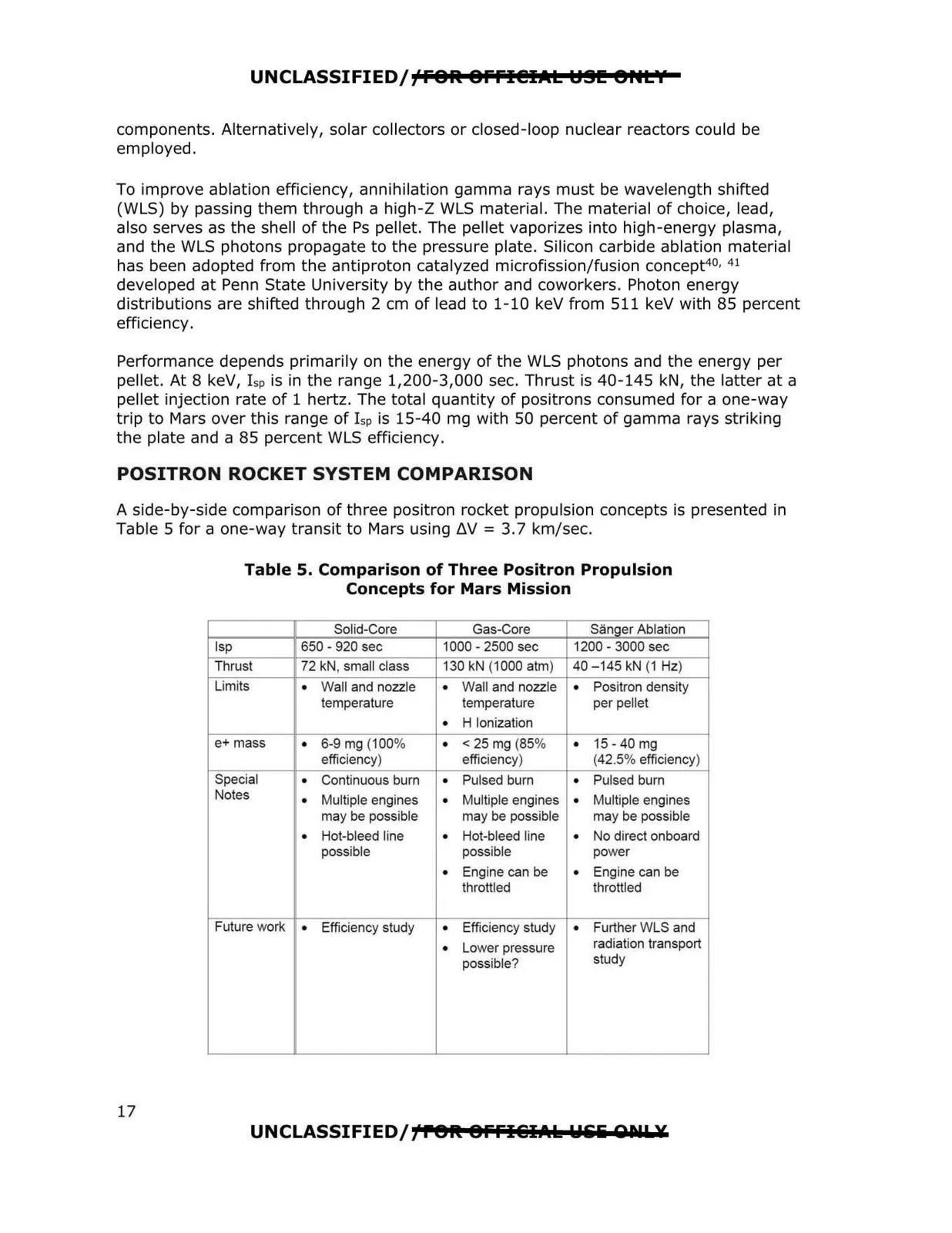
A side-by-side comparison of three positron rocket propulsion concepts is presented in
Table 5 for a one-way transit to Mars using t:N = 3. 7 km/sec.
Table 5. Comparison of Three Positron Propulsion
Concepts for Mars Mission
Solid-Core
Gas-Core
Sanger Ablation
lsp
650 - 920 sec
1000 - 2500 sec
1200 - 3000 sec
Thrust
72 kN , small class
130 kN (1000 aim)
40 -145 kN (1 Hz)
Limits
• Wall and nozzle
temperature
• Wall and nozzle
temperature
• H Ionization
• Positron density
per pellet
e+ mass
• 6-9 mg (100%
efficiency)
• < 25 mg (85%
efficiency)
• 15 - 40 mg
(42.5% efficiency)
Special
• Continuous burn
• Pulsed burn
• Pulsed burn
Notes
• Multiple engines
may be possible
• Hot-bleed line
possible
• Multiple engines
may be possible
• Hot-bleed line
possible
• Engine can be
throttled
• Multiple engines
may be possible
• No direct onboard
power
• Engine can be
throttled
Future work • Efficiency study
• Efficiency study
• Lower pressure
possible?
• Further WLS and
radiation transport
study
UNCLASSIFIED/;'rett 8FFI&IAk Uiili ODIL¥
17