AAWSAP DIRD, Positron Aerospace Propulsion, March 2010
DOW-UAP-D123 · page 25 of 35
Text
This text came with the file. It may have mistakes. When the text and the image disagree, the image is right.
••
••
UNCLASSIFIED/}FOA OFFI€1Ak Wlilii ONkY
Benefits of using positrons for a Mars mission include:
•
The "disposable /:i.V" used to propel TMI stages into low-probability Earth or Mars
intercepts can be eliminated, reducing total propellant mass.
•
Reduction in shielding and engine mass give lower initial mass low Earth orbit for
launch vehicles or faster transits for piloted missions.
•
The ERV uses a positron engine instead of LOX/CH4. This gives significant mass
savings or an equivalent reduction in Mars-to-Earth return time for astronauts.
•
The improvement in l sp translates to either a reduced launch payload mass for cargo
missions or reduced transit times for piloted missions to Mars.
•
More chemical propellant can be stored on the lander to improve aerobraking or
landing strategies that reduce hazards for astronauts.
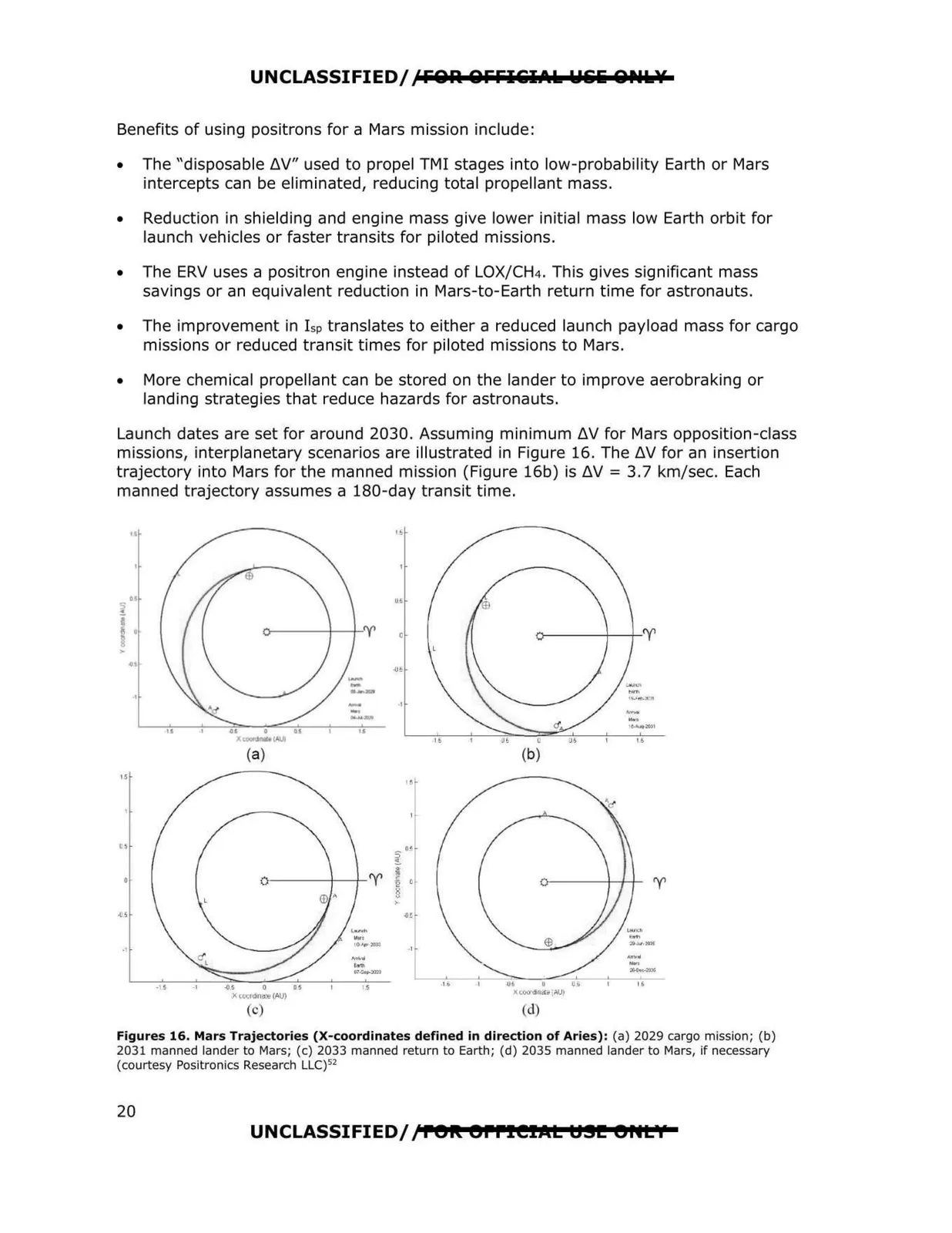
Launch dates are set for around 2030. Assuming minimum !:i.V for Mars opposition-class
missions, interplanetary scenarios are illustrated in Figure 16. The !:i.V for an insertion
trajectory into Mars for the manned mission (Figure 16b) is !:i.V = 3.7 km/sec. Each
manned trajectory assumes a 180-day transit time .
,.•
i
C
I •
.ue
'Y'
IS
"
-CS
(a)
(b)
"
..
i
~
n------+-1-'Y'
,a
0
§
>
-ts
-1
--GS
O
VS
15
)C tOCH k lO!e (P,U)
(c)
(d)
Figures 16. Mars Trajectories (X-coordinates defined in direction of Aries): (a) 2029 cargo mission; (b)
2031 manned lander to Mars; (c) 2033 manned return to Earth; (d) 2035 manned lander to Mars, if necessary
(courtesy Positronics Research LLC) 52
UNCLASSIFIED/ /FOR. orr1e1J1tt U.!I!! or~t I
20