AAWSAP DIRD, Positron Aerospace Propulsion, March 2010
DOW-UAP-D123 · page 26 of 35
Text
This text came with the file. It may have mistakes. When the text and the image disagree, the image is right.
UNCLASSIFIED/; FOR OFFICl"L U.!I! er•tY
The Mars reference mission53 , 54 considered payload masses of 60,000 kg for 2015
missions. This can be reduced to 45,000 kg assuming technological advances by 2031
with a complete interplanetary spacecraft mass of 90,000 kg.
In summary, the mission scenario for a positron spacecraft is similar to that for existing
studies, but with the use of less costly launch vehicles. Every 778 days, two 45,000-kg
payloads are launched from Earth using a Saturn V or equivalent chemical rocket. One
payload is the unmanned system or manned crew lander sent to Mars; the other
contains the positron propulsion system and the propellant tank. They are assembled as
a complete unit in LEO.
Unmanned systems are launched in advance of the crewed system in order to ensure
that the Martian habitat is well established. The crew arrives at Mars in late 2033,
performs research for 1 year, and then returns home in a smaller positron spacecraft
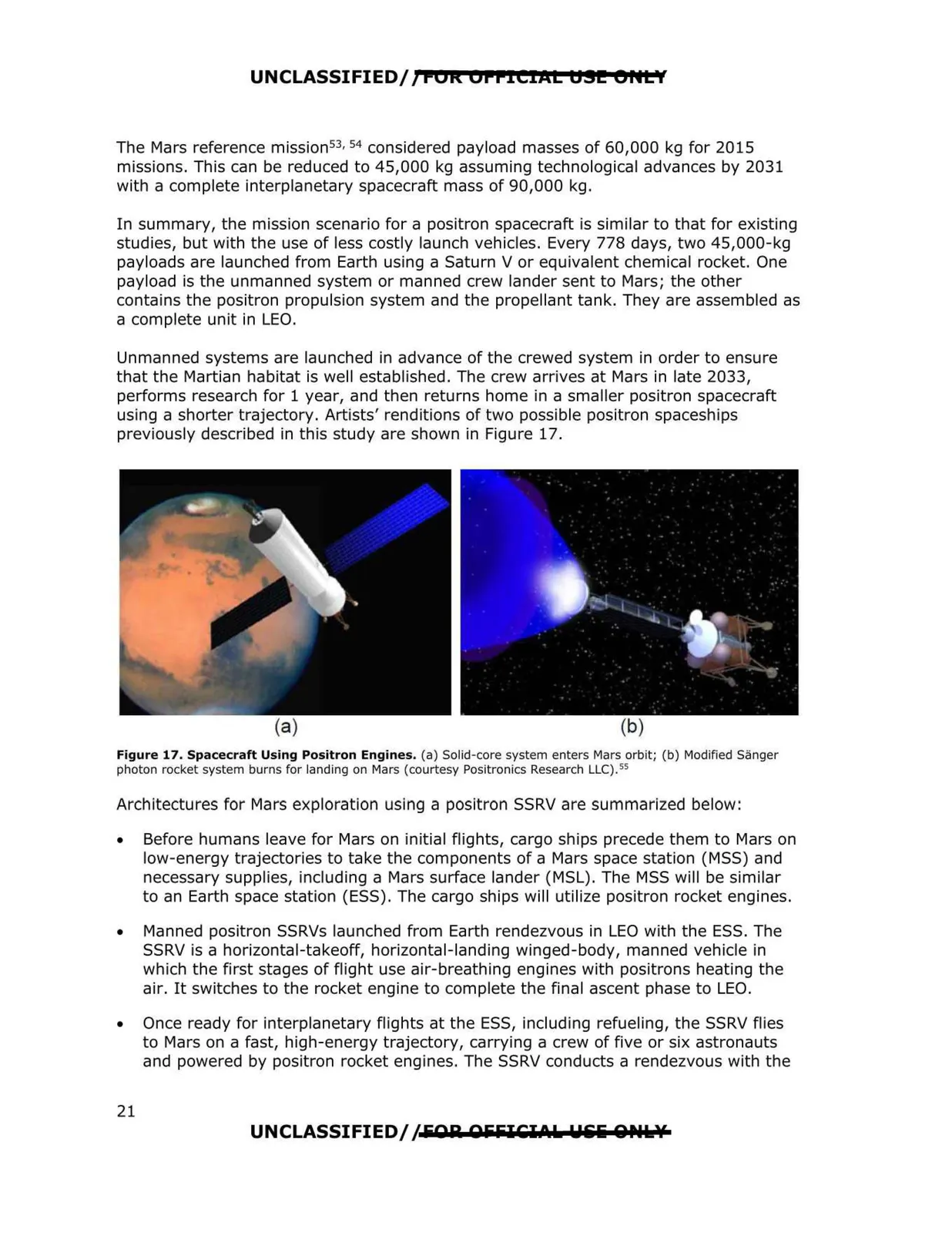
using a shorter trajectory. Artists' renditions of two possible positron spaceships
previously described in this study are shown in Figure 17.
(a)
(b)
Figure 17. Spacecraft Using Positron Engines. (a) Solid-core system enters Mars orbit; (b) Modified Sanger
photon rocket system burns for landing on Mars (courtesy Positronics Research LLC).55
Architectures for Mars exploration using a positron SSRV are summarized below:
•
Before humans leave for Mars on initial flights, cargo ships precede them to Mars on
low-energy trajectories to take the components of a Mars space station (MSS) and
necessary supplies, including a Mars surface lander (MSL). The MSS will be similar
to an Earth space station (ESS). The cargo ships will utilize positron rocket engines.
•
Manned positron SSRVs launched from Earth rendezvous in LEO with the ESS. The
SSRV is a horizontal-takeoff, horizontal-landing winged-body, manned vehicle in
which the first stages of flight use air-breathing engines with positrons heating the
air. It switches to the rocket engine to complete the final ascent phase to LEO.
•
Once ready for interplanetary flights at the ESS, including refueling, the SSRV flies
to Mars on a fast, high-energy trajectory, carrying a crew of five or six astronauts
and powered by positron rocket engines. The SSRV conducts a rendezvous with the
UNCLASSIFIED/ /FAA: AfiEICllL. Uiliii 0,.111¥
21