AAWSAP DIRD, Positron Aerospace Propulsion, March 2010
DOW-UAP-D123 · page 28 of 35
Text
This text came with the file. It may have mistakes. When the text and the image disagree, the image is right.
UNCLASSIFIED/fFOA OFFIEIAL U&li QNkY
Assuming that 1016 positrons/sec can be realized in the next 10 years, then 150
micrograms could be produced in 6 months to enable a globe-encircling flight of a small
air-breathing turbojet UAV as discussed earlier.
Positron Costs
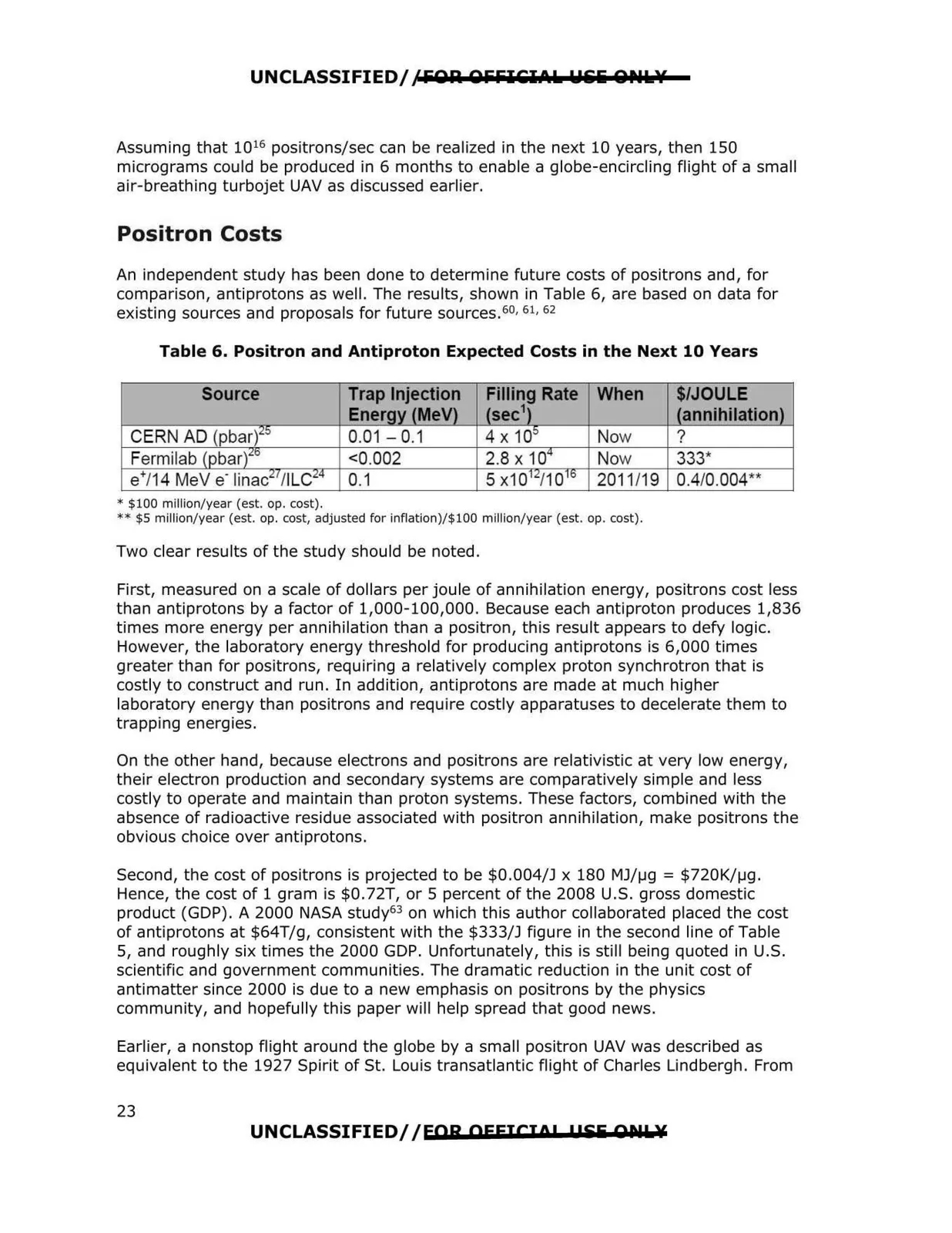
An independent study has been done to determine future costs of positrons and, for
comparison, antiprotons as well. The results, shown in Table 6, are based on data for
existing sources and proposals for future sources. 60, 61, 62
Table 6. Positron and Antiproton Expected Costs in the Next 10 Years
Source
CERNA
Fermilab
Trap Injection
Ener
0.01 - 0.1
<0.002
0.1
Filling Rate
sec1
4 X 10
2.8 X 10
When
Now
Now
2011 /1 9
$/JOULE
annihilation
?
333*
0.4/0.004**
* $100 million/year (est. op. cost).
** $5 million/year (est. op. cost, adjusted for inflation)/$100 million/year (est. op. cost).
Two clear results of the study should be noted .
First, measured on a scale of dollars per joule of annihilation energy, positrons cost less
than antiprotons by a factor of 1,000-100,000. Because each antiproton produces 1,836
times more energy per annihilation than a positron, this result appears to defy logic.
However, the laboratory energy threshold for producing antiprotons is 6,000 times
greater than for positrons, requiring a relatively complex proton synchrotron that is
costly to construct and run. In addition, antiprotons are made at much higher
laboratory energy than positrons and require costly apparatuses to decelerate them to
trapping energies.
On the other hand, because electrons and positrons are relativistic at very low energy,
their electron production and secondary systems are comparatively simple and less
costly to operate and maintain than proton systems. These factors, combined with the
absence of radioactive residue associated with positron annihilation, make positrons the
obvious choice over antiprotons.
Second, the cost of positrons is projected to be $0 .004/J x 180 MJ/µg = $720K/µg.
Hence, the cost of 1 gram is $0 .72T, or 5 percent of the 2008 U.S. gross domestic
product (GDP). A 2000 NASA study63 on which this author collaborated placed the cost
of antiprotons at $64T/g, consistent with the $333/J figure in the second line of Table
5, and roughly six times the 2000 GDP. Unfortunately, this is still being quoted in U.S.
scientific and government communities. The dramatic reduction in the unit cost of
antimatter since 2000 is due to a new emphasis on positrons by the physics
community, and hopefully this paper will help spread that good news.
Earlier, a nonstop flight around the globe by a small positron UAV was described as
equivalent to the 1927 Spirit of St. Louis transatlantic flight of Charles Lindbergh. From
UNCLASSIFIED//EAR OEEJCJO! 1!Sli ODIL¥
23