AAWSAP DIRD, Positron Aerospace Propulsion, March 2010
DOW-UAP-D123 · page 27 of 35
Text
This text came with the file. It may have mistakes. When the text and the image disagree, the image is right.
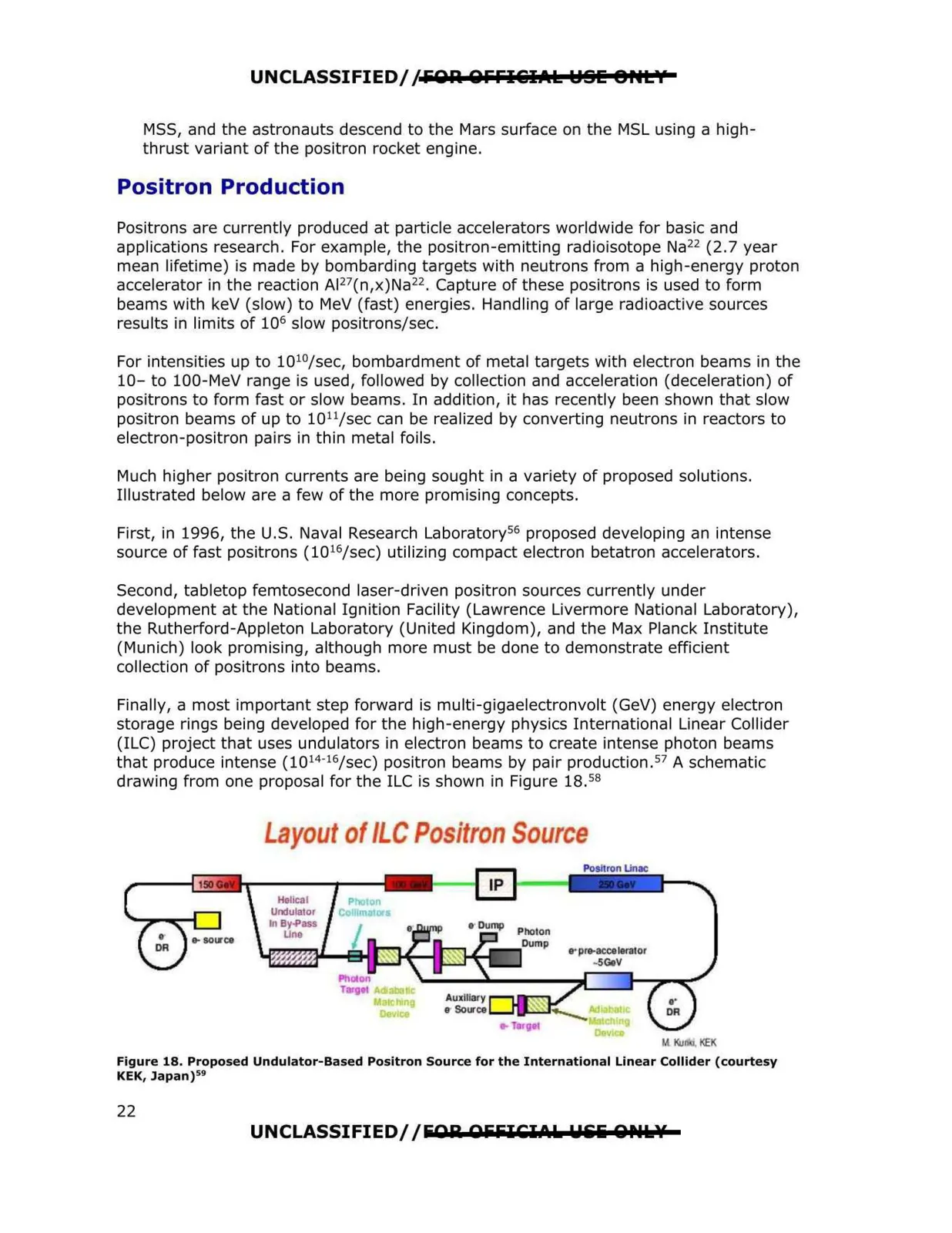
UNCLASSIFIED//FOA OFFl&IAk YSIE 8HL'I MSS, and the astronauts descend to the Mars surface on the MSL using a high thrust variant of the positron rocket engine. Positron Production Positrons are currently produced at particle accelerators worldwide for basic and applications research. For example, the positron-emitting radioisotope Na22 (2. 7 year mean lifetime) is made by bombarding targets with neutrons from a high-energy proton accelerator in the reaction Al 27(n,x)Na22 . Capture of these positrons is used to form beams with keV (slow) to MeV (fast) energies. Handling of large radioactive sources results in limits of 106 slow positrons/sec. For intensities up to 1010/sec, bombardment of metal targets with electron beams in the 10- to 100-MeV range is used, followed by collection and acceleration (deceleration) of positrons to form fast or slow beams. In addition, it has recently been shown that slow positron beams of up to 1011/sec can be realized by converting neutrons in reactors to electron-positron pairs in thin metal foils. Much higher positron currents are being sought in a variety of proposed solutions. Illustrated below are a few of the more promising concepts. First, in 1996, the U.S. Naval Research Laboratory56 proposed developing an intense source of fast positrons ( 1016/sec) utilizing compact electron betatron accelerators. Second, tabletop femtosecond laser-driven positron sources currently under development at the National Ignition Facility (Lawrence Livermore National Laboratory), the Rutherford-Appleton Laboratory (United Kingdom), and the Max Planck Institute (Munich) look promising, although more must be done to demonstrate efficient collection of positrons into beams. Finally, a most important step forward is multi-gigaelectronvolt (GeV) energy electron storage rings being developed for the high-energy physics International Linear Collider (ILC) project that uses undulators in electron beams to create intense photon beams that produce intense (10 14•16/sec) positron beams by pair production. 57 A schematic drawing from one proposal for the ILC is shown in Figure 18.58 Layout of /LC Positron Source Hollcal Undulot0r In By.P s Una M. Ku KEK Figure 18. Proposed Undulator-Based Positron Source for the International Linear Collider (courtesy KEK, Japan) 59 UNCLASSIFIED/ /iiOlil OFFICIO~ U&li QN .. ¥ 22