AAWSAP DIRD, Positron Aerospace Propulsion, March 2010
DOW-UAP-D123 · page 30 of 35
Text
This text came with the file. It may have mistakes. When the text and the image disagree, the image is right.
UNCLASSIFIED/J'FOR OFFI@IAl W&lii 9PU.Y
either space charge or magnetic energy considerations, the storage limit is tens of
picograms, 7-8 orders of magnitude short of 100 micrograms, where practical uses of
positrons begin to emerge, as illustrated earlier.
The second approach is confinement of neutral Ps atoms in manufactured porous media
of either regular lattices of atoms, such as polymers, or irregular strands of insulator
material encapsulating voids, such as silica aerogel. 69, 70 Regardless of void size, Ps
atoms ultimately annihilate with electrons attached to atoms on the boundaries of voids
by the so-called "pickoff" process. Therefore, large, observable lifetimes require
materials with extraordinarily large voids.
FORMATION OF POSITRONIUM IN POROUS MEDIA
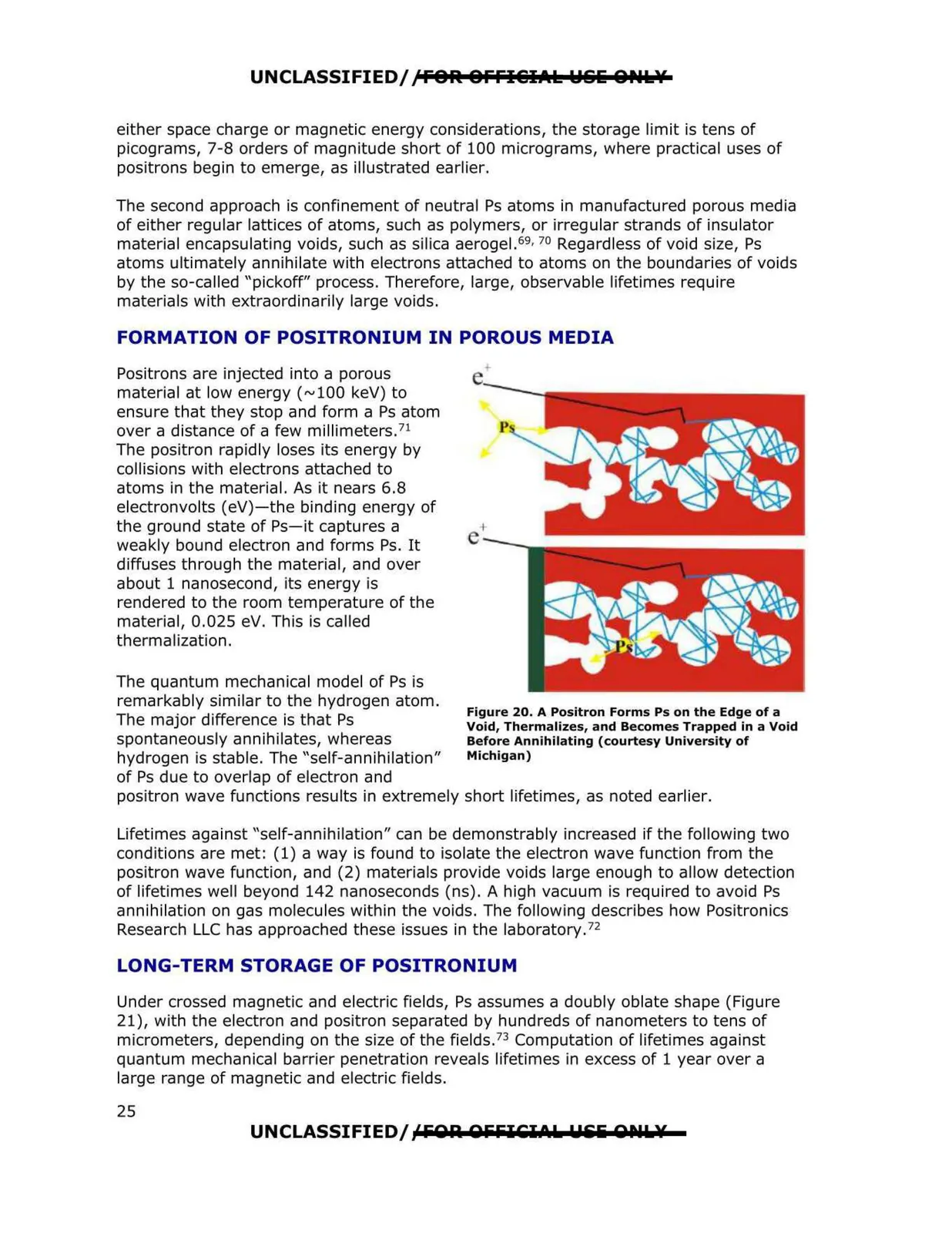
Positrons are injected into a porous
material at low energy (~100 keV) to
ensure that they stop and form a Ps atom
over a distance of a few millimeters. 71
The positron rapidly loses its energy by
collisions with electrons attached to
atoms in the material. As it nears 6.8
electronvolts (eV)-the binding energy of
the ground state of Ps-it captures a
weakly bound electron and forms Ps. It
diffuses through the material, and over
about 1 nanosecond, its energy is
rendered to the room temperature of the
material, 0.025 eV. This is called
thermalization.
The quantum mechanical model of Psis
remarkably similar to the hydrogen atom.
The major difference is that Ps
spontaneously annihilates, whereas
hydrogen is stable. The "self-annihilation"
of Ps due to overlap of electron and
positron wave functions results in extremely short lifetimes, as noted earlier.
Lifetimes against "self-annihilation" can be demonstrably increased if the following two
conditions are met: (1) a way is found to isolate the electron wave function from the
positron wave function, and (2) materials provide voids large enough to allow detection
of lifetimes well beyond 142 nanoseconds (ns). A high vacuum is required to avoid Ps
annihilation on gas molecules within the voids. The following describes how Positronics
Research LLC has approached these issues in the laboratory. 72
LONG-TERM STORAGE OF POSITRONIUM
Under crossed magnetic and electric fields, Ps assumes a doubly oblate shape (Figure
21), with the electron and positron separated by hundreds of nanometers to tens of
micrometers, depending on the size of the fields.73 Computation of lifetimes against
quantum mechanical barrier penetration reveals lifetimes in excess of 1 year over a
large range of magnetic and electric fields.
UNCLASSIFIED/,<FOA OFFICI t L !l&li 0PIL¥
Figure 20. A Positron Forms Ps on the Edge of a
Void, Thermalizes, and Becomes Trapped in a Void
Before Annihilating (courtesy University of
Michigan)
25