AAWSAP DIRD, Positron Aerospace Propulsion, March 2010
DOW-UAP-D123 · page 31 of 35
Text
This text came with the file. It may have mistakes. When the text and the image disagree, the image is right.
8
'1 00
000
o
-
0
2 I .u.)
UNCLASSIFIED/?FOR. OPPl@IAL YSI: e ..tv
Lifetime shortening owing to cyclotron
extremely low density and excellent
thermal insulating properties. It is
composed of strands of SiO2 (silica)
grains suspended in a gel that has been
dried and expanded by injection of gases
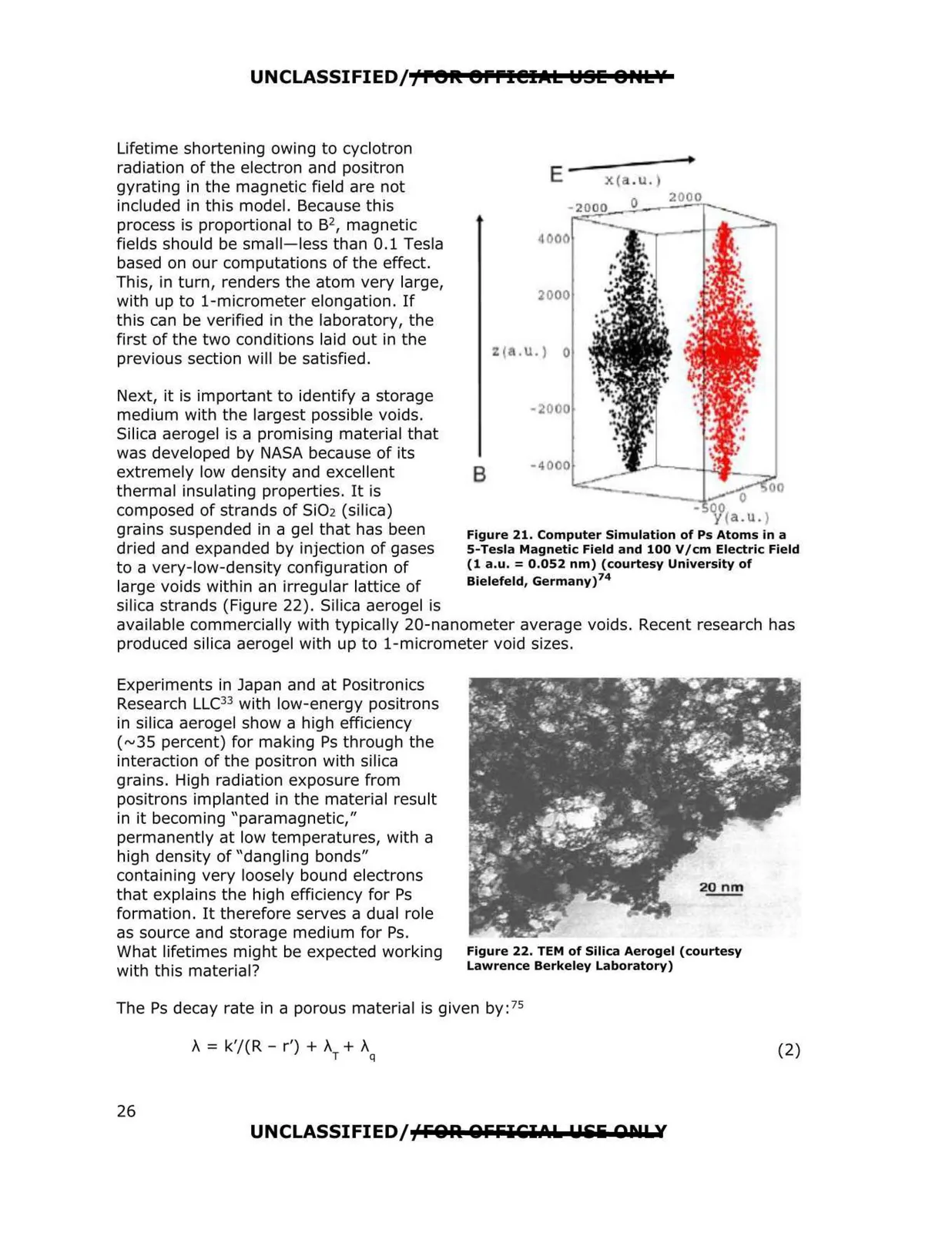
5-Tesla Magnetic Field and 100 V/ cm Electric Field
(1 a.u. = 0.052 nm) {courtesy University of
to a very-low-density configuration of
Bielefeld, Germany)74
large voids within an irregular lattice of
silica strands (Figure 22). Silica aerogel is
available commercially with typically 20-nanometer average voids. Recent research has
produced silica aerogel with up to 1-micrometer void sizes.
Experiments in Japan and at Positronics
Research LLC33 with low-energy positrons
in silica aerogel show a high efficiency
(~35 percent) for making Ps through the
interaction of the positron with silica
grains. High radiation exposure from
positrons implanted in the material result
in it becoming "paramagnetic,"
permanently at low temperatures, with a
high density of "dangling bonds"
containing very loosely bound electrons
that explains the high efficiency for Ps
formation. It therefore serves a dual role
as source and storage medium for Ps.
What lifetimes might be expected working
Figure 22. TEM of Silica Aerogel {courtesy
with this material?
Lawrence Berkeley Laboratory)
The Ps decay rate in a porous material is given by: 75
'A = k'/(R - r') + 'A + 11
T
q
(2)
Figure 21. Computer Simulation of Ps Atoms in a
radiation of the electron and positron
gyrating in the magnetic field are not
included in this model. Because this
process is proportional to B2, magnetic
fields should be small-less than 0.1 Tesla
based on our computations of the effect.
This, in turn, renders the atom very large,
with up to 1-micrometer elongation. If
this can be verified in the laboratory, the
first of the two conditions laid out in the
previous section will be satisfied.
Next, it is important to identify a storage
medium with the largest possible voids.
Silica aerogel is a promising material that
was developed by NASA because of its
E
X( .u.
2000
UNCLASSIFIED/fFOA QFFICIOls. H&'li Qlslls.\'
26