AAWSAP DIRD, Space Access: Where We’ve Been and Where We Could Go, March 2010
DOW-UAP-D124 · page 10 of 56
Text
This text came with the file. It may have mistakes. When the text and the image disagree, the image is right.
--
UNCLASSIFIED//FOR OFFl@IAL l::l!H! 8HL'I
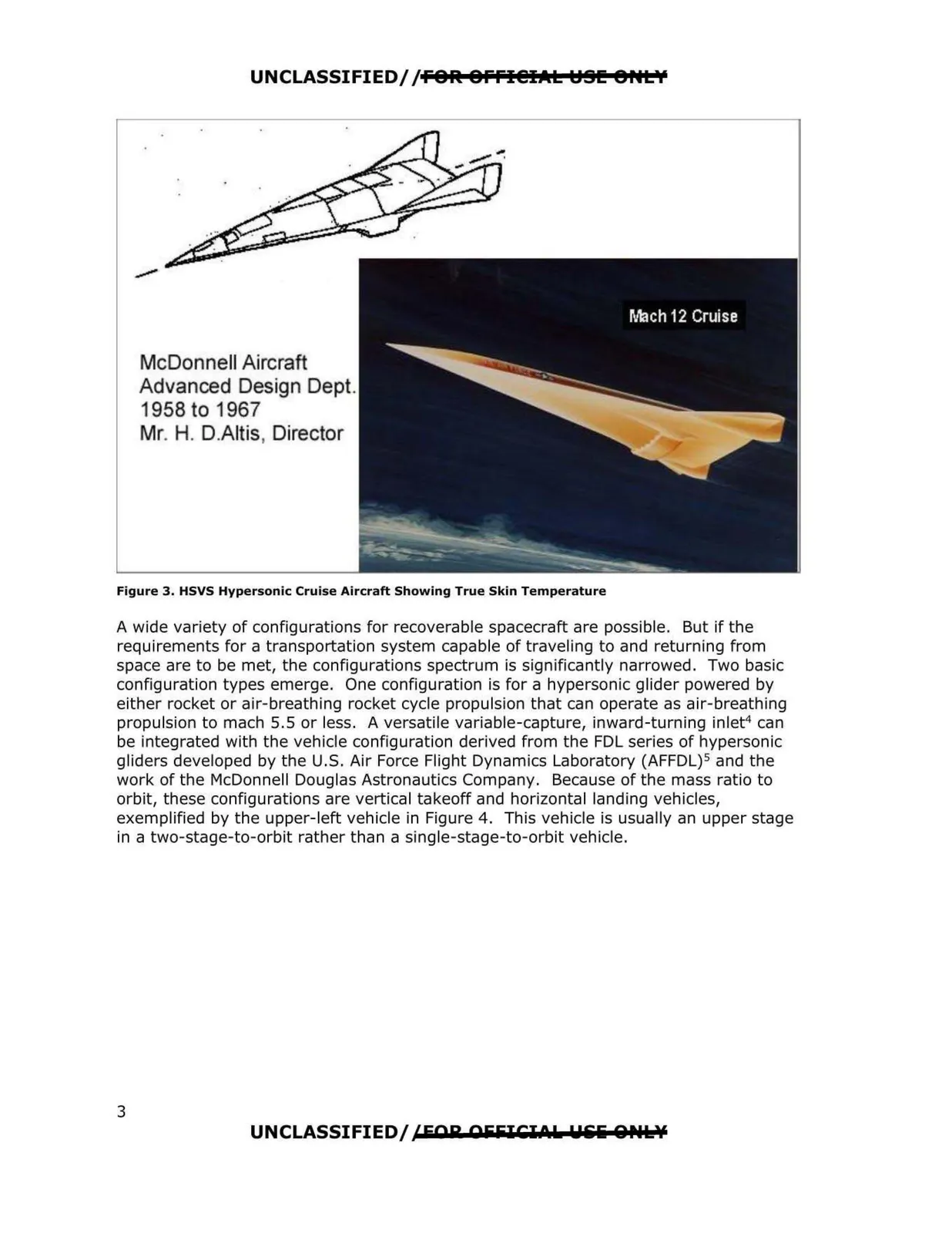
McDonnell Aircraft
Advanced Design Dept.
1958 to 1967
Mr. H. D.Altis, Director
Figure 3. HSVS Hypersonic Cruise Aircraft Showing True Skin Temperature
A wide variety of configurations for recoverable spacecraft are possible. But if the
requirements for a transportation system capable of traveling to and returning from
space are to be met, the configurations spectrum is significantly narrowed. Two basic
configuration types emerge. One configuration is for a hypersonic glider powered by
either rocket or air-breathing rocket cycle propulsion that can operate as air-breathing
propulsion to mach 5.5 or less. A versatile variable-capture, inward-turning inlet4 can
be integrated with the vehicle configuration derived from the FDL series of hypersonic
gliders developed by the U.S. Air Force Flight Dynamics Laboratory (AFFDL) 5 and the
work of the McDonnell Douglas Astronautics Company. Because of the mass ratio to
orbit, these configurations are vertical takeoff and horizontal landing vehicles,
exemplified by the upper-left vehicle in Figure 4. This vehicle is usually an upper stage
in a two-stage-to-orbit rather than a single-stage-to-orbit vehicle.
UNCLASSIFIED//EAR OFFICIO I. Uiliii 0PUi!lf
3