AAWSAP DIRD, Space Access: Where We’ve Been and Where We Could Go, March 2010
DOW-UAP-D124 · page 17 of 56
Text
This text came with the file. It may have mistakes. When the text and the image disagree, the image is right.
UNCLASSIFIED//FOR OFFI@IAL l:ISE OHL¥
goal was to be able to recover the spacecraft at any airport in CONUS, to eliminate the
need for an overseas recovery site, and to eliminate the waiting required until a lower
L/D ratio could land in CONUS (up to 14 orbits for the Apollo capsule, or 21 hours). In
an emergency, that may be too long. The AFFDL's goal for the spacecraft to support
the Manned Orbiting Laboratory was no waiting but to be able to reach CONUS from
any arbitrary MOL position in its orbit. This was considered possible in the 1964-65
briefs to the government with respect to MOL, specifically the Model 176 configuration
the MDC proposed for the MOL support in 1964.
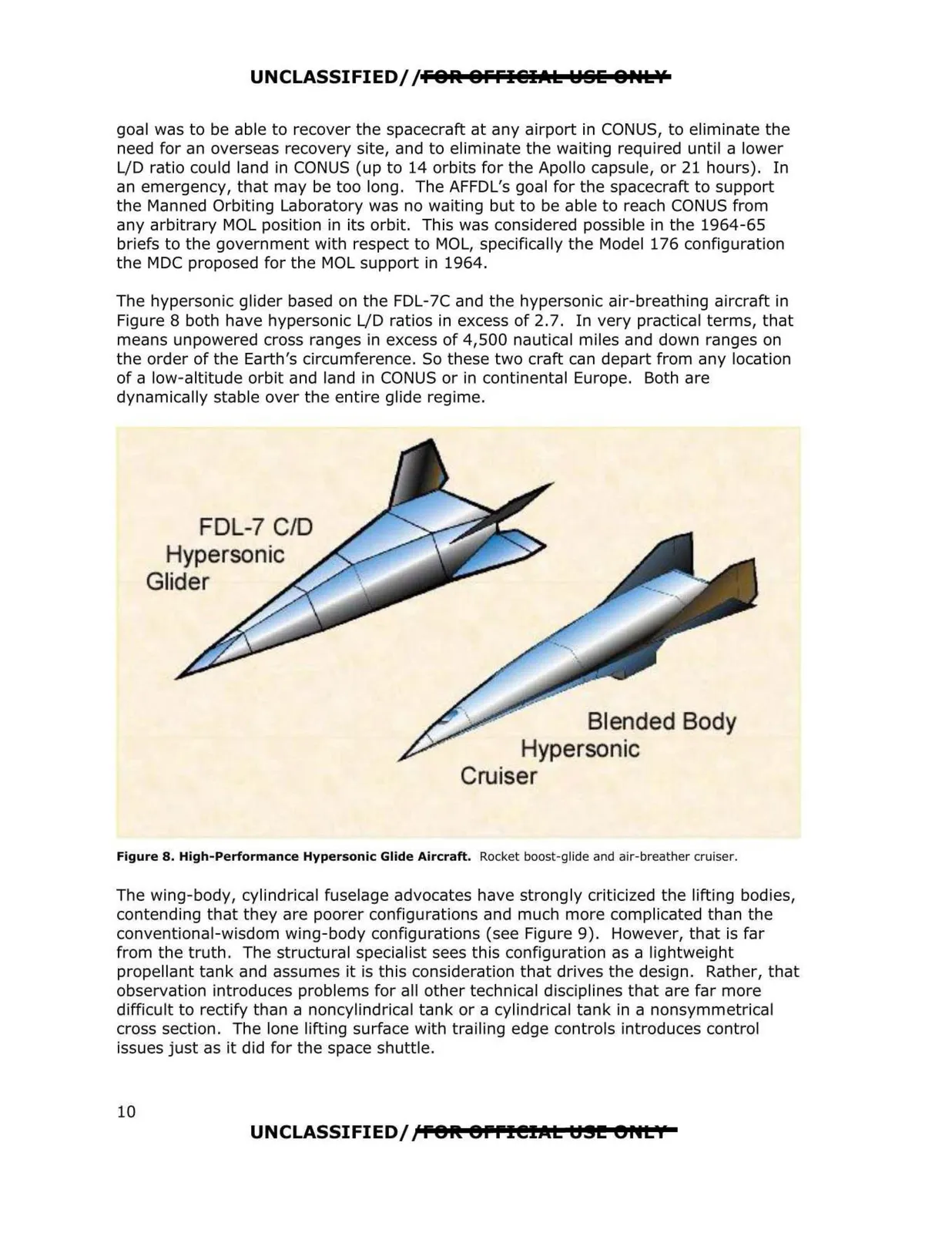
The hypersonic glider based on the FDL-7C and the hypersonic air-breathing aircraft in
Figure 8 both have hypersonic L/D ratios in excess of 2.7. In very practical terms, that
means unpowered cross ranges in excess of 4,500 nautical miles and down ranges on
the order of the Earth's circumference. So these two craft can depart from any location
of a low-altitude orbit and land in CONUS or in continental Europe. Both are
dynamically stable over the entire glide regime.
FDL-7 CID
Hypersonic
Glider
Blended Body
Hypersonic
Cruiser
Figure 8. High-Performance Hypersonic Glide Aircraft. Rocket boost-glide and air-breather cruiser.
The wing-body, cylindrical fuselage advocates have strongly criticized the lifting bodies,
contending that they are poorer configurations and much more complicated than the
conventional-wisdom wing-body configurations (see Figure 9). However, that is far
from the truth . The structural specialist sees this configuration as a lightweight
propellant tank and assumes it is this consideration that drives the design. Rather, that
observation introduces problems for all other technical disciplines that are far more
difficult to rectify than a noncylindrical tank or a cylindrical tank in a nonsymmetrical
cross section. The lone lifting surface with trailing edge controls introduces control
issues just as it did for the space shuttle.
UNCLASSIFIED/;'POlt err1e1J1tt U.!I!! er~t I
10