AAWSAP DIRD, Space Access: Where We’ve Been and Where We Could Go, March 2010
DOW-UAP-D124 · page 18 of 56
Text
This text came with the file. It may have mistakes. When the text and the image disagree, the image is right.
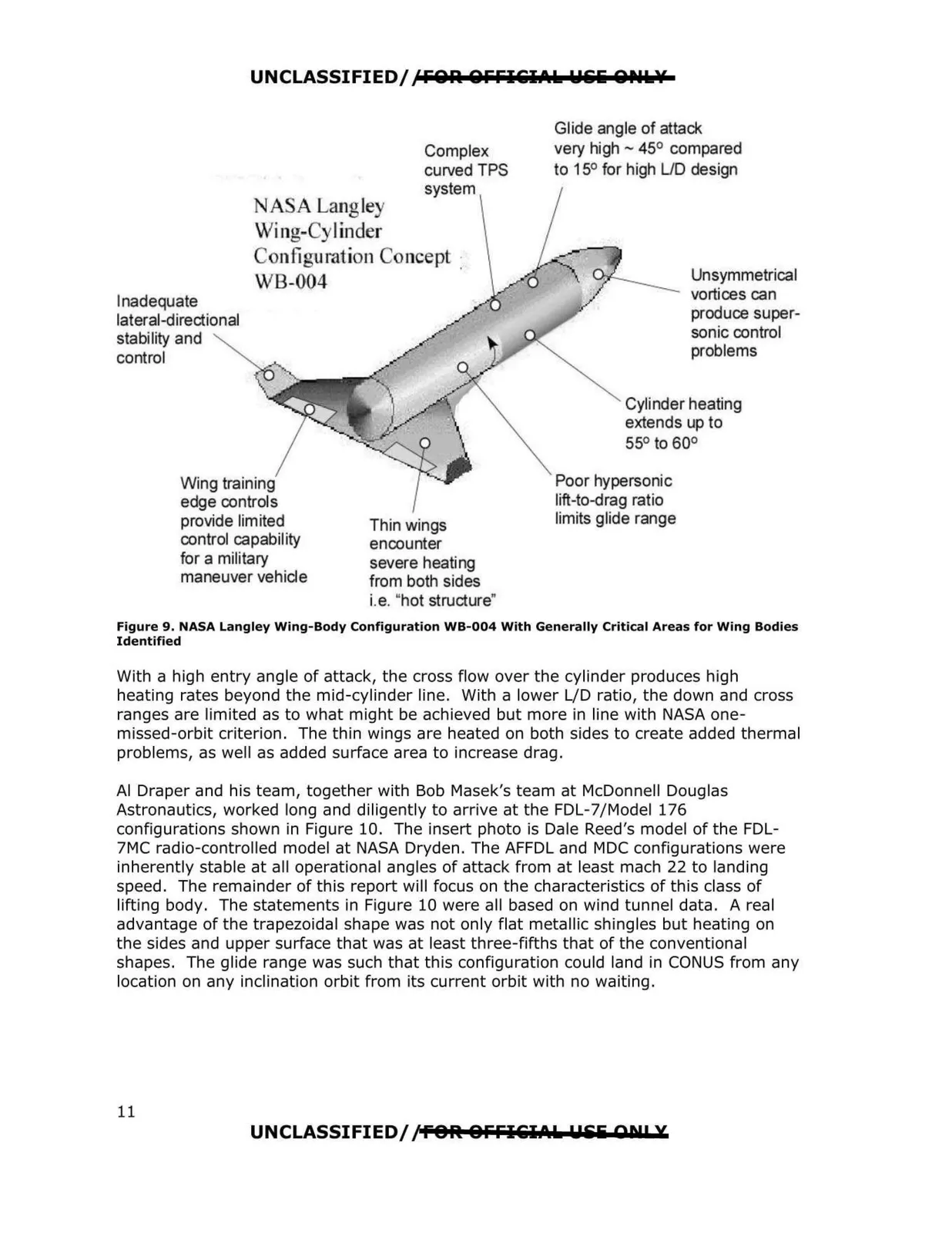
UNCLASSIFIED/fFOA OFFI&iIAk Ulilii ONkY system A ALang l Wing- yl inder nfigu rati n n ep Inadequate lateral-directional stability and control WB-004 Wing training edge control s Unsymmetrical vortices can produce super sonic control problems Cylinder heating extends up to 55° to 60° Poor hypersonic lift-to-drag ratio Glide angle of attack Complex very high ~ 45° compared curved TPS to 15° for high UO design provide limited limits glide range Thin wings control capability encounter for a military severe heating maneuver vehicle from both sides i.e. "hot structure" Figure 9. NASA Langley Wing-Body Configuration WB-004 With Generally Critical Areas for Wing Bodies Identified With a high entry angle of attack, the cross flow over the cylinder produces high heating rates beyond the mid-cylinder line. With a lower L/D ratio, the down and cross ranges are limited as to what might be achieved but more in line with NASA one missed-orbit criterion. The thin wings are heated on both sides to create added thermal problems, as well as added surface area to increase drag. Al Draper and his team, together with Bob Masek's team at McDonnell Douglas Astronautics, worked long and diligently to arrive at the FDL-7 /Model 176 configurations shown in Figure 10. The insert photo is Dale Reed's model of the FDL 7MC radio-controlled model at NASA Dryden. The AFFDL and MDC configurations were inherently stable at all operational angles of attack from at least mach 22 to landing speed. The remainder of this report will focus on the characteristics of t his class of lifting body . The statements in Figu re 10 were all based on wind tunnel data. A real advantage of the trapezoidal shape was not only flat metallic shingles but heating on the sides and upper surface that was at least three-fifths that of the conventional shapes. The glide range was such that this configuration could land in CONUS from any location on any inclination orbit from its current orbit with no waiting. UNCLASSIFIED//fOR OFFI&il.lJ.k 11ilii CNP X 11