AAWSAP DIRD, Space Access: Where We’ve Been and Where We Could Go, March 2010
DOW-UAP-D124 · page 22 of 56
Text
This text came with the file. It may have mistakes. When the text and the image disagree, the image is right.
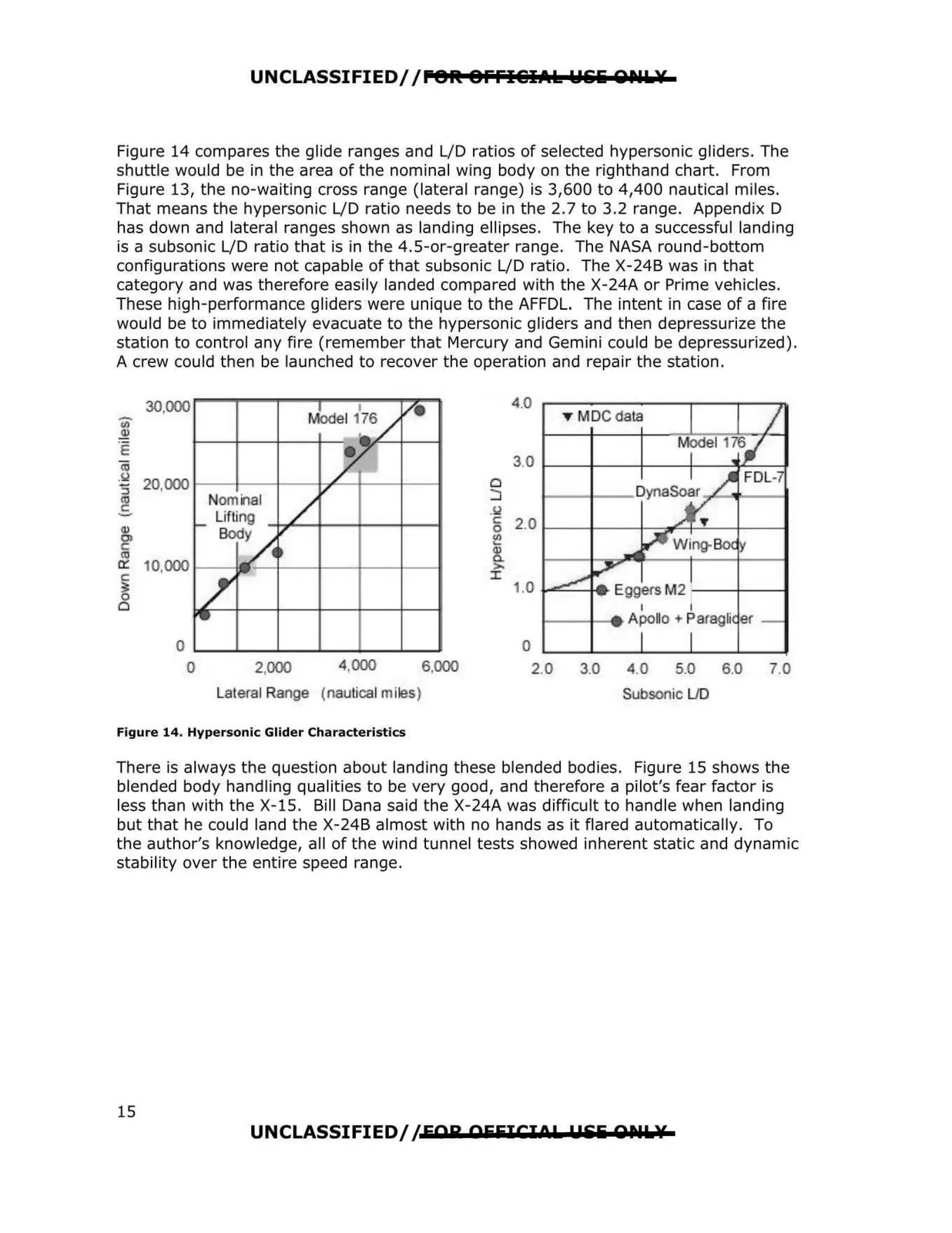
UNCLASSIFIED//POil OFFIEiIAk Ulilii QPIL¥ Figure 14 compares the glide ranges and L/D ratios of selected hypersonic gliders. The shuttle would be in the area of the nominal wing body on the righthand chart. From Figure 13, the no-waiting cross range (lateral range) is 3,600 to 4,400 nautical miles. That means the hypersonic L/D ratio needs to be in the 2.7 to 3.2 range. Appendix D has down and lateral ranges shown as landing ellipses. The key to a successful landing is a subsonic L/D ratio that is in the 4.5-or-greater range. The NASA round-bottom configurations were not capable of that subsonic L/D ratio. The X-24B was in that category and was therefore easily landed compared with the X-24A or Prime vehicles. These high-performance gliders were unique to the AFFDL. The intent in case of a fire would be to immediately evacuate to the hypersonic gliders and then depressurize the station to control any fire (remember that Mercury and Gemini could be depressurized). A crew could then be launched to recover the operation and repair the station. j ·e <O a ::i .S ~ -~ § (I,) ~ ij ~ > o::: I C ei a 30000 •· 20,0CJ0 1----+---+---,..,,...--i1----i1---1 Nominal Lifting Body 10,000 1----1■ --------+-----I 0 .....,___..___.___...___..____..____ 4.0 T MDC data 2.0 t---t----t--:::~ -t-'---+---1 1.0 ~ =--....-. 1----1--- Apollo + Par 0 0 2,000 4,000 6,000 2.0 3.0 4.0 5.0 6.0 7.0 Lateral Ran e (nautical miles) Su sonic UD Figure 14. Hypersonic Glider Characteristics There is always the question about landing these blended bodies. Figure 15 shows the blended body handling qualities to be very good, and therefore a pilot's fear factor is less than with the X-15. Bill Dana said the X-24A was difficult to handle when landing but that he could land the X-24B almost with no hands as it flared automatically. To the author's knowledge, all of the wind tunnel tests showed inherent static and dynamic stability over the entire speed range. UNCLASSIFIED//FOR AEEJCJOL flilii QPIL¥ 15