AAWSAP DIRD, Space Access: Where We’ve Been and Where We Could Go, March 2010
DOW-UAP-D124 · page 23 of 56
Text
This text came with the file. It may have mistakes. When the text and the image disagree, the image is right.
UNCLASSIFIED//P91t 9FFl@IAL YSE 8HLY
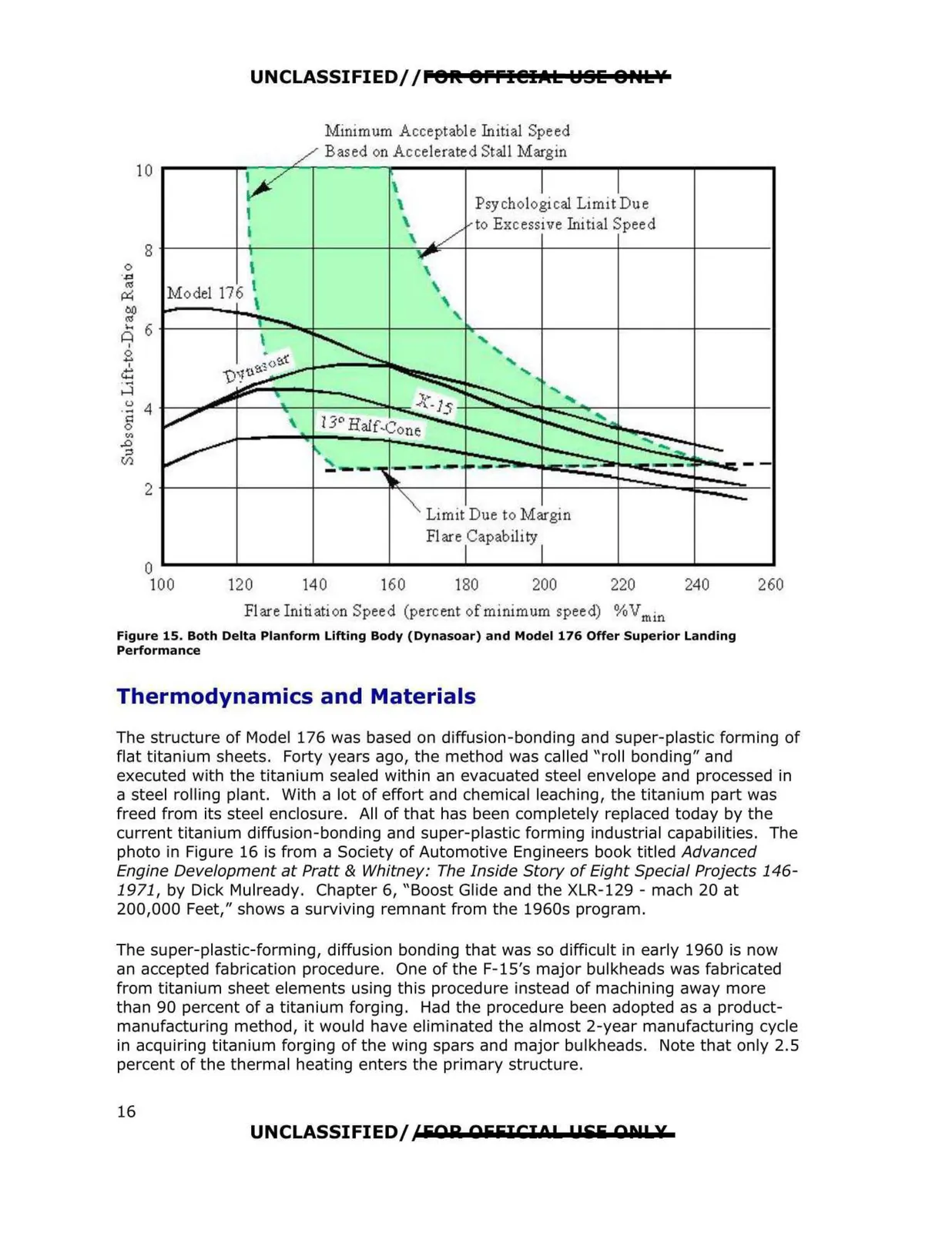
Minim um Acceptable Initial Speed
Based on Accelerated Stall M argin
Psychological LimitDue
to Excessive Initial Speed
Limit Due to Margin
Fl are Capability
0
100
120
140
160
180
200
220
240
260
Fl are Initiation Speed (percent of minimum spee d) %Vmin
Figure 15. Both Delta Planform Lifting Body {Dynasoar) and Model 176 Offer Superior Landing
Performance
Thermodynamics and Materials
The structure of Model 176 was based on diffusion-bonding and super-plastic forming of
flat titanium sheets. Forty years ago, the method was called "roll bonding" and
executed with the titanium sealed within an evacuated steel envelope and processed in
a steel rolling plant. With a lot of effort and chemical leaching, the titanium part was
freed from its steel enclosure. All of that has been completely replaced today by the
current titanium diffusion-bonding and super-plastic forming industrial capabilities. The
photo in Figure 16 is from a Society of Automotive Engineers book titled Advanced
Engine Development at Pratt & Whitney: The Inside Story of Eight Special Projects 146
1971, by Dick Mulready. Chapter 6, "Boost Glide and the XLR-129 - mach 20 at
200,000 Feet," shows a surviving remnant from the 1960s program.
The super-plastic-forming, diffusion bonding that was so difficult in early 1960 is now
an accepted fabrication procedure. One of the F-1 S's major bulkheads was fabricated
from titanium sheet elements using this procedure instead of machining away more
than 90 percent of a titanium forging. Had the procedure been adopted as a product
manufacturing method, it would have eliminated the almost 2-year manufacturing cycle
in acquiring titanium forging of the wing spars and major bulkheads. Note that only 2.5
percent of the thermal heating enters the primary structure.
16
UNCLASSIFIED/ 'EAR AEEJCJOP 1155 All! X
•