AAWSAP DIRD, Space Access: Where We’ve Been and Where We Could Go, March 2010
DOW-UAP-D124 · page 28 of 56
Text
This text came with the file. It may have mistakes. When the text and the image disagree, the image is right.
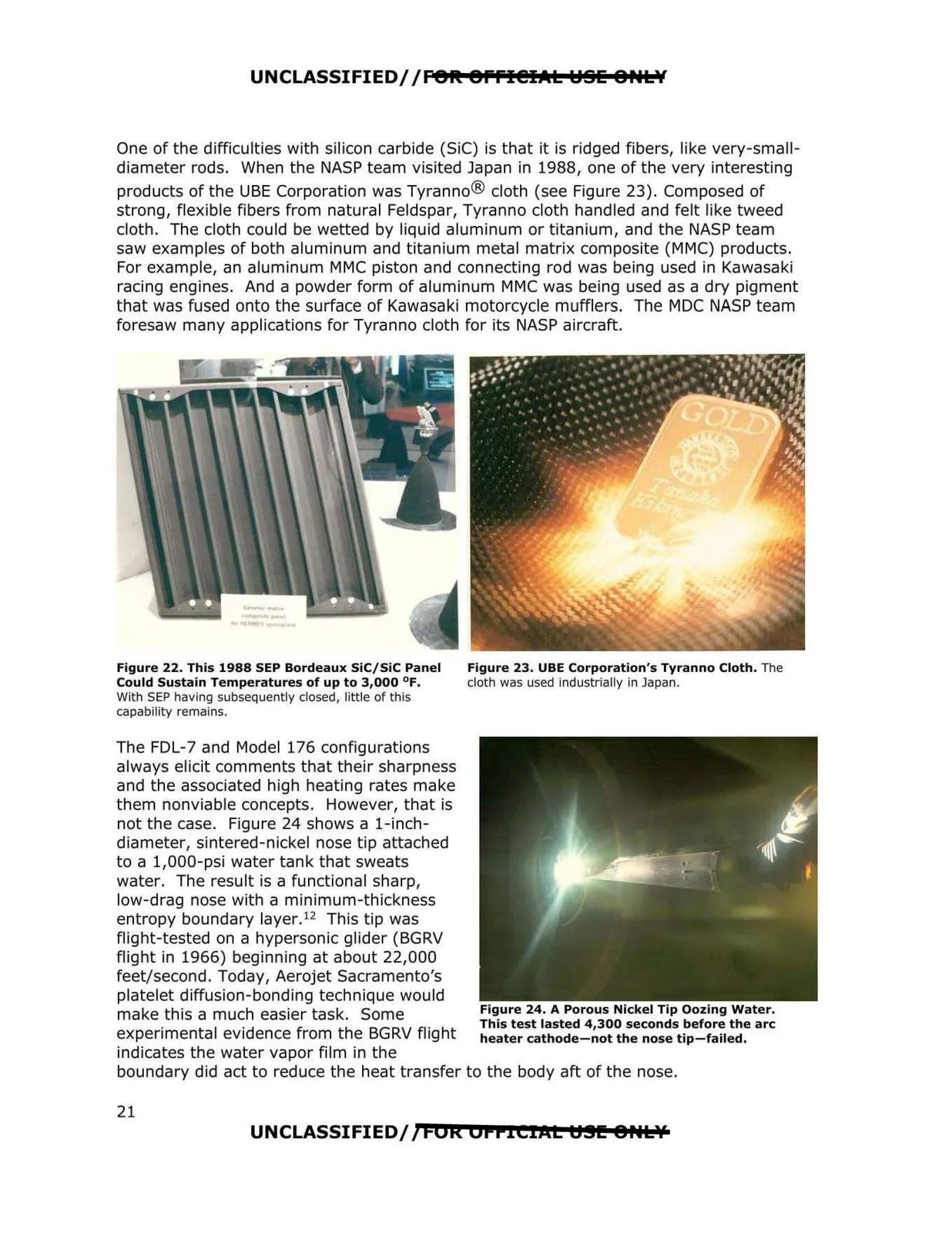
UNCLASSIFIED//f91t OFFl@IAL YSE 8HLY One of the difficulties with silicon carbide (SiC) is that it is ridged fibers, like very-small diameter rods. When the NASP team visited Japan in 1988, one of the very interesting products of the UBE Corporation was Tyranno® cloth (see Figure 23). Composed of strong, flexible fibers from natural Feldspar, Tyranno cloth handled and felt like tweed cloth. The cloth could be wetted by liquid aluminum or titanium, and the NASP team saw examples of both aluminum and titanium metal matrix composite (MMC) products. For example, an aluminum MMC piston and connecting rod was being used in Kawasaki racing engines. And a powder form of aluminum MMC was being used as a dry pigment that was fused onto the surface of Kawasaki motorcycle mufflers. The MDC NASP team foresaw many applications for Tyranno cloth for its NASP aircraft. Figure 22. This 1988 SEP Bordeaux SiC/SiC Panel Figure 23. UBE Corporation's Tyranno Cloth. The Could Sustain Temperatures of up to 3,000 °F. cloth was used industrially in Japan. With SEP having subsequently closed, little of this capability remains. The FDL-7 and Model 176 configurations always elicit comments that their sharpness and the associated high heating rates make them nonviable concepts. However, that is not the case. Figure 24 shows a 1-inch diameter, sintered-nickel nose tip attached to a 1,000-psi water tank that sweats water. The result is a functional sharp, low-drag nose with a minimum-thickness entropy boundary layer. 12 This tip was flight-tested on a hypersonic glider (BGRV flight in 1966) beginning at about 22,000 feet/second . Today, Aerojet Sacramento's platelet diffusion-bonding technique would Figure 24. A Porous Nickel Tip Oozing Water. make this a much easier task. Some This test lasted 4,300 seconds before the arc experimental evidence from the BGRV flight heater cathode-not the nose tip-failed. indicates the water vapor film in the boundary did act to reduce the heat transfer to the body aft of the nose. UNCLASSIFIED/} FOR OFFICiftL tJ9I!!! 8HLY 21