AAWSAP DIRD, Space Access: Where We’ve Been and Where We Could Go, March 2010
DOW-UAP-D124 · page 3 of 56
Text
This text came with the file. It may have mistakes. When the text and the image disagree, the image is right.
UNCLASSIFIED/;'FOR OFFI@IAL l:ISE OHL¥
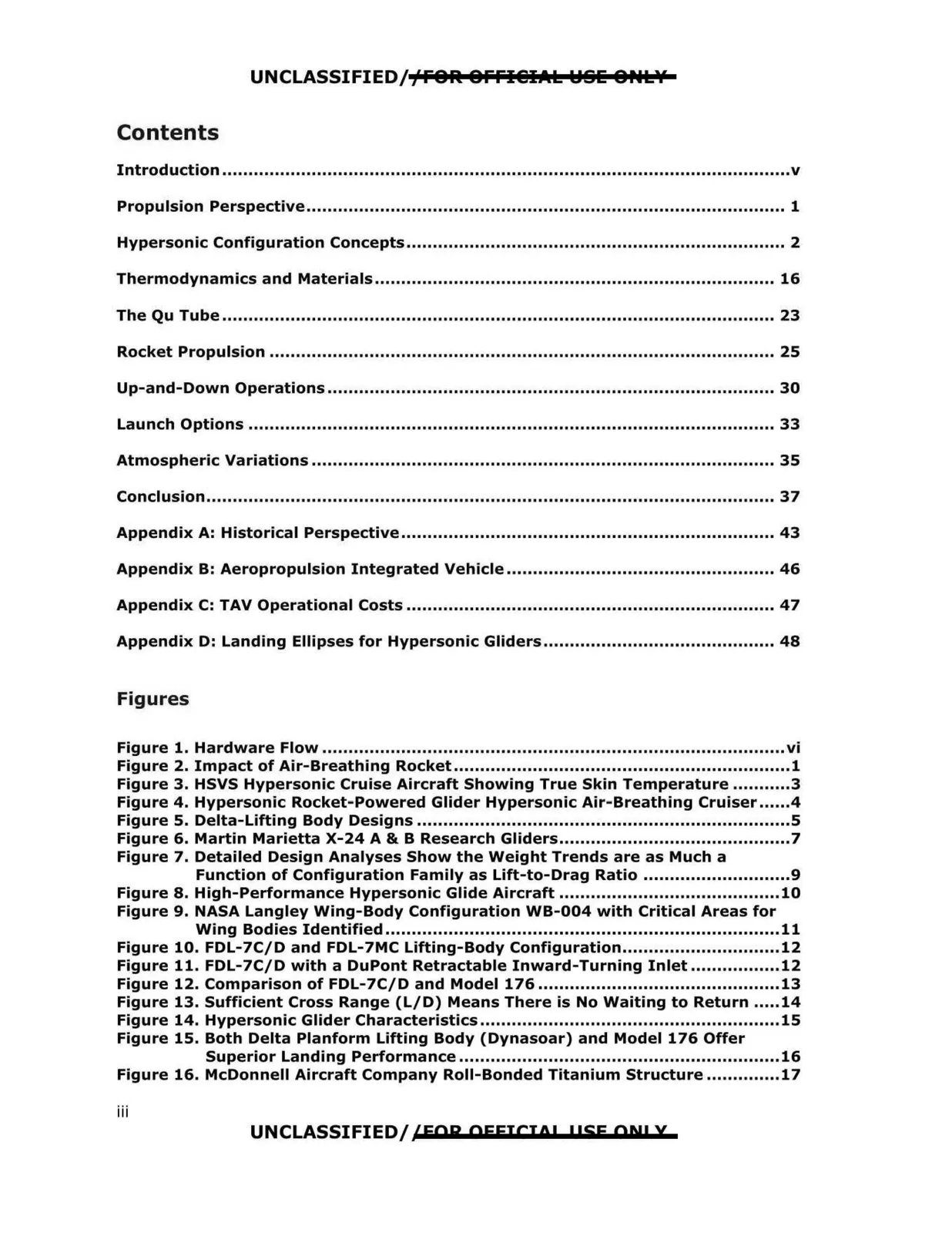
Contents
Introduction ............................................................................................................v
Propulsion Perspective........................................................................................... 1
Hypersonic Configuration Concepts........................................................................ 2
Thermodynamics and Materials ............................................................................ 16
The Qu Tube ......................................................................................................... 23
Rocket Propulsion ................................................................................................ 25
Up-and-Down Operations ..................................................................................... 30
Launch Options .................................................................................................... 33
Atmospheric Variations ........................................................................................ 35
Conclusion............................................................................................................ 37
Appendix A: Historical Perspective ....................................................................... 43
Appendix B: Aeropropulsion Integrated Vehicle ................................................... 46
Appendix C: TAV Operational Costs ...................................................................... 47
Appendix D: Landing Ellipses for Hypersonic Gliders ............................................ 48
Figures
Figure 1. Hardware Flow ........................................................................................vi
Figure 7. Detailed Design Analyses Show the Weight Trends are as Much a
Figure 9. NASA Langley Wing-Body Configuration WB-004 with Critical Areas for
Figure 15. Both Delta Planform Lifting Body (Dynasoar) and Model 176 Offer
Figure 2. Impact of Air-Breathing Rocket ................................................................1
Figure 3. HSVS Hypersonic Cruise Aircraft Showing True Skin Temperature ...........3
Figure 4. Hypersonic Rocket-Powered Glider Hypersonic Air- Breathing Cruiser ......4
Figure 5. Delta-Lifting Body Designs .......................................................................5
Figure 6. Martin Marietta X-24 A & B Research Gliders............................................7
Function of Configuration Family as Lift-to-Drag Ratio ............................9
Figure 8. High-Performance Hypersonic Glide Aircraft ..........................................10
Wing Bodies Identified ...........................................................................11
Figure 10. FDL-7C/D and FDL-7MC Lifting-Body Configuration..............................12
Figure 11. FDL-7C/D with a DuPont Retractable Inward-Turning Inlet .................12
Figure 12. Comparison of FDL-7C/D and Model 176 ..............................................13
Figure 13. Sufficient Cross Range (L/D) Means There is No Waiting to Return ..... 14
Figure 14. Hypersonic Glider Characteristics .........................................................15
Superior Landing Performance .............................................................16
Figure 16. McDonnell Aircraft Company Roll-Bonded Titanium Structure ..............17
UNCLASSIFIED//FOR OFFICIO! 1155 ON! X
iii