AAWSAP DIRD, Space Access: Where We’ve Been and Where We Could Go, March 2010
DOW-UAP-D124 · page 31 of 56
Text
This text came with the file. It may have mistakes. When the text and the image disagree, the image is right.
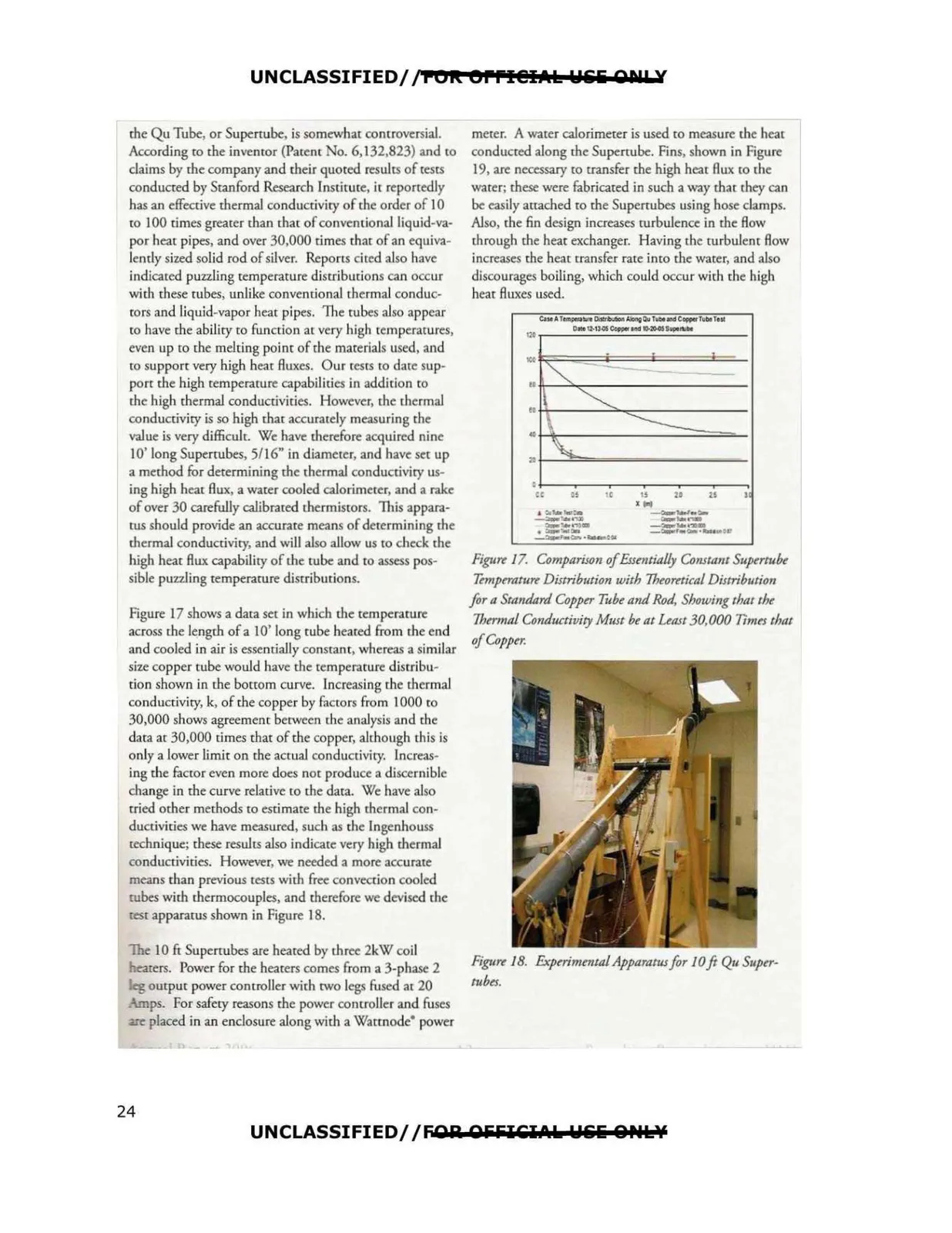
I UNCLASSIFIED/ /POI\ 8PPl@lsTd:. Ulili Otl! Y the u Tube, or uperrube, is somewhat conrrovcrsial. According co the inventor (Patenl o. 6,132,823) and to claims by the company and their quoted rcsul of rescs conducred by ranfurd Research lnslirute, it reportedly has an effective thermal conductivicy of the order of J0 co J00 times grearer than cha ofconventional liquid-va por heat pipes, and over 30,000 tim char fan equiva lemly sized solid rod of silver. Repons cited also have indicated puzzling temperature di tribtttions n. o ur with these rubes unlike conventional thermal condu cor and liquid-vapor heat pip . 11,e tube al o app ar to h ve the ability co function at v ry high re.mperatures, even up ro the melting point of the material used, nd ro supporrvery high heat .Auxes. ur cesrs to dare sup port the high tempera.cure capabilities in addition co the high thermal conductivities. However, the thermal ondu ivity is so high chac accurately measuring the value i very difficult. We have ther fore acquired nine 10' long uperrubes, 5/16" in diameter, and have er up a method for decermining the thermal conductivity us ing high heat flux, a water cooled ca.lorimcte.r, and a rake of over 30 carefully ca.librared thermistor . Thi appara• tus should provide an accurate means ofd rermining the thermal conductivity, and will also allow us 10 1eck the high heat flux capabiliiy of ch rube and co po • ible puzzling rempe.rarure di rributions. Figure 17 shows a data sec in which the ccmpe cure across the length ofa 1O' long cube hear.ed rom the end and cooled in air is essenrially connanr, wh r s similar si.ze copper tube would have the tcmpe cure djsuibu tion shown in the bocrom curve. Increasing the th rmaJ conductivicy, k, of che copper by fuctors fr m I 000 to 30,000 shows agreement becween the analysis and the daca ar 30,000 times chat of the copper, akhough chi is only a lower limit on the actual condu tiviry. Increas ing the fucror even more do s nor produ ea di mibl cllange in the curve relative to the data. We have also tried ocher methods to estimate the high th rmal con ductivities we have measured, such the lngenhouss rechniq_ue; these results also indicate very high th rmal conductivities. However, we needed a more accurate mean than previous tests with free conv ion o led rubes with thermocouples, and therefor d ·sed the rest appararus shown in Figure I . The 10 fr Superrubes are heaced by three 2kW oil rs. Power for the heaters comes from a -ph 2 :\mps. output power concroUer with two I gs fu ed at 20 For saf-ccy reasons the pow r contr0l1cr and fus placed in an endosure along with a Watmode" power meter. A water calorimeter is used ro measure the h~ conducred along rhe Supertube. Fins, hown in Figu 19, are necessary ro transfer the high heal Bux ro d1e warer; these were fabricaced in such a way that they can be easily auaclled to the uperrub using hos clamps. A1 o the fin design increases turbulence in the flow through the heat exchanger. Having the turbulent Aow increases the heat transfer rate inro the warer, and also di ourages boiling, which could oc ur with rJ1e high heat .Auxes used. CnlA l•111ptealb2: Dt£ribulon Afon;Qu l'11oeaidCClflPII' f1,1blful 0111• U.t:S.oi ec,..- and 'ID,,2045 tvptl'l:11 ,a------------- , - -~- --r-- -r----r--r---, :( ,c l3 u ll • :.t..1-;a __,__,_,, ~°!Altl"l .:.......On ~tk.-•e.u...,m X ""' --c:i..-:.....mi-: _,_..,. _____..,,.. ~,-c...-.. tC' Figure 17. Compari.Jon of&enrially Co,uwu Superrube Tt:mperarure Dfrtribution with 1heort:ticai Dutribution for a Standard Copper Tithe and Rod. Showing that the 7herma/. Conductivity Must be at Len.st 30,000 limts that ofCopper. Figure 18. Fxperimmra/. Appararusfor 10 ft Qu Super tubes. UNCLASSIFIED//FOR OfifilCl.t.k Wlili 9rtLlf 24