AAWSAP DIRD, Space Access: Where We’ve Been and Where We Could Go, March 2010
DOW-UAP-D124 · page 32 of 56
Text
This text came with the file. It may have mistakes. When the text and the image disagree, the image is right.
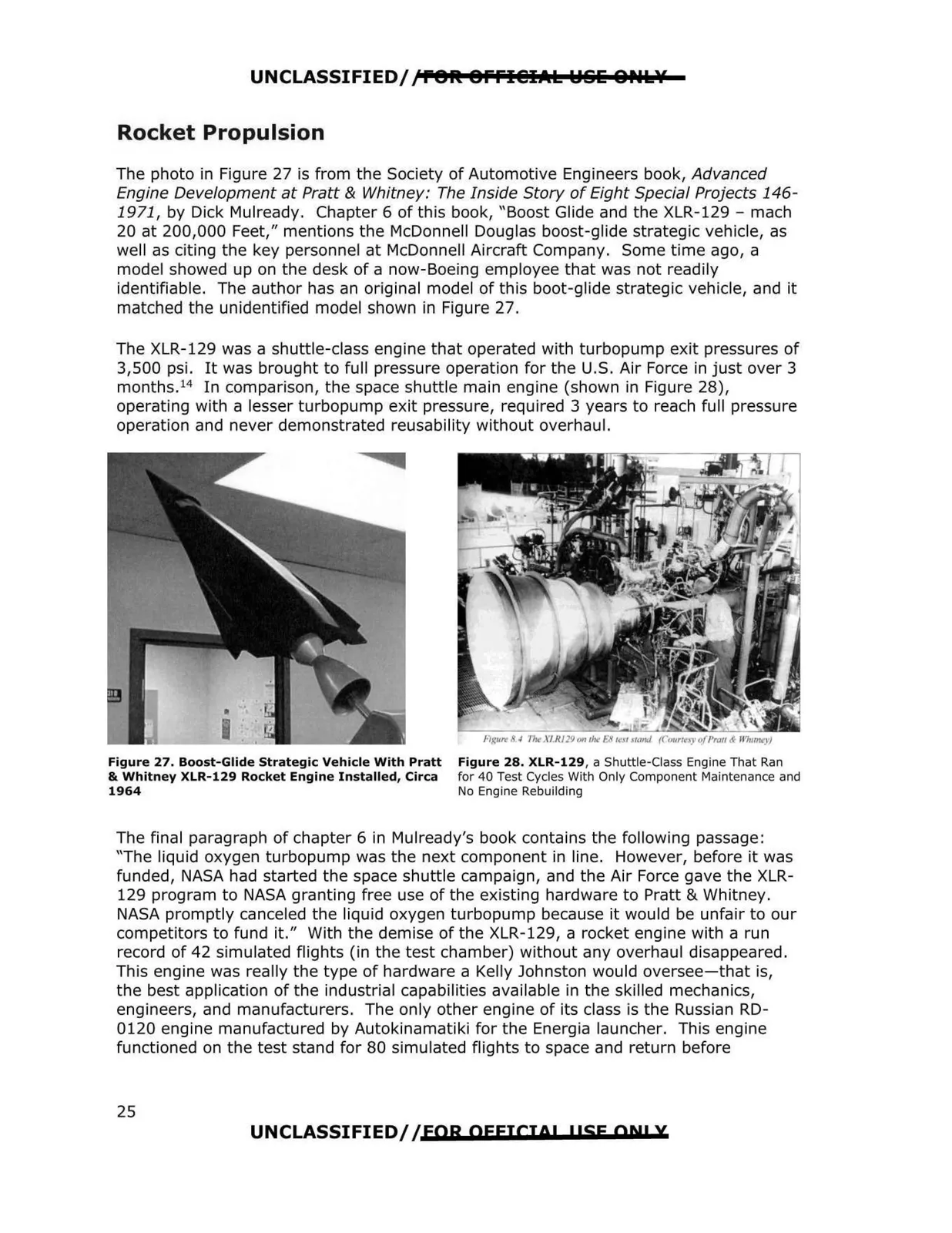
UNCLASSIFIED/)'FOR: Offl@IAL l:ISI: &PU.¥ Rocket Propulsion The photo in Figure 27 is from the Society of Automotive Engineers book, Advanced Engine Development at Pratt & Whitney: The Inside Story of Eight Special Projects 146 1971, by Dick Mulready. Chapter 6 of this book, "Boost Glide and the XLR-129 - mach 20 at 200,000 Feet," mentions the McDonnell Douglas boost-glide strategic vehicle, as well as citing the key personnel at McDonnell Aircraft Company. Some time ago, a model showed up on the desk of a now-Boeing employee that was not readily identifiable. The author has an original model of this boot-glide strategic vehicle, and it matched the unidentified model shown in Figure 27. The XLR-129 was a shuttle-class engine that operated with turbopump exit pressures of 3,500 psi. It was brought to full pressure operation for the U.S. Air Force in just over 3 months. 14 In comparison, the space shuttle main engine (shown in Figure 28), operating with a lesser turbopump exit pressure, required 3 years to reach full pressure operation and never demonstrated reusability without overhaul. Figure 27. Boost-Glide Strategic Vehicle With Pratt & Whitney XLR-129 Rocket Engine Installed, Circa 1964 Figure 28. XLR-129, a Shuttle-Class Engine That Ran for 40 Test Cycles With Only Component Maintenance and No Engine Rebuilding The final paragraph of chapter 6 in Mulready's book contains the following passage: "The liquid oxygen turbopump was the next component in line. However, before it was funded, NASA had started the space shuttle campaign, and the Air Force gave the XLR 129 program to NASA granting free use of the existing hardware to Pratt & Whitney. NASA promptly canceled the liquid oxygen turbopump because it would be unfair to our competitors to fund it." With the demise of the XLR-129, a rocket engine with a run record of 42 simulated flights (in the test chamber) without any overhaul disappeared. This engine was really the type of hardware a Kelly Johnston would oversee-that is, the best application of the industrial capabilities available in the skilled mechanics, engineers, and manufacturers. The only other engine of its class is the Russian RD 0120 engine manufactured by Autokinamatiki for the Energia launcher. This engine functioned on the test stand for 80 simulated flights to space and return before UNCLASSIFIED//EOB OEEJCIA! 1!SE ON! X 25