AAWSAP DIRD, Space Access: Where We’ve Been and Where We Could Go, March 2010
DOW-UAP-D124 · page 38 of 56
Text
This text came with the file. It may have mistakes. When the text and the image disagree, the image is right.
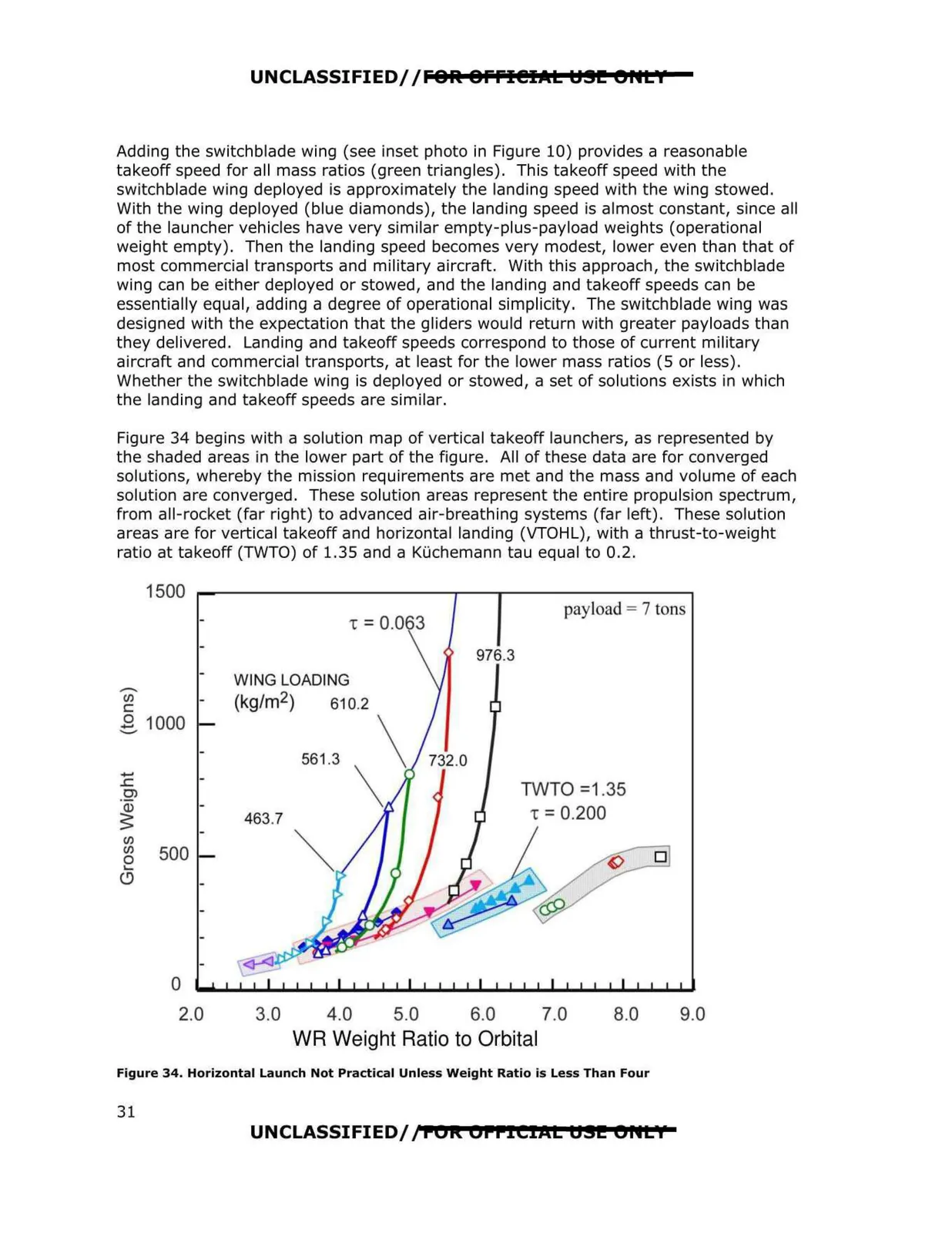
UNCLASSIFIED//FOR Offl@IJltt t:191! er\tt I Adding the switchblade wing (see inset photo in Figure 10) provides a reasonable takeoff speed for all mass ratios (green triangles). This takeoff speed with the switchblade wing deployed is approximately the landing speed with the wing stowed. With the wing deployed (blue diamonds), the landing speed is almost constant, since all of the launcher vehicles have very similar empty-plus-payload weights (operational weight empty). Then the landing speed becomes very modest, lower even than that of most commercial transports and military aircraft. With this approach, the switchblade wing can be either deployed or stowed, and the landing and takeoff speeds can be essentially equal, adding a degree of operational simplicity. The switchblade wing was designed with the expectation that the gliders would return with greater payloads than they delivered. Landing and takeoff speeds correspond to those of current military aircraft and commercial transports, at least for the lower mass ratios (5 or less). Whether the switchblade wing is deployed or stowed, a set of solutions exists in which the landing and takeoff speeds are similar. Figure 34 begins with a solution map of vertical takeoff launchers, as represented by the shaded areas in the lower part of the figure. All of these data are for converged solutions, whereby the mission requirements are met and the mass and volume of each solution are converged. These solution areas represent the entire propulsion spectrum, from all-rocket (far right) to advanced air-breathing systems (far left) . These solution areas are for vertical takeoff and horizontal landing (VTOHL), with a thrust-to-weight ratio at takeoff (TWTO) of 1.35 and a Kuchemann tau equal to 0.2. 1500 ......... (/) C: B 1000 - .c .2> ~ (/) ~ 500 .... CJ 3.0 4.0 5.0 6.0 7.0 8.0 payload = 7 tons WING LOADING (kg/m2) 610.2 561 .3 \ \ 463.7 ~ 976.3 TWTO =1 .35 ~ = 0.200 2.0 9.0 WR Weight Ratio to Orbital Figure 34. Horizontal Launch Not Practical Unless Weight Ratio is Less Than Four UNCLASSIFIED// FOR OFFICIAL U.!I! er\tt I 0 31