AAWSAP DIRD, Space Access: Where We’ve Been and Where We Could Go, March 2010
DOW-UAP-D124 · page 40 of 56
Text
This text came with the file. It may have mistakes. When the text and the image disagree, the image is right.
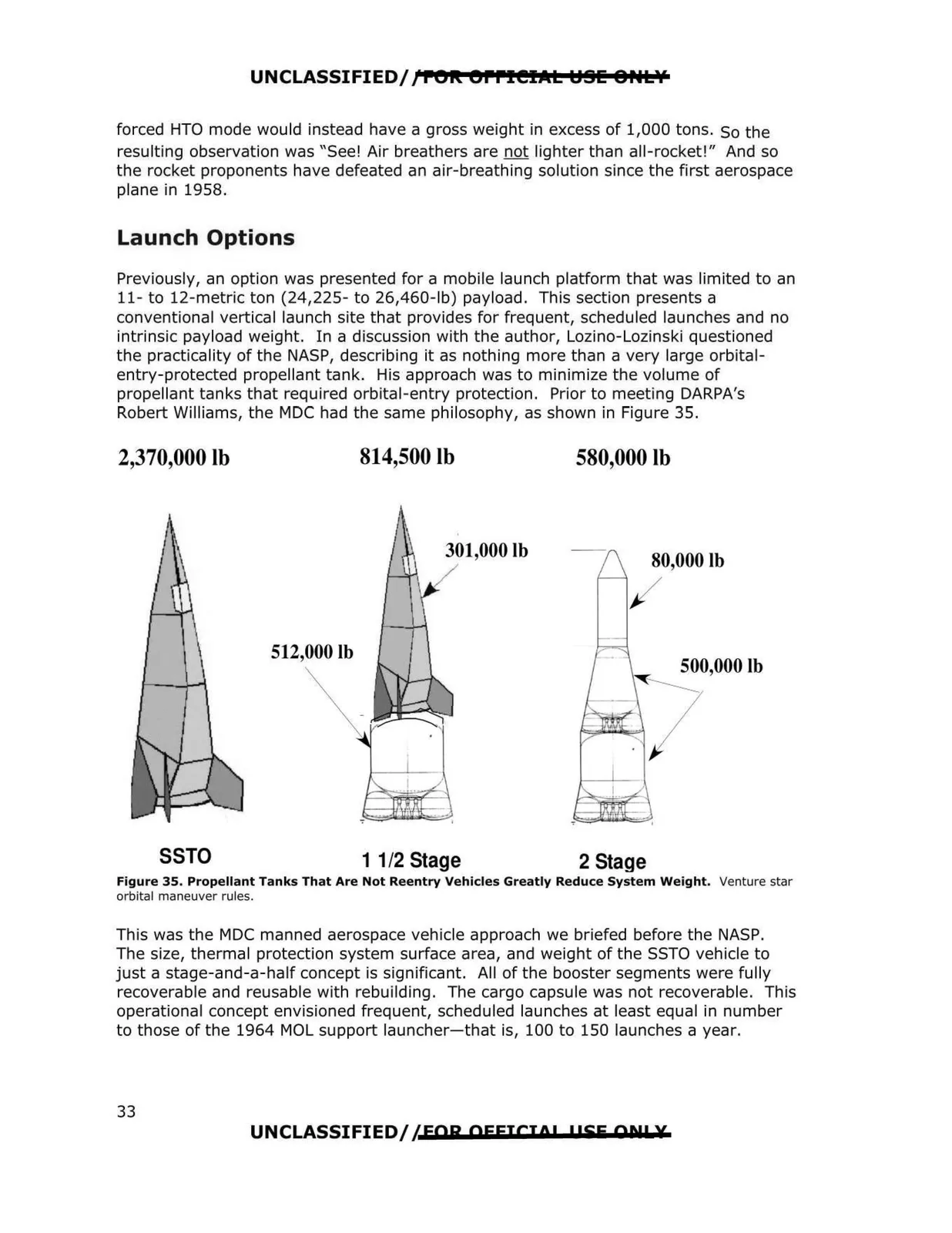
UNCLASSIFIED/ /FOR: 0rr1e1J1tt Y!H: 8HLY forced HTO mode would instead have a gross weight in excess of 1,000 tons. so the resulting observation was "See! Air breathers are not lighter than all-rocket!" And so the rocket proponents have defeated an air-breathing solution since the first aerospace plane in 1958. Launch Options Previously, an option was presented for a mobile launch platform that was limited to an 11- to 12-metric ton (24,225- to 26,460-lb) payload . This section presents a conventional vertical launch site that provides for frequent, scheduled launches and no intrinsic payload weight. In a discussion with the author, Lozino-Lozinski questioned the practicality of the NASP, describing it as nothing more than a very large orbital entry-protected propellant tank. His approach was to minimize the volume of propellant tanks that required orbital-entry protection. Prior to meeting DARPA's Robert Williams, the MDC had the same philosophy, as shown in Figure 35. 2,370,000 lb 814,500 lb 580,000 lb 301,000 lb 512,000 lb 80,000 lb SSTO 1 1/2 Stage 2 Stage Figure 35. Propellant Tanks That Are Not Reentry Vehicles Greatly Reduce System Weight. Venture star orbital maneuver rules. This was the MDC manned aerospace vehicle approach we briefed before the NASP. The size, thermal protection system surface area, and weight of the SSTO vehicle to just a stage-and-a-half concept is significant. All of the booster segments were fully recoverable and reusable with rebuilding. The cargo capsule was not recoverable. This operational concept envisioned frequent, scheduled launches at least equal in number to those of the 1964 MOL support launcher-that is, 100 to 150 launches a year. UNCLASSIFIED/tEOR OFFICIO! 1!SE Alli Y 33