AAWSAP DIRD, Space Access: Where We’ve Been and Where We Could Go, March 2010
DOW-UAP-D124 · page 44 of 56
Text
This text came with the file. It may have mistakes. When the text and the image disagree, the image is right.
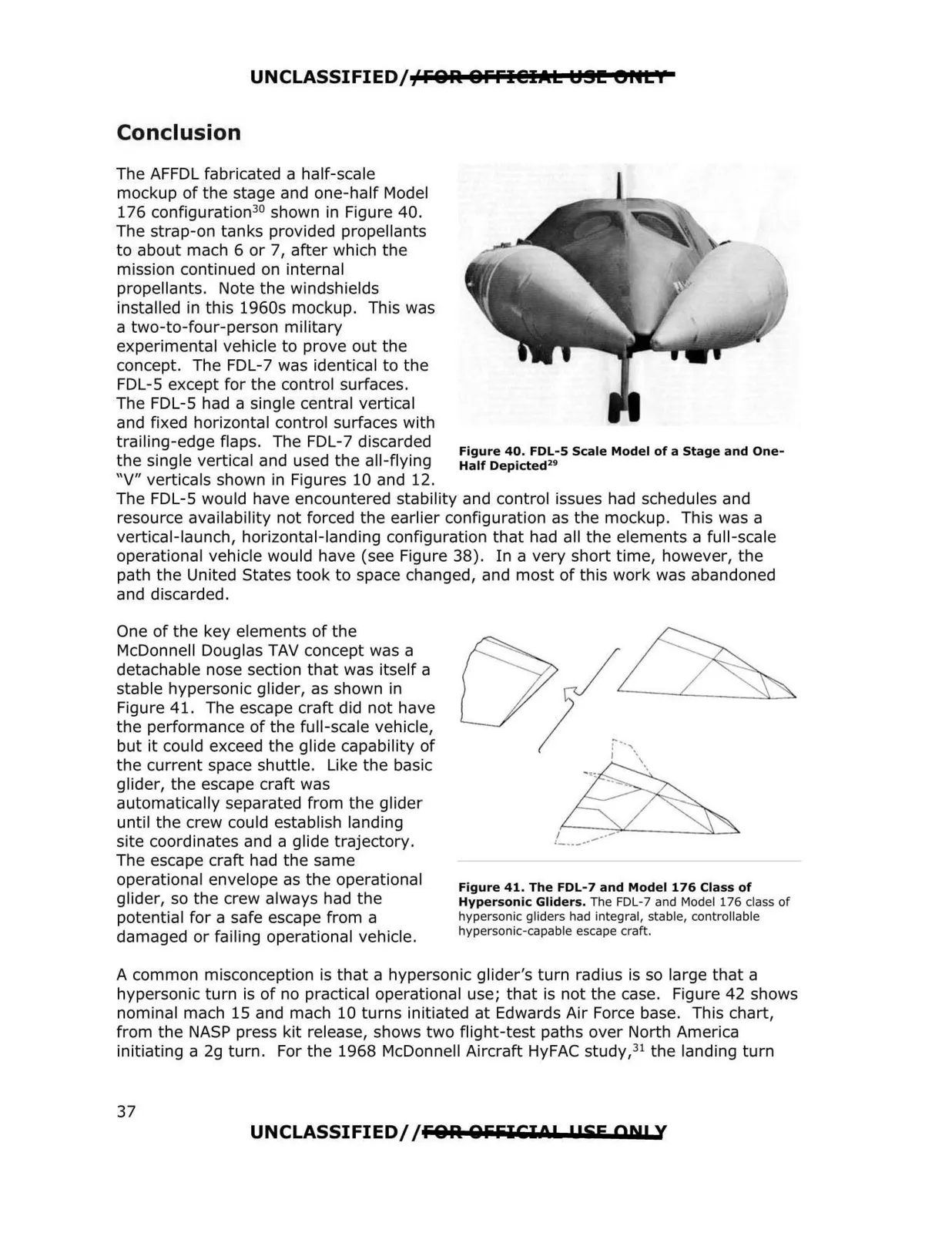
UNCLASSIFIED/fFOR: 8FFI@IAL l!ISI!!! er•t I Conclusion The AFFDL fabricated a half-scale mockup of the stage and one-half Model 176 configuration30 shown in Figure 40. The strap-on tanks provided propellants to about mach 6 or 7, after which the mission continued on internal propellants. Note the windshields installed in this 1960s mockup. This was a two-to-four-person military experimental vehicle to prove out the concept. The FOL-7 was identica I to the FDL-5 except for the control surfaces. The FDL-5 had a single central vertical and fixed horizontal control surfaces with trailing-edge flaps. The FOL-7 discarded the single vertical and used the all-flying "V" verticals shown in Figures 10 and 12. The FDL-5 would have encountered stability and control issues had schedules and resource availability not forced the earlier configuration as the mockup. This was a vertical-launch, horizontal-landing configuration that had all the elements a full-scale operational vehicle would have (see Figure 38). In a very short time, however, the path the United States took to space changed, and most of this work was abandoned and discarded. Figure 40. FDL-5 Scale Model of a Stage and One Half Depicted29 One of the key elements of the McDonnell Douglas TAV concept was a detachable nose section that was itself a stable hypersonic glider, as shown in Figure 41. The escape craft did not have L7 the performance of the full-scale vehicle, but it could exceed the glide capability of the current space shuttle. Like the basic glider, the escape craft was automatically separated from the glider until the crew could establish landing site coordinates and a glide trajectory. The escape craft had the same operational envelope as the operational Figure 41. The FDL-7 and Model 176 Class of glider, so the crew always had the Hypersonic Gliders. The FDL-7 and Model 176 class of potential for a safe escape from a hypersonic gliders had integral, stable, controllable hypersonic-capable escape craft. damaged or failing operational vehicle. A common misconception is that a hypersonic glider's turn radius is so large that a hypersonic turn is of no practical operational use; that is not the case. Figure 42 shows nominal mach 15 and mach 10 turns initiated at Edwards Air Force base. This chart, from the NASP press kit release, shows two flight-test paths over North America initiating a 2g turn. For the 1968 McDonnell Aircraft HyFAC study, 31 the landing turn UNCLASSIFIED/ /FOR: QflilCIOP !!SF ON! Y 37