AAWSAP DIRD, Space Access: Where We’ve Been and Where We Could Go, March 2010
DOW-UAP-D124 · page 46 of 56
Text
This text came with the file. It may have mistakes. When the text and the image disagree, the image is right.
UNCLASSIFIED// FOR OPPICIJct tJSI!! e ..tv
Space Based
Werning
~
Navtga1lon
Weather
deceased
LEO-Lunar
Ro es ??
(j.--
,,
I '
.,
I
--
r
I
I
I
I
Planots 0
paceways Entering the 21 t century
From Dr. William Gaubatz
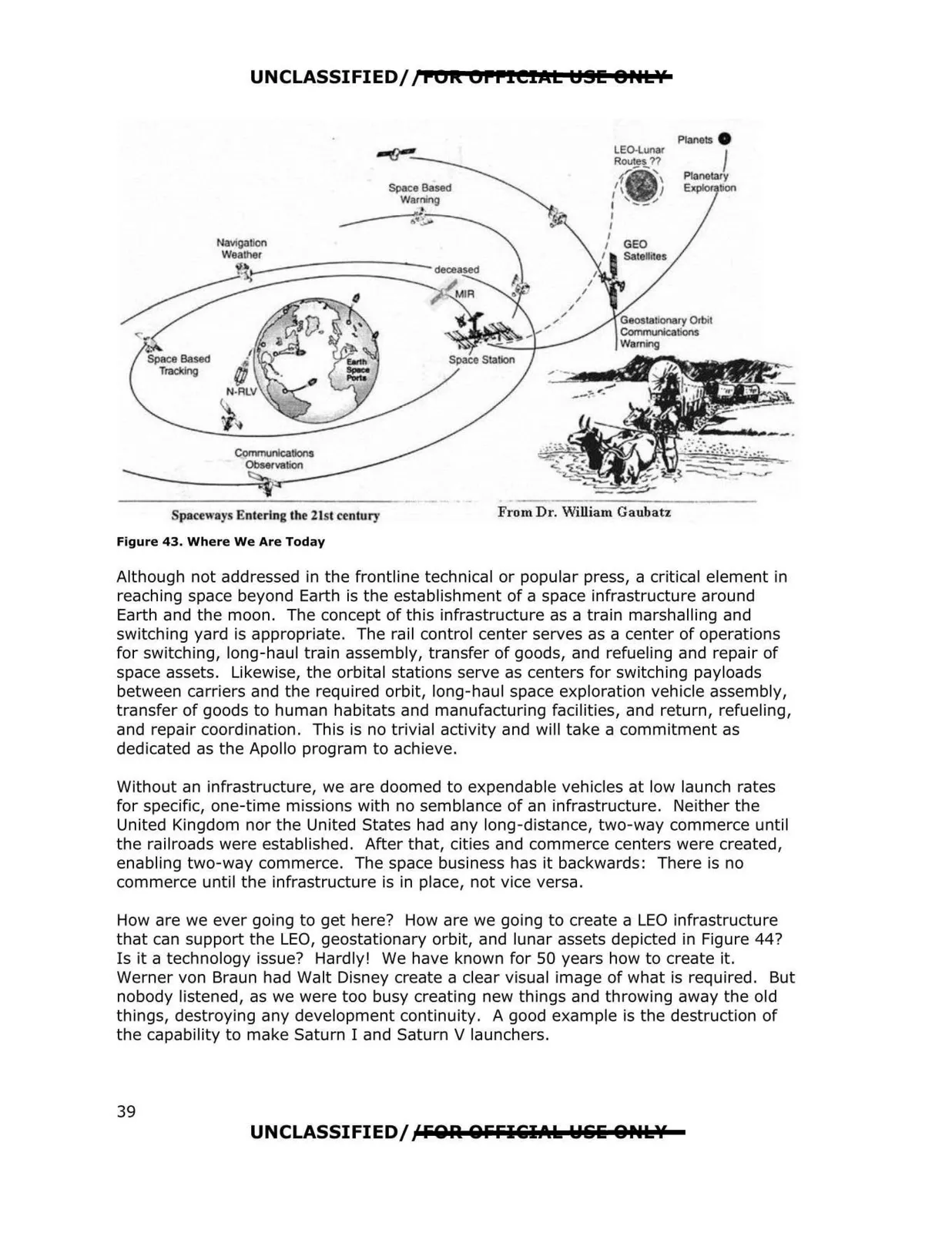
Figure 43. Where We Are Today
Although not addressed in the Frontline technical or popular press, a critical element in
reaching space beyond Earth is the establishment of a space infrastructure around
Earth and the moon. The concept of this infrastructure as a train marshalling and
switching yard is appropriate. The rail control center serves as a center of operations
for switching, long-haul train assembly, transfer of goods, and refueling and repair of
space assets. Likewise, the orbital stations serve as centers for switching payloads
between carriers and the required orbit, long-haul space exploration vehicle assembly,
transfer of goods to human habitats and manufacturing facilities, and return, refueling,
and repair coordination. This is no trivial activity and will take a commitment as
dedicated as the Apollo program to achieve.
Without an infrastructure, we are doomed to expendable vehicles at low launch rates
for specific, one-time missions with no semblance of an infrastructure. Neither the
United Kingdom nor the United States had any long-distance, two-way commerce until
the railroads were established. After that, cities and commerce centers were created,
enabling two-way commerce. The space business has it backwards: There is no
commerce until the infrastructure is in place, not vice versa.
How are we ever going to get here? How are we going to create a LEO infrastructure
that can support the LEO, geostationary orbit, and lunar assets depicted in Figure 44?
Is it a technology issue? Hardly! We have known for 50 years how to create it.
Werner von Braun had Walt Disney create a clear visual image of what is required. But
nobody listened, as we were too busy creating new things and throwing away the old
things, destroying any development continuity. A good example is the destruction of
the capability to make Saturn I and Saturn V launchers.
UNCLASSIFIED/,,roA OFFI&il.t.k W&li &rtllf
39