AAWSAP DIRD, Inertial Electrostatic Confinement Fusion, March 2010
DOW-UAP-D125 · page 19 of 72
Text
This text came with the file. It may have mistakes. When the text and the image disagree, the image is right.
UNCLASSIFIED/ /FOA QFFI&IAL ~!ii: f>HLY
In this RF gun, a graded index magnetic field is used to increase the ionization
efficiency. A key component is the magnetic focusing lens at the extraction port. This
allows very efficient differential pumping between the high pressure gun chamber and
the low pressure IEC chamber. It also provides some control of the angular vellocity of
entering ions.
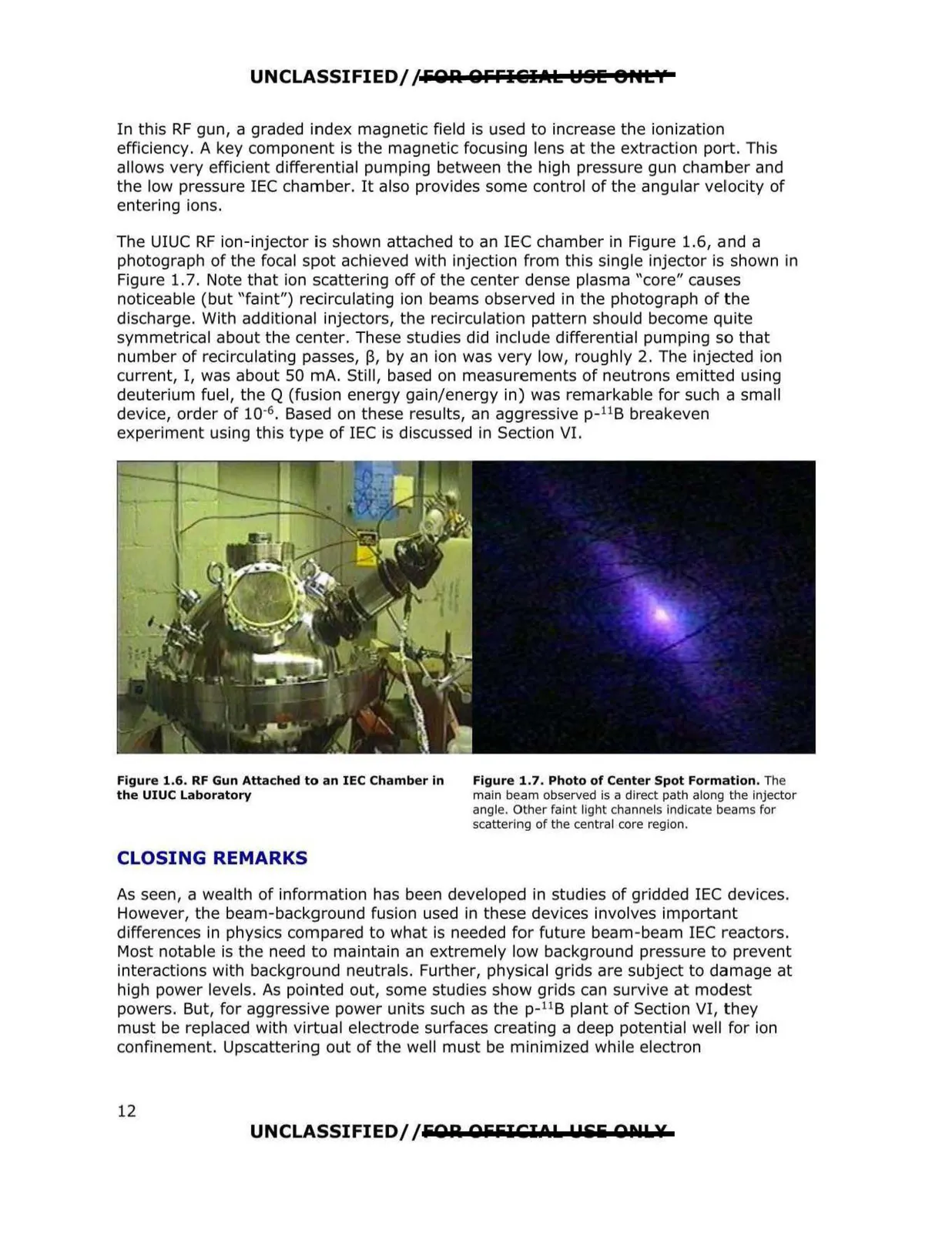
The UIUC RF ion-injector is shown attached to an IEC chamber in Figure 1.6, and a
photograph of the focal spot achieved with injection from this single injector is shown in
Figure 1.7. Note that ion scattering off of the center dense plasma "core" causes
noticeable (but "faint") recirculating ion beams observed in the photograph of the
discharge. With additional injectors, the recirculation pattern should become quite
symmetrical about the center. These studies did include differential pumping so that
number of recircu lating passes, ~. by an ion was very low, roughly 2. The injected ion
current, I, was about 50 mA. Still, based on measurements of neutrons emitted using
deuterium fuel, the Q (fusion energy gain/energy in) was remarkable for such a small
device, order of 10·6. Based on these results, an aggressive p-11B breakeven
experiment using this type of IEC is discussed in Section VI.
Figure 1.6. RF Gun Attached to an IEC Chamber in
Figure 1.7. Photo of Center Spot Formation. The
the UIUC Laboratory
main beam observed is a direct path along the injector
angle. Other faint light channels indicate beams for
scattering of the central core region.
CLOSING REMARKS
As seen, a wealth of information has been developed in studies of gridded IEC devices.
However, the beam-background fusion used in these devices involves important
differences in physics compared to what is needed for future beam-beam IEC reactors.
Most notable is the need to maintain an extremely low background pressure to prevent
interactions with background neutrals. Further, physical grids are subject to damage at
high power levels. As pointed out, some studies show grids can survive at modest
powers. But, for aggressive power units such as the p- 11B plant of Section VI, they
must be replaced with virtual electrode surfaces creating a deep potential well for ion
confinement. Upscattering out of the well must be minimized while electron
UNCLASSIFIED/ /liOA: OlililCI0L: !Pi'li ODIL:¥
12