AAWSAP DIRD, Inertial Electrostatic Confinement Fusion, March 2010
DOW-UAP-D125 · page 25 of 72
Text
This text came with the file. It may have mistakes. When the text and the image disagree, the image is right.
UNCLASSIFIED//POI\ orr1e1At t.9!11!! f>HLY
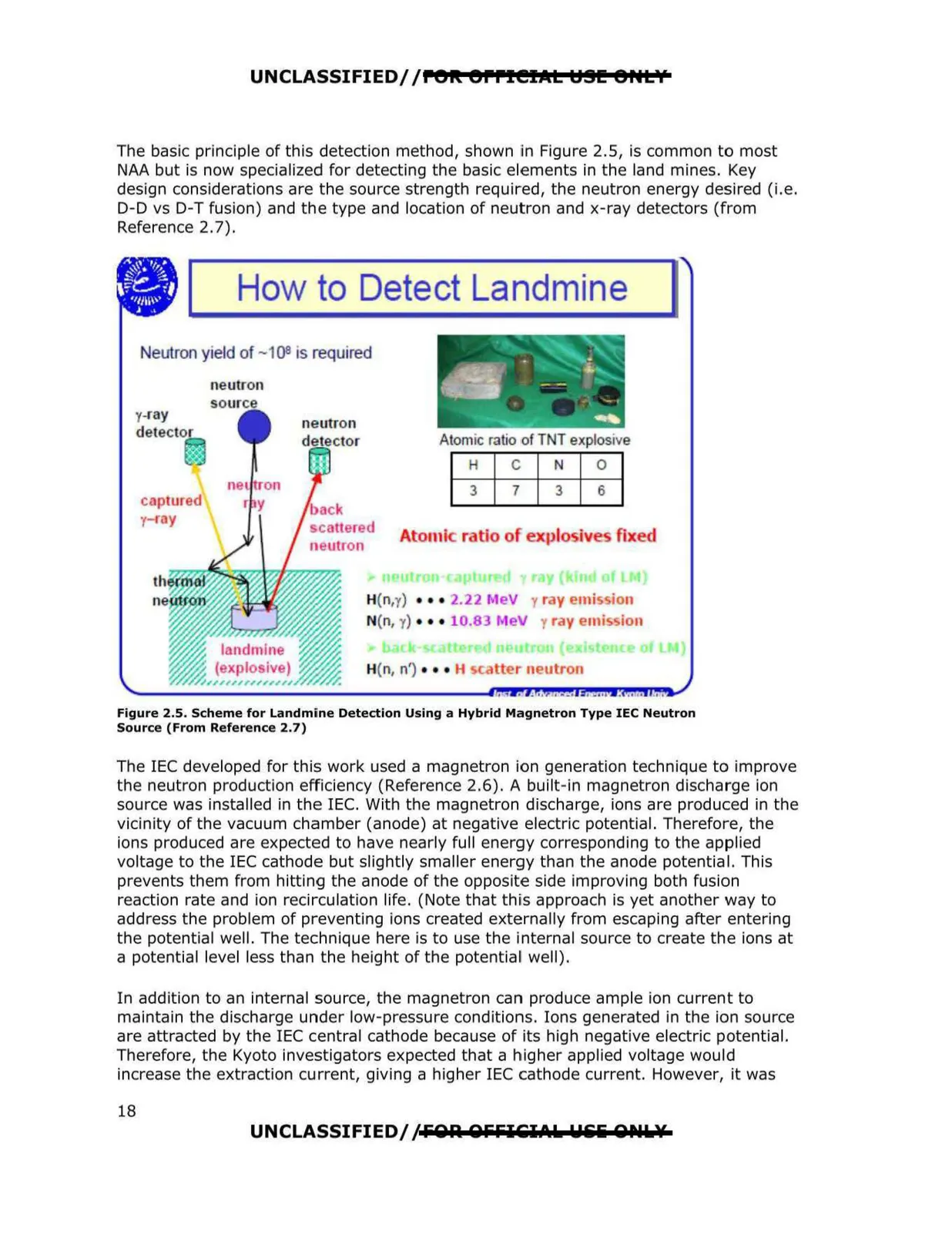
The basic principle of this detection method, shown in Figure 2.5, is common to most
NAA but is now specialized for detecting the basic elements in the land mines. Key
design considerations are the source strength required, the neutron energy desired (i.e.
D-D vs D-T fusion) and the type and location of neutron and x-ray detectors (from
Reference 2. 7).
How to Detect Landmine I
Neutron yield of -1 08 is required
-~--~~
,...,
·i-~~
~
neutron
ta111•
- - -~ ...
y~ay
detector
source
•
., \
-
I
~- ~
Alo •
•
T explosive
I 3
,
3 I ~ I
Ato, 1 r io of
iv
fix d
y ray en i ion
N(n, y) • • • 10.83 MeV y ray n i ion
Figure 2.5. Scheme for Landmine Detection Using a Hybrid Magnetron Type IEC Neutron
Source (From Reference 2.7)
The IEC developed for this work used a magnetron ion generation technique to improve
the neutron production efficiency (Reference 2.6). A built-in magnetron discharge ion
source was installed in the IEC. With the magnetron discharge, ions are produced in the
vicinity of the vacuum chamber (anode) at negative electric potential. Therefore, the
ions produced are expected to have nearly full energy corresponding to the applied
voltage to the IEC cathode but slightly smaller energy than the anode potential. This
prevents them from hitting the anode of the opposite side improving both fusion
reaction rate and ion recirculation life. (Note that thiis approach is yet another way to
address the problem of preventing ions created externally from escaping after entering
the potential well. The technique here is to use the internal source to create the ions at
a potential level less than the height of the potential! well).
In addition to an internal source, the magnetron can produce ample ion current to
maintain the discharge under low-pressure conditions. Ions generated in the ion source
are attracted by the IEC central cathode because of its high negative electric potential.
Therefore, the Kyoto investigators expected that a higher applied voltage would
increase the extraction current, giving a higher IEC cathode current. However, it was
UNCLASSIFIED/ /FOA OFFIQIAk Wliii 01\lk¥
18