AAWSAP DIRD, Inertial Electrostatic Confinement Fusion, March 2010
DOW-UAP-D125 · page 26 of 72
Text
This text came with the file. It may have mistakes. When the text and the image disagree, the image is right.
UNCLASSIFIED//&Olil O&FICIA.k Wlili QNkY
found that there is an optimum voltage in terms of a maximum IEC cathode current.
Ions supplied by the magnetron ion source are essential to maintain the hybrid (glow
and magnetron) discharge under low gas pressure conditions. The reason for this
voltage limit is not clear. Unfortunately this effect limits the cathode voltage despite the
need for high voltage for neutron production near the peak energy of the fusiorn cross
section. Thus this issue deserves more study to optimize use of a hybrid magnetron
source IEC operation. Still the design worked reasonably well for the initial mine
detection experiments. Unfortunately, the project was terminated prematurely due to
financial constraints, so information on optimization possibility remains incomplete.
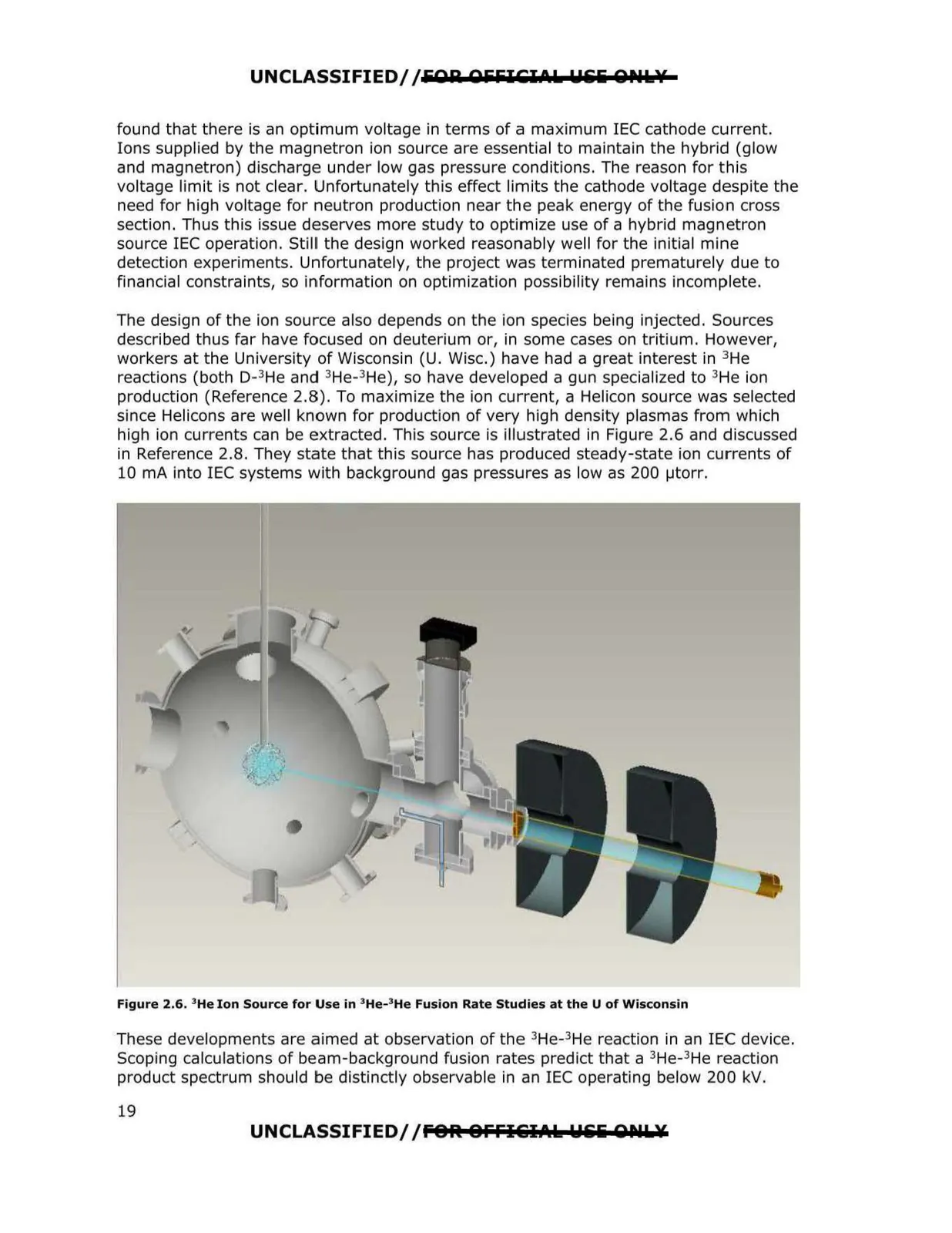
The design of the ion source also depends on the ion species being injected. Sources
described thus far have focused on deuterium or, in some cases on tritium. However,
workers at the University of Wisconsin (U. Wisc.) have had a great interest in 3He
reactions (both D-3He and 3He-3He), so have developed a gun specialized to 3He ion
production (Reference 2.8). To maximize the ion current, a Helicon source was selected
since Helicons are well known for production of very high density plasmas from which
high ion currents can be extracted. This source is illustrated in Figure 2.6 and discussed
in Reference 2.8. They state that this source has produced steady-state ion currents of
10 mA into IEC systems with background gas pressures as low as 200 µtorr.
Figure 2.6. 3He Ion Source for Use in 3He-3He Fusion Rate Studies at the U of Wisconsin
These developments are aimed at observation of the 3He-3He reaction in an IEC device.
Scoping calculations of beam-background fusion rates predict that a 3He-3He reaction
product spectrum should be distinctly observable in an IEC operating below 200 kV.
UNCLASSIFIED//FOR OFFI&Isl.k Wlili Ql'II.¥
19