AAWSAP DIRD, Inertial Electrostatic Confinement Fusion, March 2010
DOW-UAP-D125 · page 36 of 72
Text
This text came with the file. It may have mistakes. When the text and the image disagree, the image is right.
UNCLASSIFIED//FOA OFFI&IAk WSE 8Ptklf
low fuel leakage and extreme maneuverability make it a near-term competitor with
other devices such as Hall thrusters for future commercial thruster applications in the
multi-kW range. The extension to a p-11B self-powered unit would resolve many
problems anticipated as larger power requirements develop. It would be extendable to
large power units needed for eventual fast deep space propulsion. Much more research
and development is required to ensure that step in a timely fashion, however.
The Dipole Assisted IEC (DaIEC)
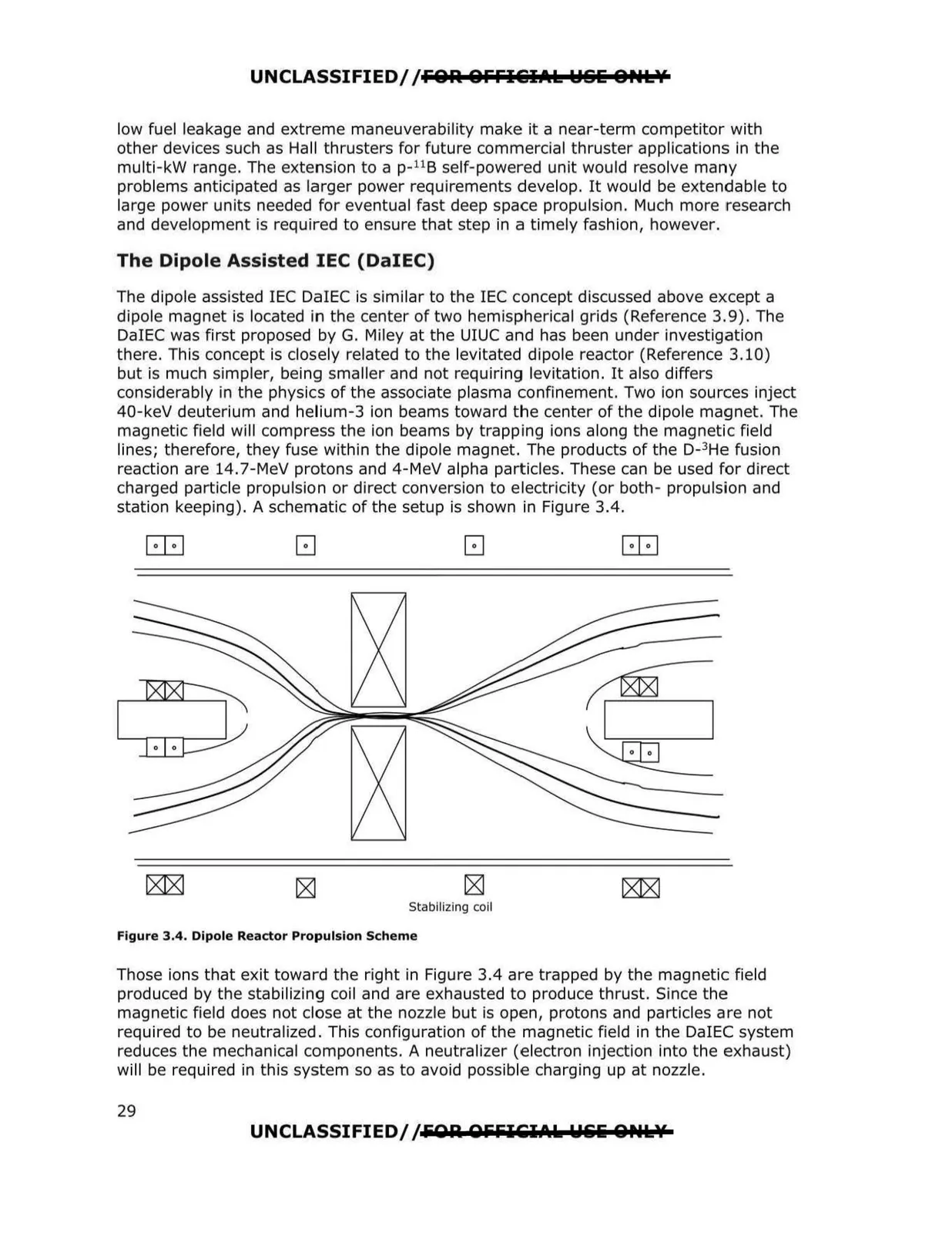
The dipole assisted IEC DaIEC is similar to the IEC concept discussed above except a
dipole magnet is located in the center of two hemispherical grids (Reference 3. 9). The
DaIEC was first proposed by G. Miley at the UIUC and has been under investigation
there. This concept is closely related to the levitated dipole reactor (Reference 3.10)
but is much simpler, being smaller and not requiring levitation. It also differs
considerably in the physics of the associate plasma confinement. Two ion sources inject
40-keV deuterium and helium-3 ion beams toward the center of the dipole magnet. The
magnetic field will compress the ion beams by trapping ions along the magnetic field
lines; therefore, they fuse within the dipole magnet. The products of the D-3He fusion
reaction are 14. 7-MeV protons and 4-MeV alpha particles. These can be used for direct
charged particle propulsion or direct conversion to electricity (or both- propulsion and
station keeping). A schematic of the setup is shown in Figure 3.4.
G:EJ
[:E]
[8J
Stabilizing coil
Figure 3.4. Dipole Reactor Propulsion Scheme
Those ions that exit toward the right in Figure 3.4 are trapped by the magnetic field
produced by the stabilizing coil and are exhausted to produce thrust. Since the
magnetic field does not close at the nozzle but is open, protons and particles are not
required to be neutralized. This configuration of the magnetic field in the DaIEC system
reduces the mechanical components. A neutralizer (electron injection into the exhaust)
will be required in this system so as to avoid possible charging up at nozzle.
UNCLASSIFIED/ /5i0A 05i5ilCIAk Wli& 0,.k?f
29