AAWSAP DIRD, Inertial Electrostatic Confinement Fusion, March 2010
DOW-UAP-D125 · page 35 of 72
Text
This text came with the file. It may have mistakes. When the text and the image disagree, the image is right.
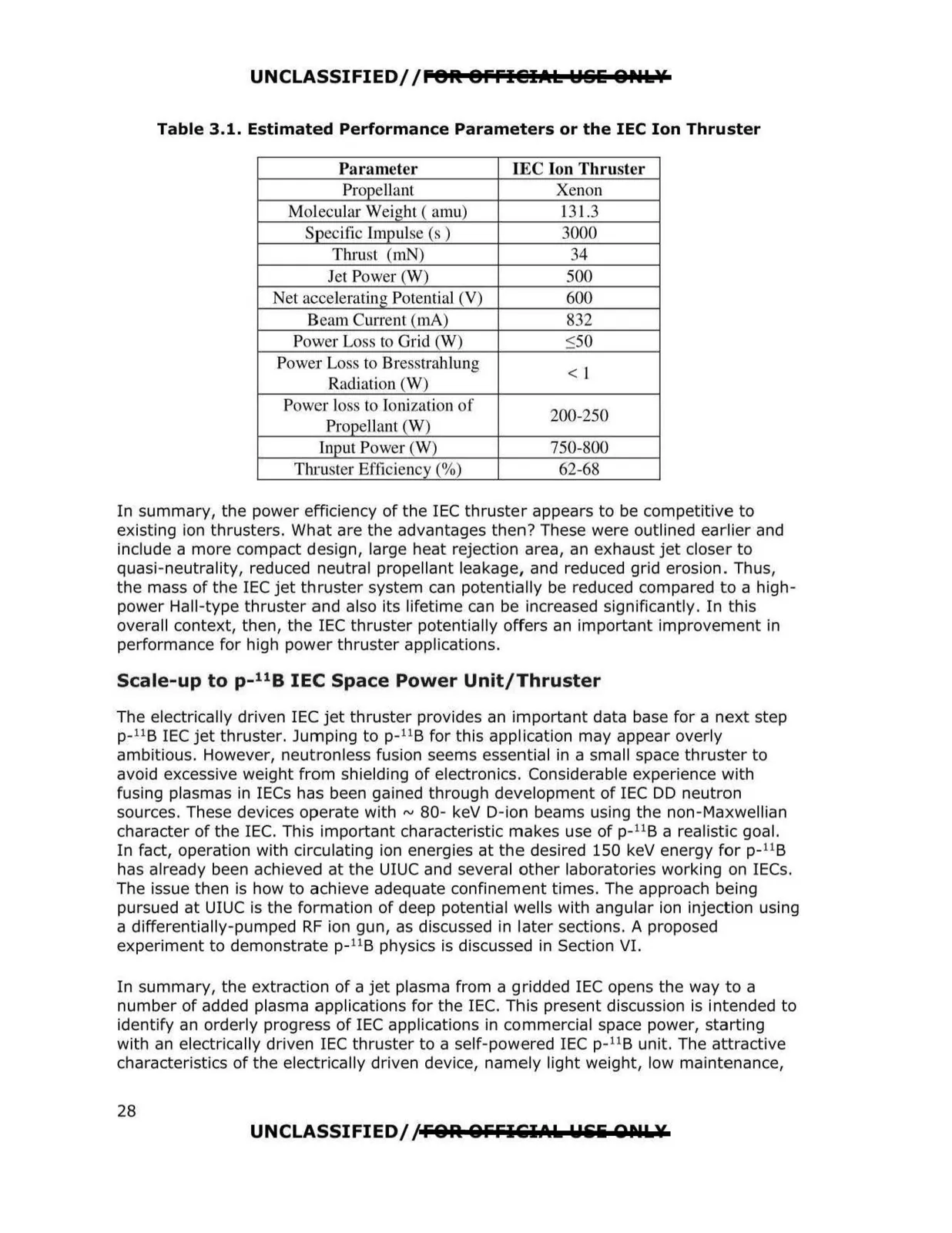
UNCLASSIFIED/ /fOR Offl@IAL W&& 8Nk¥ Table 3.1. Estimated Performance Parameters or the IEC Ion Thruster Parameter IEC Ion Thruster Propellant Xenon Molecular Weight ( arnu) 131.3 Specific Impulse (s) 3000 Thrust (m.N) 34 Jet Power (W) 500 Net accelerating Potential (V) 600 Beam Current (mA) 832 Power Loss to Grid (W) :S50 Power Loss to Bresstrahlung Radiation (W) < 1 Power lo s to Ionization of Propellan t (W) 200-250 Input Power (W) Thruster Efficiency(%) 750-800 62-68 In summary, the power efficiency of the IEC thruster appears to be competitive to existing ion thrusters. What are the advantages then? These were outlined earlier and include a more compact design, large heat rejection area, an exhaust jet closer to quasi-neutrality, reduced neutral propellant leakage, and reduced grid erosion. Thus, the mass of the IEC jet thruster system can potentially be reduced compared to a high power Hall-type thruster and also its lifetime can be increased significantly. In this overall context, then, the IEC thruster potentially offers an important improvement in performance for high power thruster applications. Scale-up to p- 11B IEC Space Power Unit/Thruster The electrically driven IEC jet thruster provides an important data base for a next step p- 11 B IEC jet thruster. Jumping to p-11 B for this application may appear overly ambitious. However, neutronless fusion seems essential in a small space thruster to avoid excessive weight from shielding of electronics. Considerable experience with fusing plasmas in IECs has been gained through development of IEC DD neutron sources. These devices operate with ~80- keV D-ion beams using the non-Maxwellian character of the IEC. This important characteristic makes use of p- 11B a realistic goal. In fact, operation with circulating ion energies at the desired 150 keV energy for p- 11B has already been achieved at the UIUC and several other laboratories working on IECs. The issue then is how to achieve adequate confinement times. The approach being pursued at UIUC is the formation of deep potential wells with angular ion injection using a differentially-pumped RF ion gun, as discussed in later sections. A proposed experiment to demonstrate p- 11B physics is discussed in Section VI. In summary, the extraction of a jet plasma from a gridded IEC opens the way to a number of added plasma applications for the IEC. This present discussion is intended to identify an orderly progress of IEC applications in commercial space power, starting with an electrically driven IEC thruster to a self-powered IEC p- 11B unit. The attractive characteristics of the electrically driven device, namely light weight, low maintenance, UNCLASSIFIED/ /FOR OFFIQIAk Wii QrelL¥ 28