AAWSAP DIRD, Inertial Electrostatic Confinement Fusion, March 2010
DOW-UAP-D125 · page 45 of 72
Text
This text came with the file. It may have mistakes. When the text and the image disagree, the image is right.
I
UNCLASSIFIED/ f FOR OFFl@IAL ~81: 8HLY
I
I
f"'I \
I I \
I I \
I I \
I I
\
I
I
\
f
I
\
'
I
I '\
- - .. -
'
\
\
' ...
E
Emax
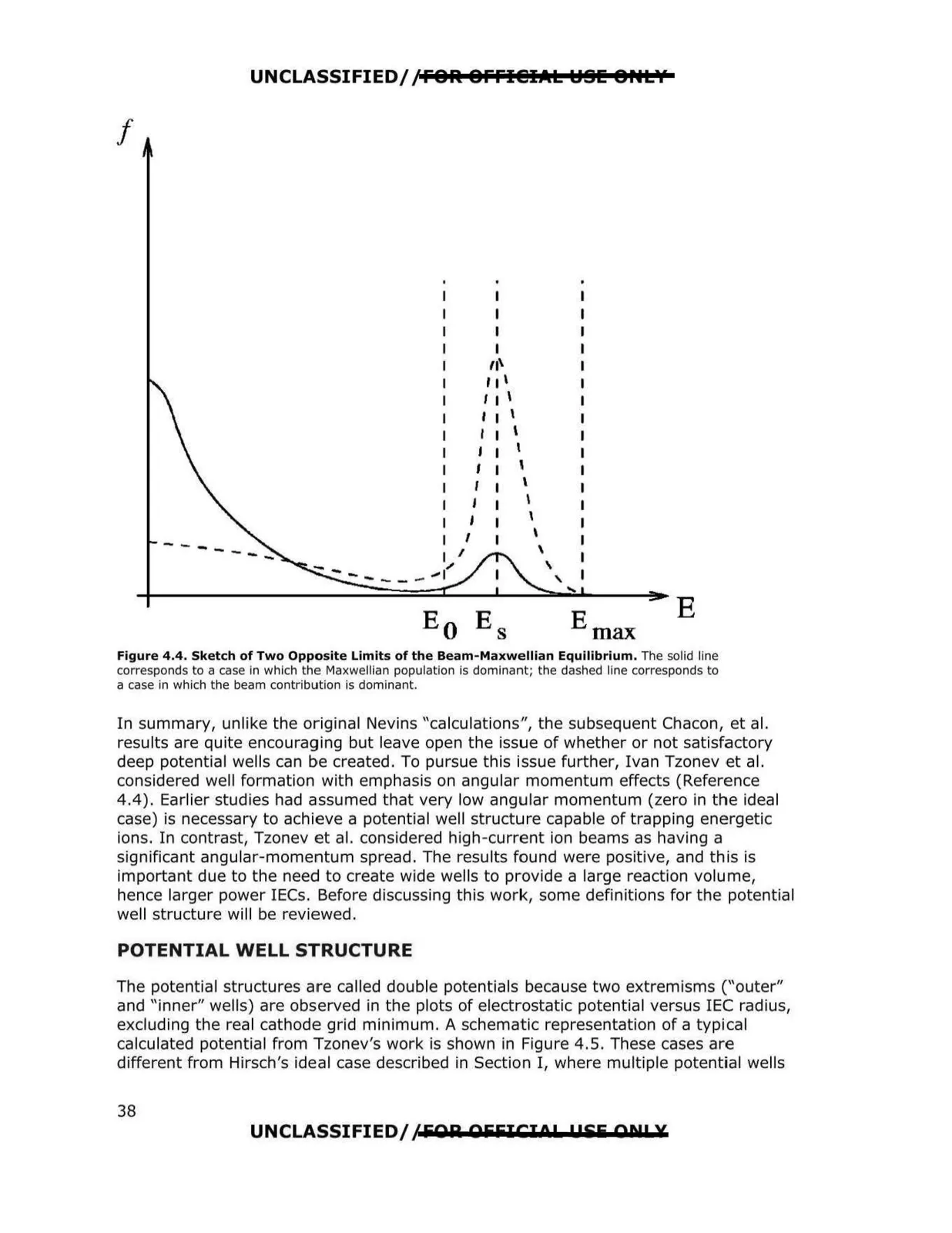
Figure 4.4. Sketch of Two Opposite Limits of the Beam-Maxwellian Equilibrium. The solid line
corresponds to a case In which the Maxwellian population Is dominant; the dashed line corresponds to
a case in which the beam contribution is dominant.
In summary, unlike the original Nevins "calculations", the subsequent Chacon, et al.
results are quite encouraging but leave open the issue of whether or not satisfactory
deep potential wells can be created. To pursue this issue further, Ivan Tzonev ,et al.
considered well formation with emphasis on angular momentum effects (Reference
4.4) . Earlier studies had assumed that very low angular momentum (zero in the ideal
case) is necessary to achieve a potential well structure capable of trapping energetic
ions. In contrast, Tzonev et al. considered high-current ion beams as having a
significant angular-momentum spread. The results found were positive, and this is
important due to the need to create wide wells to provide a large reaction volume,
hence larger power IECs. Before discussing this work, some definitions for the potential
well structure will be reviewed.
POTENTIAL WELL STRUCTURE
The potential structures are called double potentials because two extremisms ("outer"
and "inner" wells) are observed in the plots of electrostatic potential versus IEC radius,
excluding the real cathode grid minimum. A schematic representation of a typical
calculated potential from Tzonev's work is shown in Figure 4.5. These cases are
different from Hirsch's ideal case described in Section I, where multiple potential wells
UNCLASSIFIED/ }FOA: OFFICI0L: !Pili ON! X
38