AAWSAP DIRD, Inertial Electrostatic Confinement Fusion, March 2010
DOW-UAP-D125 · page 62 of 72
Text
This text came with the file. It may have mistakes. When the text and the image disagree, the image is right.
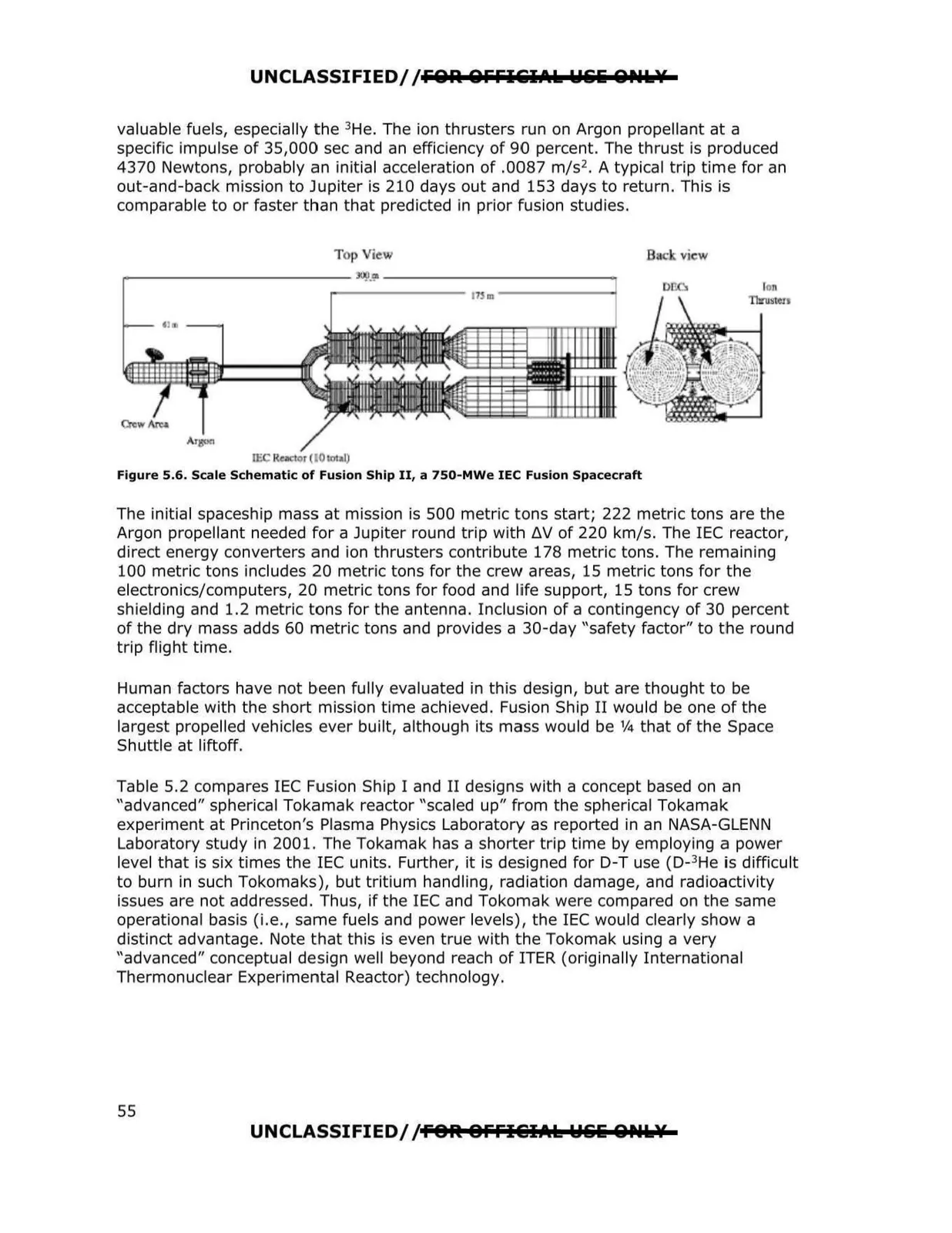
Figure 5.6. Scale Schematic of Fusion Ship II, a 750-MWe IEC Fusion Spacecraft
UNCLASSIFIED/ /FOA OFFI&iIAk Wli& ONkY
valuable fuels, especially t he 3 He. The ion thrusters run on Argon propellant at a
specific impulse of 35,000 sec and an efficiency of 90 percent. The thrust is produced
4370 Newtons, probably an initial acceleration of .0087 m/s 2. A typical trip time for an
out-and-back mission to Jupiter is 210 days out and 153 days to return. This is
comparable to or faster than that predicted in prior fusion studies.
B • vi w
The initial spaceship mass at mission is 500 metric tons start; 222 metric tons are the
Argon propellant needed for a Jupiter round trip with /:::,,.V of 220 km/s. The IEC reactor,
direct energy converters and ion thrusters contribute 178 metric tons. The remaining
100 metric tons includes 20 metric tons for the crew areas, 15 metric tons for the
electronics/computers, 20 metric tons for food and life support, 15 tons for crew
shielding and 1.2 metric tons for the antenna. Inclusion of a contingency of 30 percent
of the dry mass adds 60 metric tons and provides a 30-day "safety factor" to the round
trip flight time.
Human factors have not been fully evaluated in this design, but are thought to be
acceptable with the short mission time achieved. Fusion Ship II would be one of the
largest propelled vehicles ever built, although its mass would be ¼ that of the Space
Shuttle at liftoff.
Table 5.2 compares IEC Fusion Ship I and II designs with a concept based on an
"advanced" spherical Tokamak reactor "scaled up" from the spherical Tokamak
experiment at Princeton's Plasma Physics Laboratory as reported in an NASA-GLENN
Laboratory study in 2001. The Tokamak has a shorter trip time by employing a power
level that is six times the IEC units. Further, it is designed for D-T use (D-3He is difficult
to burn in such Tokomaks), but tritium handling, radiation damage, and radioactivity
Issues are not addressed. Thus, if the IEC and Tokamak were compared on the same
operational basis (i.e., same fuels and power levels), the IEC would clearly show a
distinct advantage. Note that this is even true with the Tokamak using a very
"advanced" conceptual design well beyond reach of ITER (originally International
Thermonuclear Experimental Reactor) technology.
UNCLASSIFIED/ /FOR OFFIEiIAk lel&& 0Nk¥
55