AAWSAP DIRD, Inertial Electrostatic Confinement Fusion, March 2010
DOW-UAP-D125 · page 65 of 72
Text
This text came with the file. It may have mistakes. When the text and the image disagree, the image is right.
UNCLASSIFIED// FOA OFFI&IAk WSE 8Ptklf
Retrapping of Axial- Loss Particles
Axial plasma particle loss escaping out through the end cone (spindle cone) of the first
MCSA unit should be retrapped in the second unit because of "KAM effective
scattering". This KAM scattering occurs as particles move into the null-field region
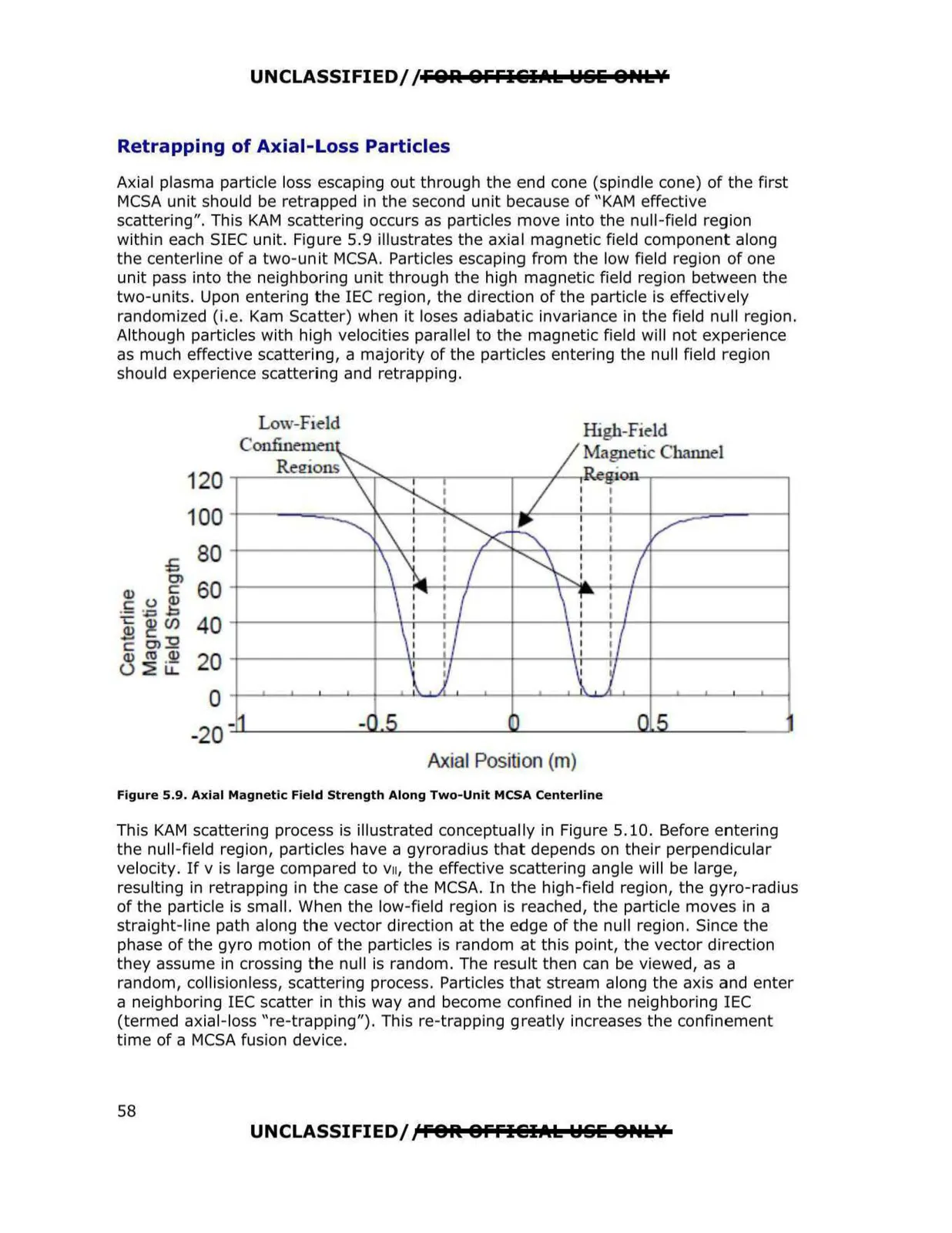
within each SIEC unit. Figure 5.9 illustrates the axial magnetic field component along
the centerline of a two-unit MCSA. Particles escaping from the low field region of one
unit pass into the neighboring unit through the high magnetic field region between the
two-units. Upon entering the IEC region, the direction of the particle is effectively
randomized (i.e. Kam Scatter) when it loses adiabatic invariance in the field null region .
Although particles with high velocities parallel to the magnetic field will not experience
as much effective scattering, a majority of the particles entering the null field region
should experience scattering and retrapping.
Lmi,r-Fi ld
High-Field
£
O>
Q)
C
C
O
Q)
·-:c, .=
~~en
c a,-o
~~~
120
100
80
60
40
20
0
-20
Magnetic hannd
-.------....-...,....,-~--.----r---r--r¼'..Ggt.00,..........-------,
Axial Position (m)
Figure 5.9. Axial Magnetic Field Strength Along Two-Unit MCSA Centerline
This KAM scattering process is illustrated conceptually in Figure 5.10. Before entering
the null-field region, particles have a gyroradlus that depends on their perpendicular
velocity. If v is large compared to vu, the effective scattering angle wi ll be large,
resulting in retrapping in the case of the MCSA. In the high-field region, the gyro-radius
of the particle is small. When the low-field region is reached, the particle moves in a
straight-line path along the vector direction at the edge of the null region. Since the
phase of the gyro motion of the particles is random at this point, the vector direction
they assume in crossing the null is random. The result then can be viewed, as a
random, collisionless, scattering process. Particles that stream along the axis and enter
a neighboring IEC scatter in this way and become confined in the neighboring IEC
(termed axial-loss "re-trapping"). This re-trapping greatly increases the confinement
time of a MCSA fusion device.
UNCLASSIFIED/ I FOR 8ffIOIAk WSE 8Ptk\f
58