AAWSAP DIRD, Advanced Nuclear Propulsion for Manned Deep Space Missions, March 2010
DOW-UAP-D126 · page 10 of 37
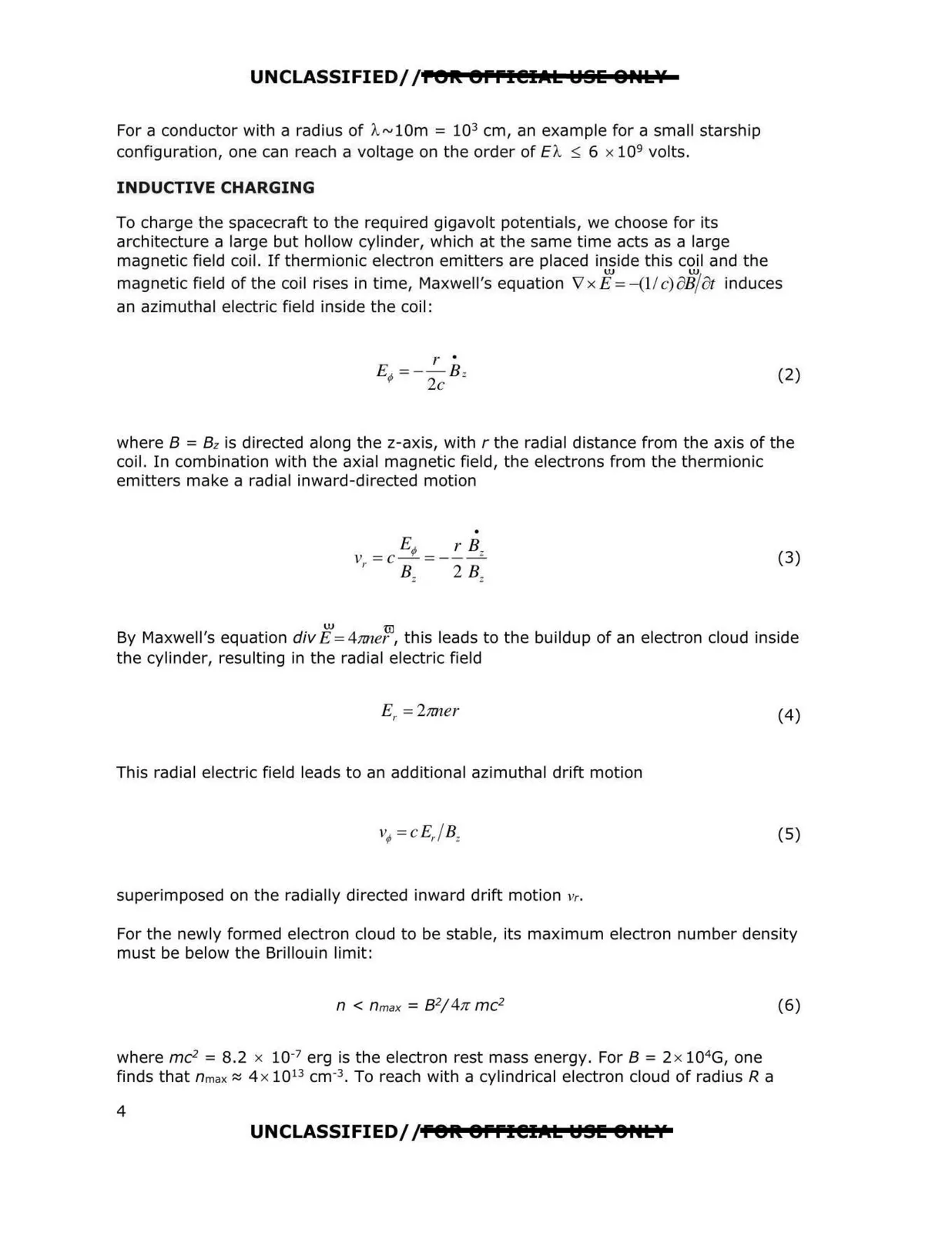
Text
This text came with the file. It may have mistakes. When the text and the image disagree, the image is right.
UNCLASSIFIED/ /FOR. orrl@IAL YSE 8PtLlf
For a conductor with a radius of A- ~10m = 103 cm, an example for a small starship
configuration, one can reach a voltage on the order of E ).. ~ 6 x 10⁹ volts.
INDUCTIVE CHARGING
To charge the spacecraft to the required gigavolt potentials, we choose for its
architecture a large but hollow cylinder, which at the same time acts as a large
magnetic field coil. If thermionic electron emitters are placed inside this coil and the
magnetic field of the coil rises in time, Maxwell's equation V x E=---{11 c)aBjat induces
an azimuthal electric field inside the coil:
r _•
£ ¢ = --B,
(2)
2c
where B = Bz is directed along the z-axis, with r the radial distance from the axis of the
coil. In combination with the axial magnetic field, the electrons from the thermionic
emitters make a radial inward-directed motion
(3)
By Maxwell's equation div E=4mie'!P, this leads to the buildup of an electron cloud inside
the cylinder, resulting in the radial electric field
E, = 2nner
(4)
This radial electric field leads to an additional azimuthal drift motion
(5)
superimposed on the radially directed inward drift motion vr.
For the newly formed electron cloud to be stable, its maximum electron number density
must be below the Brillouin limit:
n < n max = B2/ 4n mc2
(6)
where mc2 = 8.2 x 10⁻⁷ erg is the electron rest mass energy. For B = 2 x 10⁴G, one
finds that n max ~ 4 x 1013 cm-3 . To reach with a cylindrical electron cloud of radius R a
UNCLASSIFIED//POil orrl@IAL Y!H! OHL¥
4