AAWSAP DIRD, Advanced Nuclear Propulsion for Manned Deep Space Missions, March 2010
DOW-UAP-D126 · page 11 of 37
Text
This text came with the file. It may have mistakes. When the text and the image disagree, the image is right.
UNCLASSIFIED//FOR OFFI@IAL YSE OHL¥
potential equal to V requires an electron number density n~v/ neR2 . For V = 109 volts
::::l 3 x 10⁶ esu and R = 103cm, one finds that n ~ 2x 109 cm-3, well below nmax,
Deuterium as the Preferred Nuclear Rocket Fuel
To appreciate the importance of deuterium as the preferred and abundantly available
nuclear rocket fuel, one must consider the secondary reactions with D of the He3 and T
reaction products from D-D fusion. Taking these reactions into account, one obtains
from 6 deuterium nuclei an energy of 26.8 megaelectronvolts (MeV) in charged fusion
products, made up of He3 and H, and an energy of 16.55 MeV in neutrons. This means
62 percent of the energy is released into charged fusion products and 38 percent into
neutrons-a substantial improvement over the DT reaction, in which only 20 percent of
the energy goes into He4 .
Of interest also is the average velocity, averaged over the momentum of the charged
fusion products, because it is a measure of the maximum specific impulse, respectively
the maximum exhaust velocity:
6
_
L m;v;
v = ~i=~I __
6
(7)
I m;
i= I
-
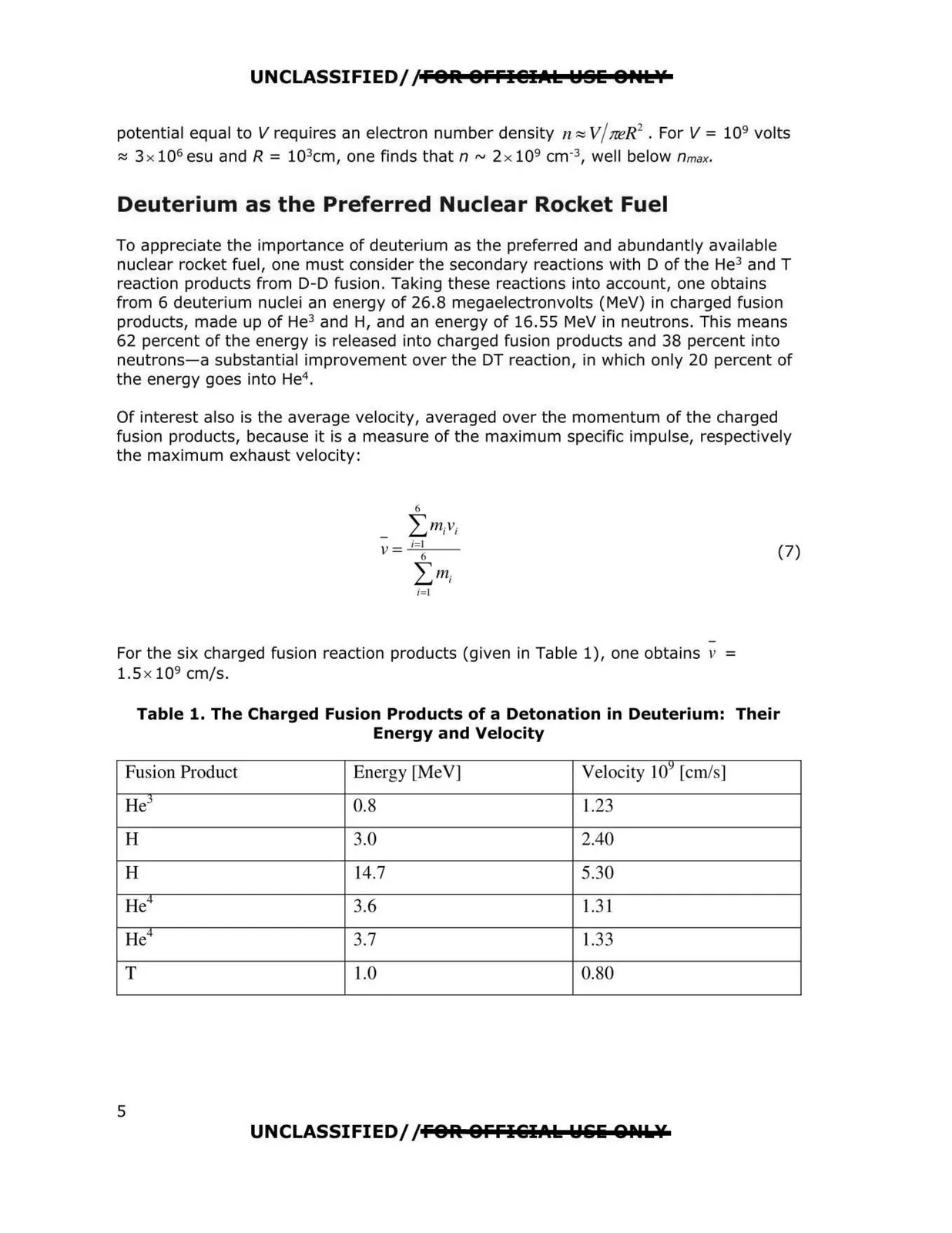
For the six charged fusion reaction products (given in Table 1), one obtains v =
l.S x 109 cm/s.
Table 1. The Charged Fusion Products of a Detonation in Deuterium: Their
Energy and Velocity
Fusion Product
Energy [Me V]
Velocity lOY [cm/s]
Hej
0.8
1.23
H
3.0
2.40
H
14.7
5.30
He4
3.6
1.31
He4
3.7
1.33
T
1.0
0.80
UNCLASSIFIED//FOR OFFI&I.t.k Wliliii Qfslk¥
5