AAWSAP DIRD, Advanced Nuclear Propulsion for Manned Deep Space Missions, March 2010
DOW-UAP-D126 · page 14 of 37
Text
This text came with the file. It may have mistakes. When the text and the image disagree, the image is right.
UNCLASSIFIED//Pelt err1e1J11t l!ISl!!! eHt'I
l > le
(15)
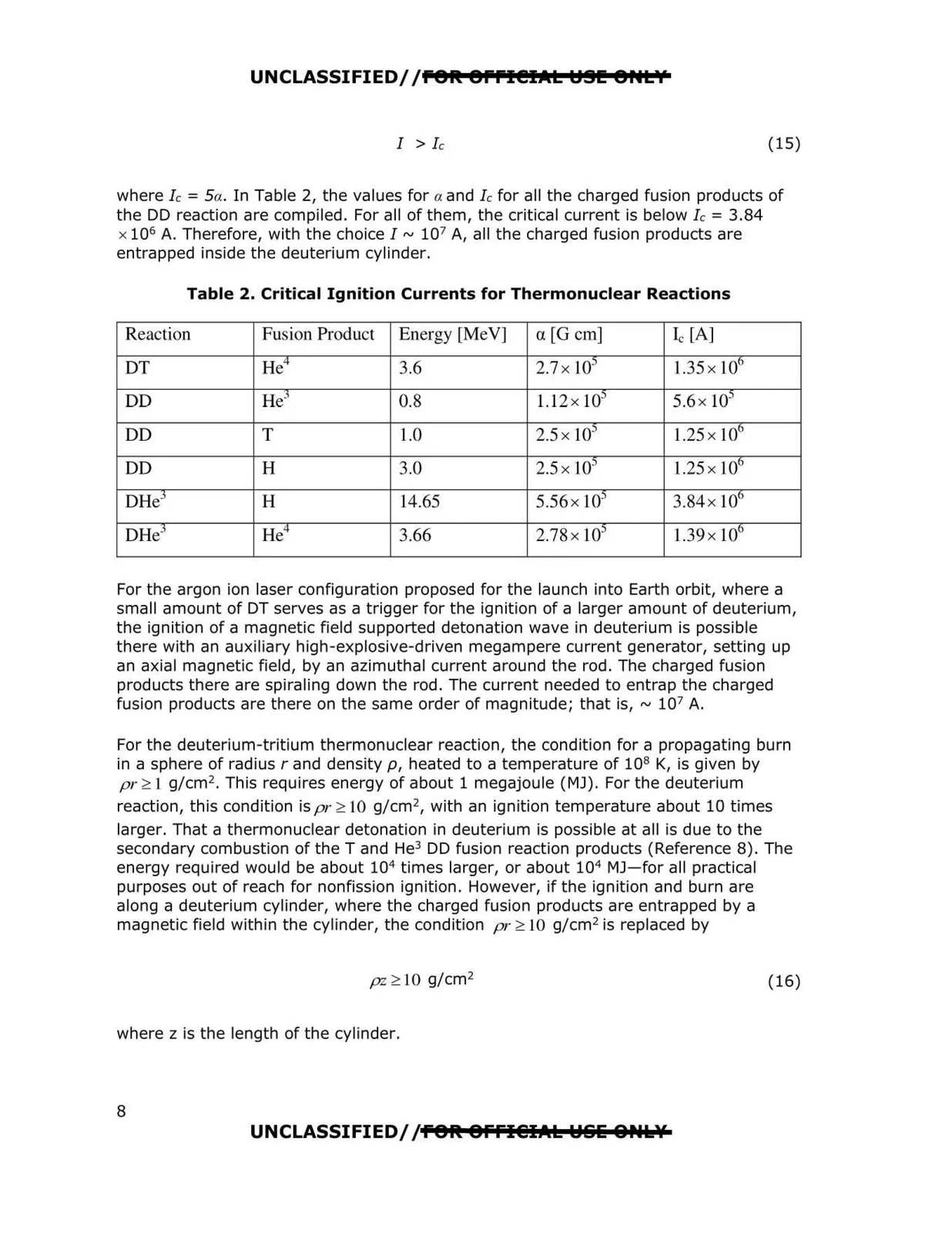
where le = Sa. In Table 2, the values for a and le for all the charged fusion products of
the DD reaction are compiled. For all of them, the critical current is below l e = 3.84
x 106 A. Therefore, with the choice l ~ 107 A, all the charged fusion products are
entrapped inside the deuterium cylinder.
Table 2. Critical Ignition Currents for Thermonuclear Reactions
Reaction
Fusion Product
Energy [Me V]
a [G cm]
le [A]
DT
He4
3.6
2.7 x 10:i
1.35 X 10°
DD
He5
0.8
l.12 x 10:,
5.6 x 10⁵
DD
T
1.0
2.5 x 10:i
1.25 X 10°
DD
H
3.0
2.5 x 10"'
1.25 X 10°
DHe3
H
14.65
5.56 x 10⁵
3.84x 10⁶
DHe5
He4
3.66
2.78 x 10:i
1.39 x 10°
For the argon ion laser configuration proposed for the launch into Earth orbit, where a
small amount of DT serves as a trigger for the ignition of a larger amount of deuterium,
the ignition of a magnetic field supported detonation wave in deuterium is possible
there with an auxiliary high-explosive-driven megampere current generator, setting up
an axial magnetic field, by an azimuthal current around the rod. The charged fusion
products there are spiraling down the rod. The current needed to entrap the charged
fusion products are there on the same order of magnitude; that is, ~ 107 A.
For the deuterium-tritium thermonuclear reaction, the condition for a propagating burn
in a sphere of radius rand density p, heated to a temperature of 108 K, is given by
pr ~ l g/cm 2 . This requires energy of about 1 megajoule (MJ). For the deuterium
reaction, this condition is pr~ 10 g/cm 2, with an ignition temperature about 10 times
larger. That a thermonuclear detonation in deuterium is possible at all is due to the
secondary combustion of the T and He3 DD fusion reaction products (Reference 8). The
energy required would be about 104 times larger, or about 104 MJ-for all practical
purposes out of reach for nonfission ignition. However, if the ignition and burn are
along a deuterium cyl inder, where the charged fusion products are entrapped by a
magnetic field within the cylinder, the condition pr~ 10 g/cm 2 is replaced by
pz ~10 g/cm 2
(16)
where z is the length of the cylinder.
UNCLASSIFIED//felt 8ffl@IAI: W&li 8Ptl:¥
8