AAWSAP DIRD, Advanced Nuclear Propulsion for Manned Deep Space Missions, March 2010
DOW-UAP-D126 · page 15 of 37
Text
This text came with the file. It may have mistakes. When the text and the image disagree, the image is right.
UNCLASSIFIED/;'FOR OFFl&I.t.k Wlilii QNL¥
If the charged fusion products are entrapped within the deuterium cylinder, and if the
condition pz. > 10g/cm2 is satisfied, and finally, if the beam energy is large enough that
a length z > (10/p) cm of the cylinder is heated to a temperature of 109 K, a
thermonuclear detonation wave can propagate down the cylinder. This then leads to
large fusion gains.
The stopping length of single GeV protons in dense deuterium is much too large to fulfill
inequality (Reference 16). But this is different for an intense beam of protons, where
the stopping length is determined by the electrostatic proton-deuteron two-stream
instability (Reference 14). In the presence of a strong azimuthal magnetic field, the
beam dissipation is enhanced by the formation of a collisionless shock (Reference 15)
with the thickness of the shock by order of magnitude equal to the Larmor radius of the
deuterium ions at a temperature of 109 K, which for a magnetic field on the order of 107
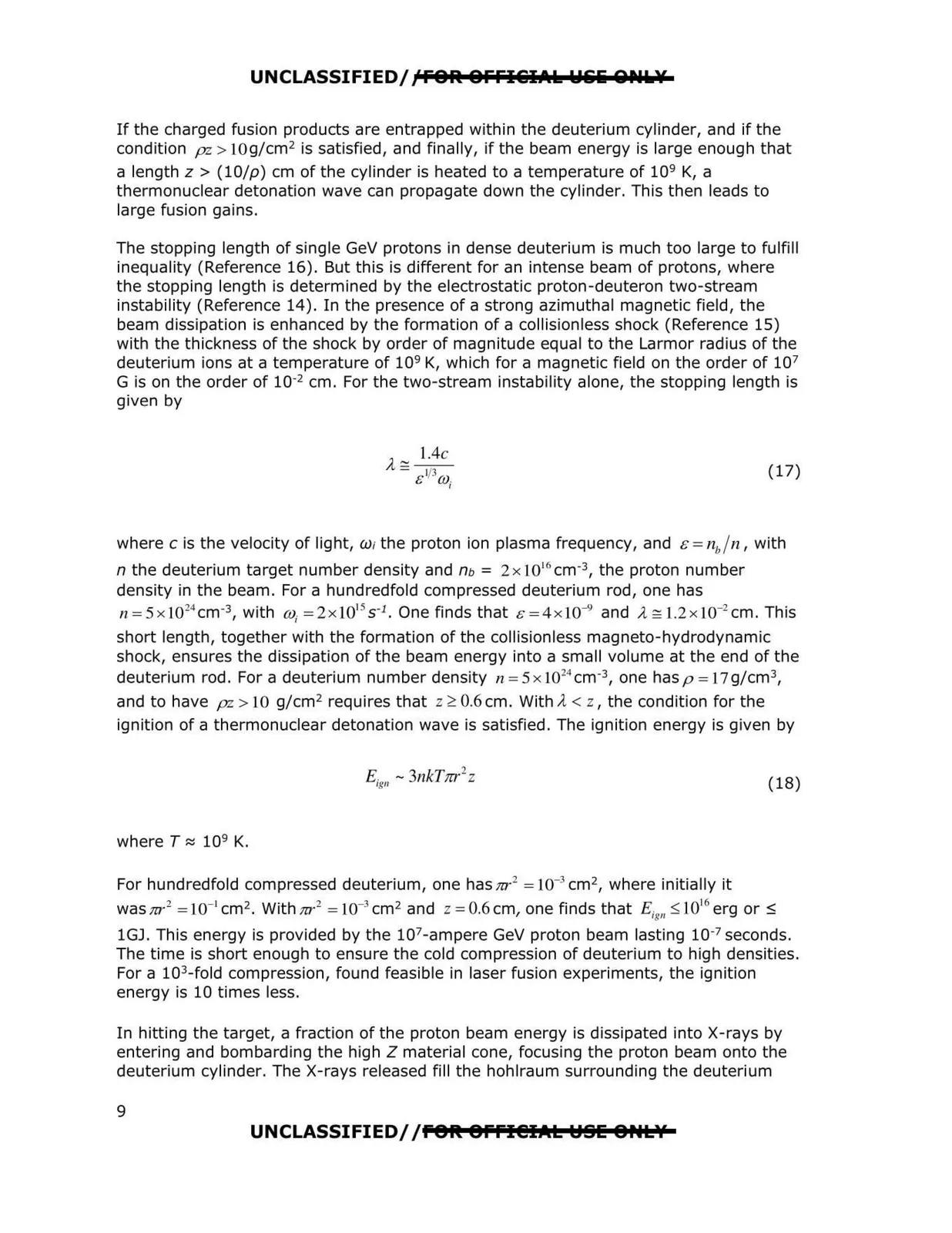
G is on the order of 10-2 cm. For the two-stream instability alone, the stopping length is
given by
(17)
where c is the velocity of light, Wi the proton ion plasma frequency, and & =nb / n, with
n the deuterium target number density and nb = 2 x 1016 cm-3, the proton number
density in the beam. For a hundredfold compressed deuterium rod, one has
n = 5 x 1024cm-3 , with m,- = 2 x l015 s-1 . One finds that e =4 xl0-9 and ,i 2:: 1.2 x 10⁻² cm . This
short length, together with the formation of the collisionless magneto-hydrodynamic
shock, ensures the dissipation of the beam energy into a small volume at the end of the
deuterium rod. For a deuterium number density n = 5 x 1024 cm-3 , one hasp= 17 g/cm3,
and to have pz. > 10 g/cm 2 requires that z ~ 0.6 cm. With /4 < z , the condition for the
ignition of a thermonuclear detonation wave is satisfied. The ignition energy is given by
E,-g ~ 3nkTtrr2z
11
(18)
where T ~ 109 K.
For hundredfold compressed deuterium, one has nr 2 = 10-3 cm 2, where initially it
was nr2 = 10-• cm 2. With nr2 = 10-3 cm 2 and z = 0.6 cm, one finds that E,-811 ::; 1016 erg or ~
lGJ. This energy is provided by the 107-ampere GeV proton beam lasting 10-7 seconds.
The time is short enough to ensure the cold compression of deuterium to high densities.
For a 103-fold compression, found feasible in laser fusion experiments, the ignition
energy is 10 times less.
In hitting the target, a fraction of the proton beam energy is dissipated into X-rays by
entering and bombarding the high Z material cone, focusing the proton beam onto the
deuterium cylinder. The X-rays released fill the hohlraum surrounding the deuterium
UNCLASSIFIED//fOll Offl@IAL YSIE 8Htl/
9