AAWSAP DIRD, Advanced Nuclear Propulsion for Manned Deep Space Missions, March 2010
DOW-UAP-D126 · page 17 of 37
Text
This text came with the file. It may have mistakes. When the text and the image disagree, the image is right.
UNCLASSIFIED//POil Offl@IAL YSlii &P•tlf
extravagant in the sense that only a small fraction of the fission explosive is consumed.
This problem can be overcome through the nonfission ignition of small fusion
explosions. A first step in this direction is the nonfission ignition of deuterium-tritium
(DT) thermonuclear microexplosions, expected to be realized in the near future. This
reaction was chosen for the first proposed thermonuclear microexplosion propulsion
concept, with the ignition done by an intense relativistic electron beam (Reference 1,
2). But because in the DT reaction 80 percent of the energy is released into neutrons
that cannot be reflected from the spacecraft by a magnetic mirror, it was proposed to
surround the microexplosion with a neutron-absorbing hydrogen propellant, increasing
the thrust at the expense of the specific impulse. For this reason, in the "Daedalus"
interstellar probe study by the British Interplanetary Society (Reference 3), the
neutron-less helium3-deuterium (He3-D) reaction was proposed, because for such a
mission the specific impulse should be as high as possible. But even in a He3-D plasma,
there are a some neutron-producing DD reactions. There is no large source of He3 on
Earth, though it might exist on the surface of the Moon and in the atmosphere of
Jupiter. In the DD reaction, much less energy goes into neutrons, but it is more difficult
to ignite.
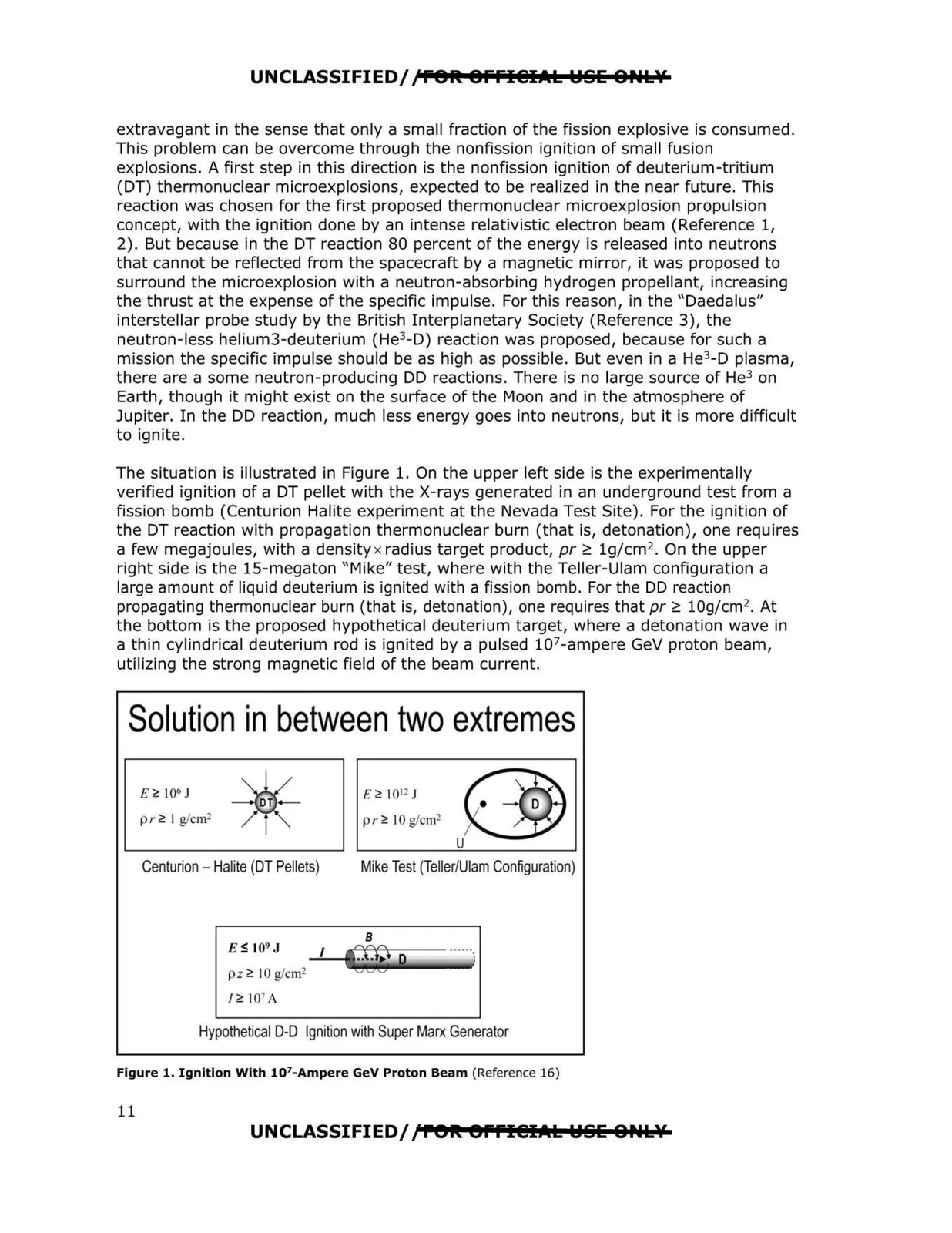
The situation is illustrated in Figure 1. On the upper left side is the experimentally
verified ignition of a DT pellet with the X-rays generated in an underground test from a
fission bomb (Centurion Halite experiment at the Nevada Test Site). For the ignition of
the DT reaction with propagation thermonuclear burn (that is, detonation), one requires
a few megajoules, with a density x radius target product, pr~ lg/cm2 . On the upper
right side is the 15-megaton "Mike" test, where with the Teller-Ulam configuration a
large amount of liquid deuterium is ignited with a fission bomb. For the DD reaction
propagating thermonuclear burn (that is, detonation), one requires that pr~ 10g/cm2. At
the bottom is the proposed hypothetical deuterium target, where a detonation wave in
a thin cylindrical deuterium rod is ignited by a pulsed 107-ampere GeV proton beam,
utilizing the strong magnetic field of the beam current.
Solution in between two extremes
£~ l06J
£~!0 12 J
pr~ I g/cm2
@
pr~ 10 g/cm2
/j *
u
Centurion - Halite (DT Pellets)
Mike Test (Teller/Ulam Configuration)
B
E S 109 J
I
......
• ..\.t►~ n
·,
pz ~ 10 g/cm2
---
I~ 101 A
Hypothetical D-D Ignition with Super Marx Generator
Figure 1. Ignition With 107-Ampere GeV Proton Beam (Reference 16)
UNCLASSIFIED/ /FOR. 0PPl@IAL Y§lii 8PUzlf
11