AAWSAP DIRD, Advanced Nuclear Propulsion for Manned Deep Space Missions, March 2010
DOW-UAP-D126 · page 16 of 37
Text
This text came with the file. It may have mistakes. When the text and the image disagree, the image is right.
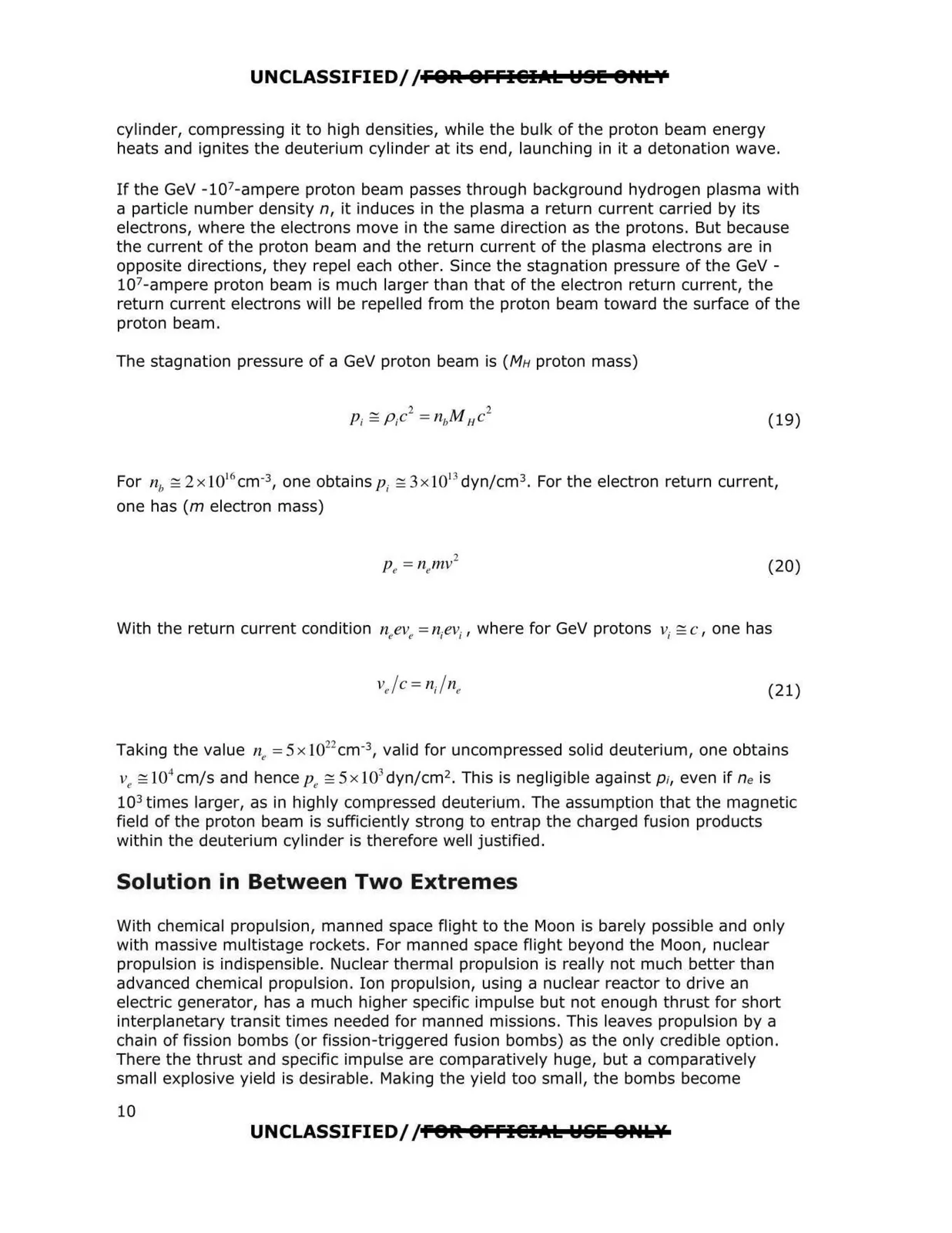
UNCLASSIFIED//FOR 8FFI@IAL 1::191!! 8HL'I cylinder, compressing it to high densities, while the bulk of the proton beam energy heats and ignites the deuterium cylinder at its end, launching in it a detonation wave. If the GeV -107-ampere proton beam passes through background hydrogen plasma with a particle number density n, it induces in the plasma a return current carried by its electrons, where the electrons move in the same direction as the protons. But because the current of the proton beam and the return current of the plasma electrons are in opposite directions, they repel each other. Since the stagnation pressure of the GeV 107-ampere proton beam is much larger than that of the electron return current, the return current electrons will be repelled from the proton beam toward the surface of the proton beam. The stagnation pressure of a GeV proton beam is (MH proton mass) (19) 6 3 3 3 , • For n b = 2 x l0 1 cm- one obtainsp; = 3xl0 1 dyn/cm For the electron return current, one has (m electron mass) (20) With the return current condition neeve =n;ev; , where for GeV protons v; =c, one has (21) Taking the value n e =5x 1022cm-3, valid for uncompressed solid deuterium, one obtains 2 ve =10 4 cm/sand hence Pe =5 x 10 3 dyn/cm This is negligible against p;, even if n e is • 103 times larger, as in highly compressed deuterium. The assumption that the magnetic field of the proton beam is sufficiently strong to entrap the charged fusion products within the deuterium cylinder is therefore well justified. Solution in Between Two Extremes With chemical propulsion, manned space flight to the Moon is barely possible and only with massive multistage rockets. For manned space flight beyond the Moon, nuclear propulsion is indispensible. Nuclear thermal propulsion is really not much better than advanced chemical propulsion. Ion propulsion, using a nuclear reactor to drive an electric generator, has a much higher specific impulse but not enough thrust for short interplanetary transit times needed for manned missions. This leaves propulsion by a chain of fission bombs (or fission-triggered fusion bombs) as the only credible option. There the thrust and specific impulse are comparatively huge, but a comparatively small explosive yield is desirable. Making the yield too small, the bombs become UNCLASSIFIED//fOll Offl@IAk l::l&li 8Ptk¥ 10