AAWSAP DIRD, Advanced Nuclear Propulsion for Manned Deep Space Missions, March 2010
DOW-UAP-D126 · page 19 of 37
Text
This text came with the file. It may have mistakes. When the text and the image disagree, the image is right.
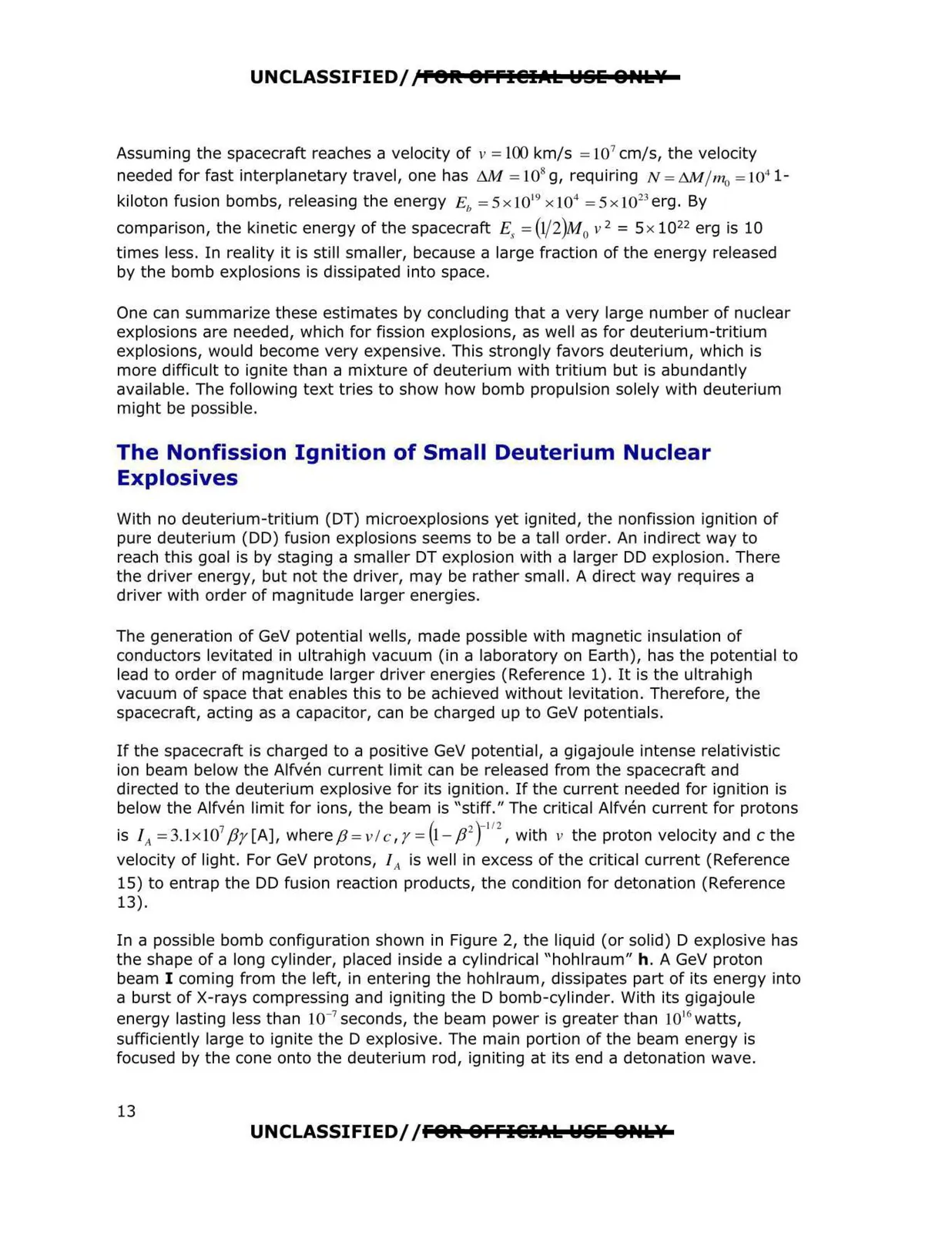
UNCLASSIFIED//POil Offl@IAL YSE &P•tlf Assuming the spacecraft reaches a velocity of v = 100 km/s = 107 emfs, the velocity needed for fast interplanetary travel, one has !),,Af = 108 g, requiring N = D.M/ m0 =104 1 kiloton fusion bombs, releasing the energy E h = 5 x 1019 x 104 = 5 x 10²³ erg. By comparison, the kinetic energy of the spacecraft E,. = (1/2)M0 v 2 = 5x 10²² erg is 10 times less. In reality it is still smaller, because a large fraction of the energy released by the bomb explosions is dissipated into space. One can summarize these estimates by concluding that a very large number of nuclear explosions are needed, which for fission explosions, as well as for deuterium-tritium explosions, would become very expensive. This strongly favors deuterium, which is more difficult to ignite than a mixture of deuterium with tritium but is abundantly available. The following text tries to show how bomb propulsion solely with deuterium might be possible. The Nonfission Ignition of Small Deuterium Nuclear Explosives With no deuterium-tritium (DT) microexplosions yet ignited, the nonfission ignition of pure deuterium (DD) fusion explosions seems to be a tall order. An indirect way to reach this goal is by staging a smaller DT explosion with a larger DD explosion. There the driver energy, but not the driver, may be rather small. A direct way requires a driver with order of magnitude larger energies. The generation of GeV potential wells, made possible with magnetic insulation of conductors levitated in ultrahigh vacuum (in a laboratory on Earth), has the potential to lead to order of magnitude larger driver energies (Reference 1). It is the ultrahigh vacuum of space that enables this to be achieved without levitation. Therefore, the spacecraft, acting as a capacitor, can be charged up to GeV potentials. If the spacecraft is charged to a positive GeV potential, a gigajoule intense relativistic ion beam below the Alfven current limit can be released from the spacecraft and directed to the deuterium explosive for its ignition. If the current needed for ignition is below the Alfven limit for ions, the beam is "stiff." The critical Alfven current for protons is IA =3.1 x 10⁷ ,By [A], where j3 = vI c, r = (1 - /32 t' 12 , with v the proton velocity and c the velocity of light. For GeV protons, I A is well in excess of the critical current (Reference 15) to entrap the DD fusion reaction products, the condition for detonation (Reference 13). In a possible bomb configuration shown in Figure 2, the liquid (or solid) D explosive has the shape of a long cylinder, placed inside a cylindrical "hohlraum" h. A GeV proton beam I coming from the left, in entering the hohlraum, dissipates part of its energy into a burst of X-rays compressing and igniting the D bomb-cylinder. With its gigajoule energy lasting less than 10-7 seconds, the beam power is greater than 1016 watts, sufficiently large to ignite the D explosive. The main portion of the beam energy is focused by the cone onto the deuterium rod, igniting at its end a detonation wave. UNCLASSIFIED//FOR 8FFI&I.t.k Y&li &P•tY 13