AAWSAP DIRD, Advanced Nuclear Propulsion for Manned Deep Space Missions, March 2010
DOW-UAP-D126 · page 20 of 37
Text
This text came with the file. It may have mistakes. When the text and the image disagree, the image is right.
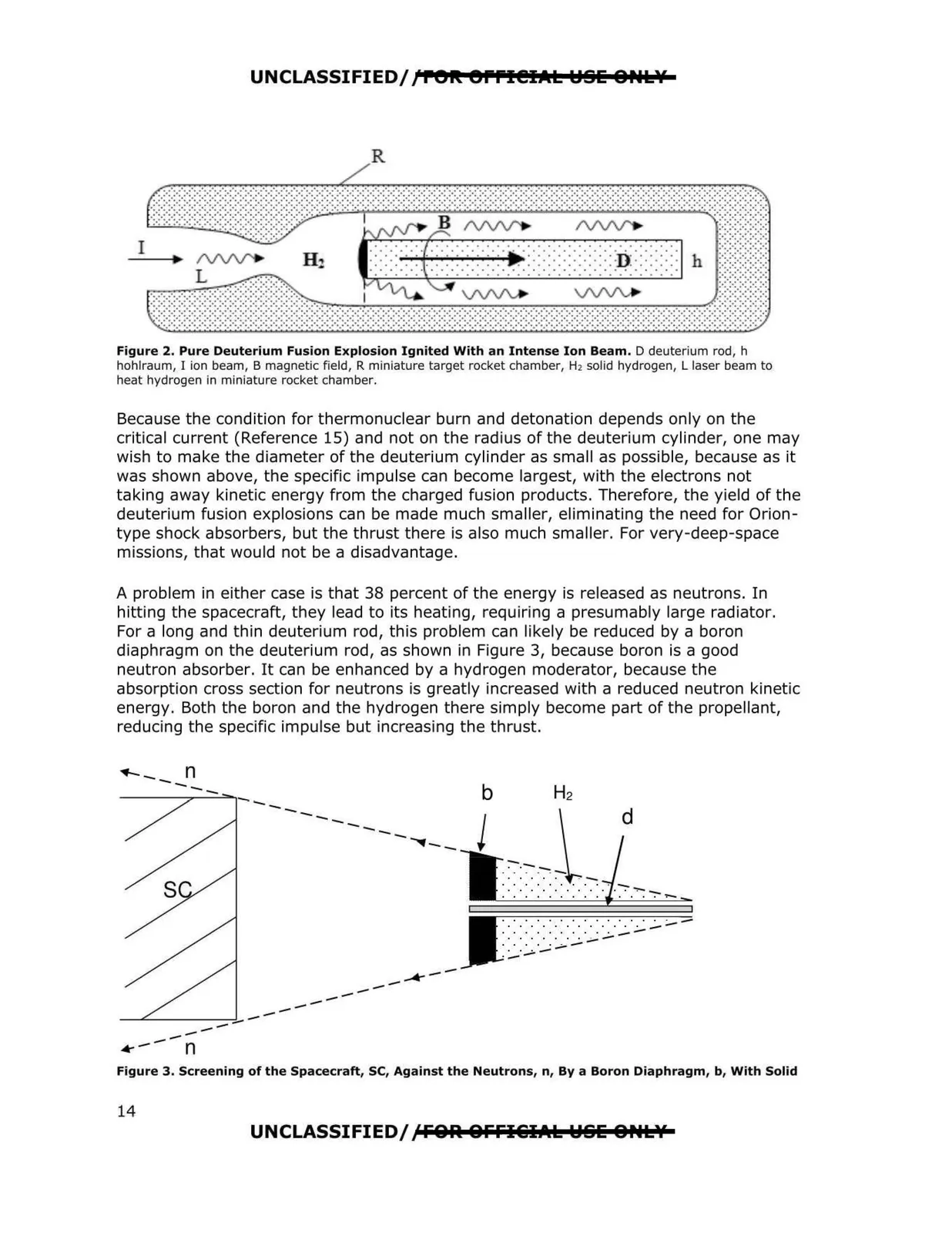
----- --------- UNCLASSIFIED/ /FOR. OFFl@IAL l:ISE 8PtLlf R Figure 2. Pure Deuterium Fusion Explosion Ignited With an Intense Ion Beam. D deuterium rod, h hohlraum, l ion beam, B magnetic field, R miniature target rocket chamber, H 2 solid hydrogen, L laser beam to heat hydrogen in miniature rocket chamber. Because the condition for thermonuclear burn and detonation depends only on the critical current (Reference 15) and not on the radius of the deuterium cylinder, one may wish to make the diameter of the deuterium cylinder as small as possible, because as it was shown above, the specific impulse can become largest, with the electrons not taking away kinetic energy from the charged fusion products. Therefore, the yield of the deuterium fusion explosions can be made much smaller, eliminating the need for Orion type shock absorbers, but the thrust there is also much smaller. For very-deep-space missions, that would not be a disadvantage. A problem in either case is that 38 percent of the energy is released as neutrons. In hitting the spacecraft, they lead to its heating, requiring a presumably large radiator. For a long and thin deuterium rod, this problem can likely be reduced by a boron diaphragm on the deuterium rod, as shown in Figure 3, because boron is a good neutron absorber. It can be enhanced by a hydrogen moderator, because the absorption cross section for neutrons is greatly increased with a reduced neutron kinetic energy. Both the boron and the hydrogen there simply become part of the propellant, reducing the specific impulse but increasing the thrust. ....... - .... ---- n Figure 3. Screening of the Spacecraft, SC, Against the Neutrons, n, By a Boron Diaphragm, b, With Solid UNCLASSIFIED/fFOR OFFI&I.t.L l:l&E 8PtLY 14