AAWSAP DIRD, Advanced Nuclear Propulsion for Manned Deep Space Missions, March 2010
DOW-UAP-D126 · page 24 of 37
Text
This text came with the file. It may have mistakes. When the text and the image disagree, the image is right.
UNCLASSIFIED/ /FOR. OFFICIAL t:191!!! OHL'f
For E b = 5 x 10 19 erg, M 0 = 109 g, and setting for v = 10 km/s = 106 cm/s the escape
velocity from Earth, one finds that N ~ 10. Assuming an efficiency of 10 percent, about
100 1-kiloton explosions would therefore be needed.
Neutron Entrapment in an Autocatalytic Thermonuclear
Detonation Wave - a Means to Increase the Specific
Impulse and to Solve the Large Radiator Problem
The principal reason why neutrons released by thermonuclear reactions pose such a
serious problem is that they cannot be repelled from the spacecraft by a magnetic field.
However, choosing a neutron-absorbing target as shown in Figure 3, one can reduce
the flux of neutrons hitting the spacecraft. Besides inflicting material damage on the
spacecraft, the neutrons release heat that must be removed by a very large radiator.
The idea of the autocatalytic thermonuclear detonation wave (Reference 13) presents a
solution, which if feasible would very much reduce the magnitude of this problem. For
its implementation, it requires very large bremsstrahlung flux densities in the burn zone
behind the thermonuclear detonation front. Such large bremsstrahlung flux densities
will occur in deuterium detonation burn, at the highest temperature for all the
thermonuclear reactions.
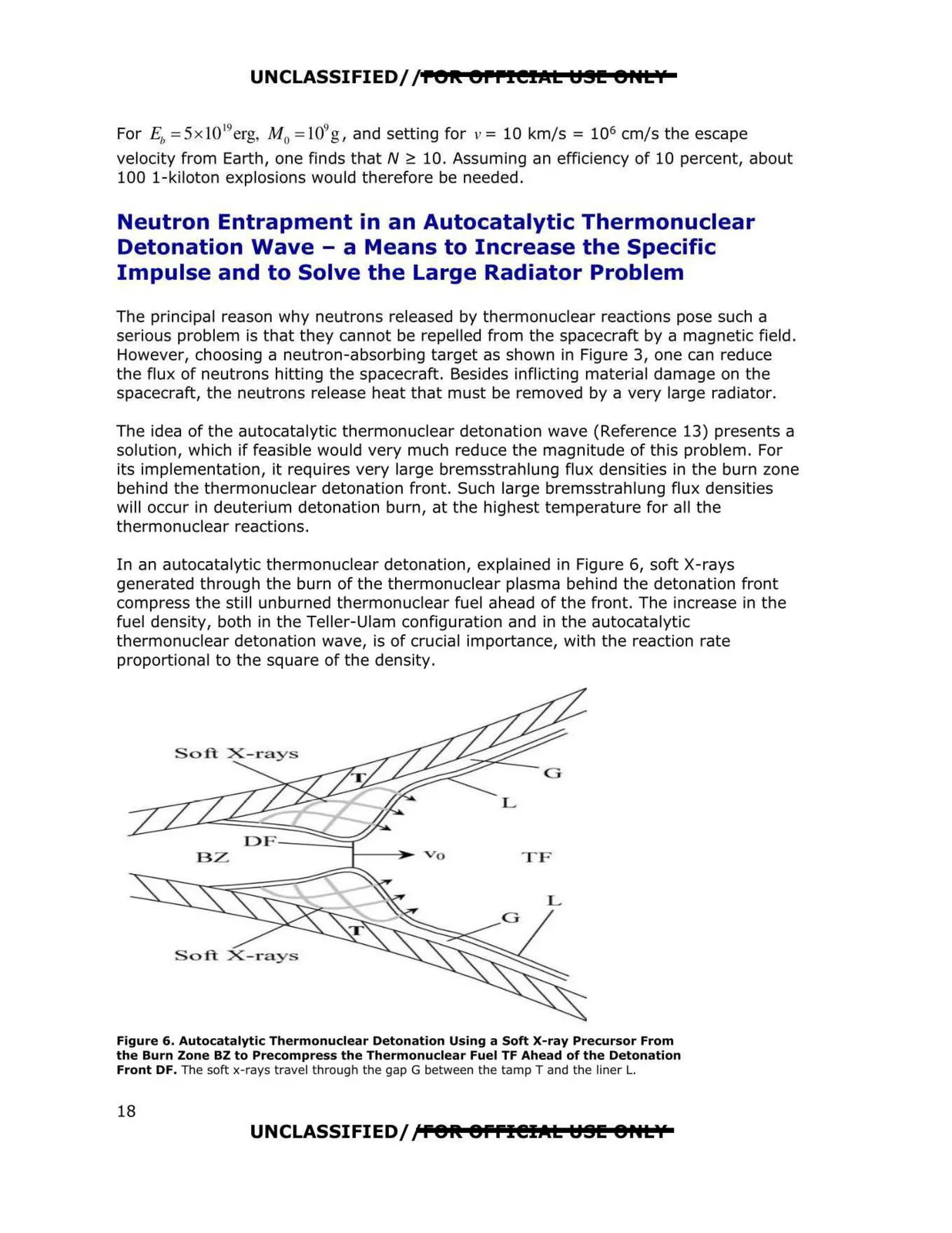
In an autocatalytic thermonuclear detonation, explained in Figure 6, soft X-rays
generated through the burn of the thermonuclear plasma behind the detonation front
compress the still unburned thermonuclear fuel ahead of the front. The increase in the
fuel density, both in the Teller-Ulam configuration and in the autocatalytic
thermonuclear detonation wave, is of crucial importance, with the reaction rate
proportional to the square of the density.
Figure 6. Autocatalytic Thermonuclear Detonation Using a Soft X-ray Precursor From
the Burn Zone BZ to Precompress the Thermonuclear Fuel TF Ahead of the Detonation
Front DF. The soft x-rays travel through the gap G between the tamp T and the liner L.
UNCLASSIFIED//POil orr1e1s1tt t:191! OHL'f
18